Currently:
Archive for July, 2002
2002-07-31»
replying to dave winer»
The best trick in blogging: wait a while, and someone else will write your entry for you. Dave Winer said yesterday:
Very little really usable software has come from people who are willing to work for $0. (I chose my words carefully, infrastructure is another matter entirely.) Further, it’s weird to say, as Richard Stallman does, that by coercing programmers to work for $0 that that’s freedom. To me it seems obvious that that’s slavery.
… which seemed to me so wrong, on so many levels. But it took a better man than me to write the gentlemanly reply (and from more experience than I can provide too):
I’m surprised by each of these sentiments: that we’re not writing usable software, that we’re not making money, and that it’s coercion (and thus slavery).
Comments Off on replying to dave winer
2002-07-30»
all hail verity»
Jorn‘s just linked to the very funny Verity Stob journals, so I guess I can now. Verity was my first boss, actually – we both worked on or near a magazine called .EXE in the early Nineties. One of my proudest claims is that I’m the annoying new office boy who sets fire to a UNIX box in one of the earlier columns. The girl Adrian Mole should have married, if life were kinder to him, and even crueller to Verity.
Comments Off on all hail verity
2002-07-25»
zero-day pr0n!»
Bram Cohen , the man behind CodeCon and other fine goods and services, has a problem. He’s been working on an excellent P2P utility for the last six months or so, called BitTorrent. The idea behind BT is brilliant – it’s a helper application for browsers that lets you download large files (like movies) from multiple locations at the same time. One site is the original location – the others are all the other BitTorrent users who are downloading the file at the same time. In return, you share the bits of the file you’ve already grabbed to other downloaders. It’s like instant, distributed mirroring. It takes the load off the original server and increases the speed of everyone’s file grab . The throttled bandwidth taken by others uploading is not noticeable (after all, you’re already filling much of your pipe with your download anyway), and unlike most P2P apps, it all goes away as soon as you’ve finished downloading anyway.
Anyway, Bram’s in the final stages of stress testing his code – but he’s got a problem. BitTorrent currently shrugs off every load test he’s thrown at it, but even in the middle of a slashdotting, he’s only ever seen twenty or so people doing a simultaneous download of his test files. In the words of Bram:
I’m now in the very bizarre position of having to beg for people to download porn. The page of the current load test (a 700+ meg file) is http://bitconjurer.org/BitTorrent/porn.html.
Windows, Unix tars and a Debian package of BitTorrent are available from Bram’s site.I’ve suggested that he get hold of the ISOs to the full Debian 3.0 install CDs – the equivalent of pr0n among the Free Software sexless beings of pure energy.
Comments Off on zero-day pr0n!
2002-07-24»
stopesso on the move»
ExxonMobil tried to have the French version of the Stop Esso protest site shut down. The French court threw out all of Exxon’s claims (including a bid to have “Esso” removed from the pages’ meta tags), except for one – that Stop Esso can’t use their parody of the Esso logo.
So the French language Stop Esso site has moved ISPs – to one in Houston, Texas. Right next to ExxonMobil’s Baytown refinery. Parody is a protected speech under US law.
Comments Off on stopesso on the move
2002-07-21»
no popups the mozilla way»
I wrote in the Sunday Times a couple of weeks ago about how relatively free of spam and popup windows my online life has been since I started using Mozilla and SpamAssassin. Quite a few people wrote in to ask for instructions on getting hold of these programs for Windows. I don’t have a place to stick Sunday Times feedback (I really should get around to archiving the old articles), so I’ll dump the instructions here.
I haven’t used it myself, but there’s now a commercial version of SpamAssassin for Outlook. You can get a trial version from the Deersoft’s SpamAssassin Pro homepage.
Mozilla has always been available for Windows machines. You can download it from the Mozilla site. To turn off popups, you need to dig into the advanced preferences a little. Here’s what my preference panel looks like:
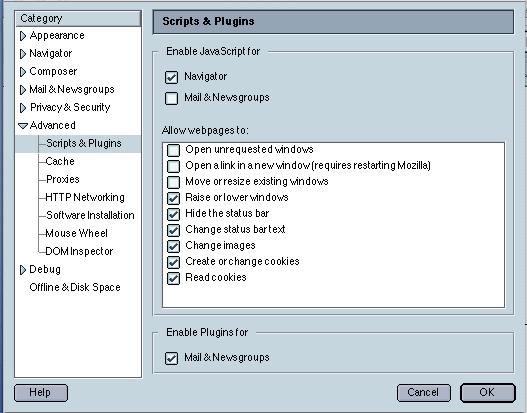
Hope that helps!
Comments Off on no popups the mozilla way
playing around with tinderbox»
I downloaded the 14 day trial of Tinderbox, Eastgate’s fascinating new hypertext organiser. It’s a sort of outliner-cum-mindmapper-cum-hypertext-cum-blogging app. On first glance, I really liked it. I especially liked the fact that the file format is in a clear and simple XML. I have an outliner on my Palm – Progect – which has a huge chunk of my life in it. It’s GPLed, and there’s a great Perl library that can parse its database contents. So I installed the Perl program, and converted my outlines to Tinderbox’s XML format to play around with. Six months worth of notes seems a good thing to test out their organiser, and if it makes sense to commit to using Tinderbox, I can probably write a decent Palm->Tinderbox syncing app. That’d be great!
The trial version of Tinderbox isn’t having any of it. It tells me that I can only create a few notes in this limited version, and politely declines to do much more.
Fair enough, I guess.
Sigh.
So far, since borrowing this iBook, I have, or have seriously consider spending the following wodges of cash:
- $ 80 – bust iBook power supply
- $129 – Jaguar
- $100 per annum – .Mac subscription
- $ 95 – Tinderbox
- $ 80 – QuicKeys
- $ 20 – Keyboard Maestro
- $700 – Apple Developer Connection subscription
Some of these don’t really count – I didn’t ponder the ADC membership for very long, and QuicKeys is just a more expensive version of Keyboard Maestro. I really didn’t consider any of them for very long, to be honest, because I can’t afford any additional expenses right now.
But all of this is mounting up – to a lot of virtual money, and a very unsettling sensation.
Every time I get to something interesting in the Mac world, I bump into a barrier of dollar signs, where upon I have to spend more money to access the secret levels. It feels strange to have the possibilities of what I can do on my own PC suddenly limited by how much I can afford.
No, that’s not right: it feels odd to be unable even to ascertain the limits of what I can do, by dint of what I can afford.
Of course I understand that this is the way the world is. I’m not complaining about people asking for money. I’m guessing that Tinderbox is worth $95 – perhaps not to me, not right now, but certainly to many others, and definitely to the people who wrote it.
But you know what? I feel poor. And I never felt poor with Linux.
On the contrary, I felt drowned in riches.
Comments Off on playing around with tinderbox
2002-07-20»
the milkman cometh»
 Andrew Mackay (who appears as Prof in TV’s “Time Gentlemen Please”, but is better known off screen as my mate), has written a one man show about being a milkman. Which he was, once. It’s called “A Measure of a Milkman”. You’ve missed the previews in London, but you can still book the Edinburgh Fringe run online. It will be very good.
To publicise the London run, Andy sent out a limited edition sound file of some milk being delivered (using the traditional British electric milk float). I, of course, believe that all information should be free, so here is a copy of it. Please do not use it to construct your own one-man shows about milkmen. Thanks.
Here are some poems about milkfloats.
Comments Off on the milkman cometh
2002-07-18»
barcelona = nil»
I hate it when it takes me six months to catch up on the news. Barcelona have disbanded! My friends will tell you that I despise all music (a useful affectation in any conversation). But I genuinely loved I Have The Password To Your Shell Account, and not just for the lyrics.
Oh alright. Mostly the lyrics.
Comments Off on barcelona = nil
2002-07-16»
raphael photographers of san jose, you provoke me to great wrath»
Oh, what do you do? I came back from an argument at a photographers today. The Irish Times needed a headshot for a column I’m writing for them, so I just popped around the corner to a place called Raphael Photographers, run by a guy called Phil. The prints came back today. They are, to my unprofessional eye, really bad. Like, patently bad. There’s a water marking on the print. The background is dotted, as though it was poorly developed. There were reflections off my glasses that Phil’s tried to clumsily retouch, which leaves my right eye looking like I have a third pupil.
We got into a row. Phil there claims that reflections are “inevitable”. In a studio, with full control over lighting, and says that any professional photographer would agree with him. He refuses to reshoot the picture, or give me my money back. Quinn turns up. Quinn’s dad was a photographer, so we find ourselves trying to explain to Phil that you can avoid reflections, that you can fix these things if you pay attention at the time. He denies this vehemently. In the end, Quinn and I start getting the giggles. He seemed to be making such bizarre claims about the nature of photography. I really needed some pictures – and fast; but in the end both Quinn and I were both pulling our punches. Essentially, Phil had more to gain from this argument. If we lost, we lost $60 and some lousy photos. If we won, Phil would lose $60, have to redo the shoot, and we’d have to make him admit that he was a bad photographer.
If I was giving a review of Raphael – which I am, because I’m writing this to get spotted by Google (hey, Mr Googlebot: that’s Raphael Photographers of the Alameda, San Jose, California) – I’d say he was a bad photographer. But that’s easy for me to say. What’s it like for him? I’m not the world’s greatest writer. Often, I suck. But Phil doesn’t seem to be able to admit when he screws up. I don’t know what to do in that situation: am I supposed to convince him, grind him down, rub his nose in it? That doesn’t seem what one should do. He kept showing me other photographs, pointing out the reflections in those, and saying “Look! Here!”. And I kept biting my tongue from saying, yeah, Phil – but that’s because these completely suck too. You need to find a better job!
But what if there are no better jobs? What if he doesn’t know how to do anything else? What if he’s a bad photographer, but really good at selling his photos? And why don’t epinions ever end up this wishy-washy and existential?
Comments Off on raphael photographers of san jose, you provoke me to great wrath
2002-07-15»
all hail harry newton»
One of the best bits about living with people is you get to read all their books. Gilbert is in my eternal gratitude list for showing me Harry Newton‘s Telecom Dictionary. Any dictionary that includes definitions for Caller-ID message format, Poisson distributions, meatware, Podiumware, RS233 and Harry himself (“According to Susan, his wife of over 21 years, he has become a sex symbol for women who no longer care.”), is a winner.
There’s no topical reason for writing this. I just thought people should know.
Comments Off on all hail harry newton