main bit This page looks very fancy in a modern browser, with "stylesheets" and "layout" and thing, but frankly I prefer the way you're seeing it here. Congratulations for not crumbling to the Browser Upgrade Initiative! Support the Web Designer Downgrade Conclusion!
a man slumped on his desk, from 'The Sleep of Reason Produces
      Monsters'

Oblomovka

oblomovitis

latest entry

this year
2006
2006
2005
2004
2003
2002
2001

rss

search entries:

usual, suspect

need to know

haddock

boingboing

current thrills

Thinking List

Delicious Links

EFF DeepLinks

sponsors

David McBride

Adewale Oshineye

Diggory, Andrew, and Matt R.

writing

ancient notes

why I like 802.11
senate committee letter
oscon2003
ms and free software

code

ubiquity
webolodeon
wat
tagling
haiku

info

e-mail

homepage

pgp etc

amazon wishlist

oblomov

the book

    January 2003    
Su Mo Tu We Th Fr Sa
          1  2  3  4
 5  6  7  8  9 10 11
12 13 14 15 16 17 18
19 20 21 22 23 24 25
26 27 28 29 30 31   
                    
<<Dec Feb>>

Currently:

2003-01-31

Byliner is BACK

Phil "Samuel Pepys" Gyford has re-animated an old project of his, Byliner. It keeps track of online publications like Salon, the Guardian and the NYT, and mails you when new articles appear by your favourite authors. It's a great resource - can't wait for when Phil implements RSS feeds too. The Daypop stylee most popular stories and authors page is fun.

Phew, glad I didn't manage to get my INS papers in

Looks like there's a reasonable chance they would have been shredded, along with as many as 90,000 other applicants. As Robin says, how many of those INS detainees were held as a result of this, or some less deliberate bureaucratic foul-up?

2003-01-27

The perils of RSS readers:

I'm forever getting half-way through what I think is one of Doc Searl's posts, then abruptly realising that I'm actually reading Samuel Pepy's Diary. "Met with Tom Newton, my old comrade, and took him to the Crown in the Palace". Oh, oh, I think: he means this palace, not this palace.

Venting plasma

The talk I gave at the SDForum meet has now been slotted into the archive. It's an hour long. I wouldn't bother listening if I were you - I can give you the juicy bit in a nutshell.

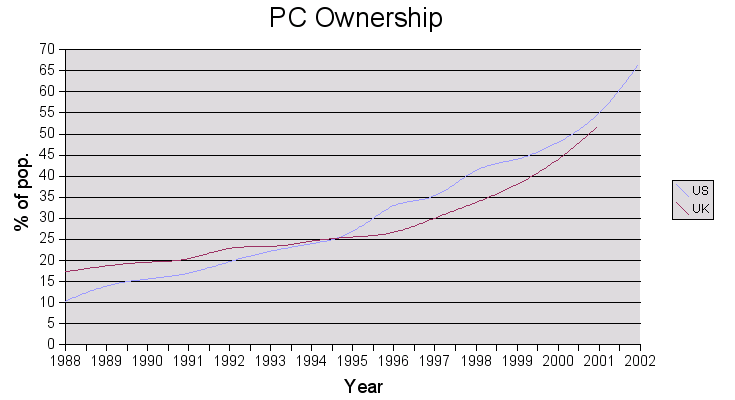
I spoke about the old idea that Europe is approximately 18 months behind the US in terms of PC and Internet tech. My position was that this was true from about 1994-2001, but that this was a temporary blip, spurred mostly by the geographical and cultural advantage the US had in Internet adoption. Here's the really fun graph:

I stole most of the stats for this graph from this paper. As you can see, between 1984 and 1994, PC ownership as %age of the population in the UK was higher than the US. The US sneaked ahead during a burst of computer ownership in the late nineties (I think perhaps spurred by faster Net adoption), but since then the distance between the two curves has narrowed. Or at least, I think it has - I had to a bit of extrapolation for some of the points on that last bit of the curve.
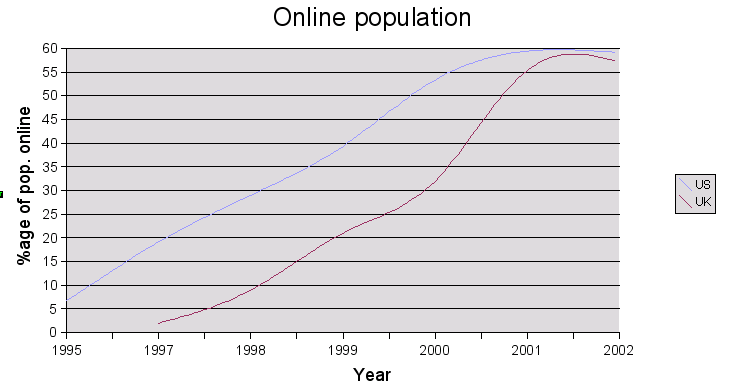
Here's the other graph, which shows the narrowing of the "18 month" gap between the UK and US a bit more clearly.

Teevee

Reading Doc Searls' entry on how American TV is changing, I think about my impressions about how slow, hide bound and expensive American TV networks appear compared to the UK networks. UK television is caught between the need to be very cheap (small country, higher costs) and the requirement to keep up some semblance of quality (big, well-funded BBC with high values). Now add to that a recent market-liberalisation-through-technology: Brits get dozens of channels via broadcast, digital satellite (23%) or digital terrestrial (6%), digital cable (8%), or analogue cable (7%). Forty percent of British TVs have some kind of interactivity feature, 80% of them have Teletext. (Stats grabbed from the ITC

Setting up a TV channel in Britain is surprisingly cheap: at the most basic level, you just pay for a satellite transponder, which can be less than a million quid. Of course, turning a profit in that multi-channel market isn't easy, but the low barriers to entry and fierce competition does encourage innovation. Well, the innovation that leads to Millionaire, Robot Wars, and dozens of below-the-radar cheap-and-cheerful throw away shows, anyway. Your typical market competition, in other words. The BBC, curiously, doesn't rise above this bear pit: much to the dismay of some its more patrician elements, it wades on in, fists flying, grabbing for audience share in an attempt to justify its license fee.

I don't think one system is particularly better than the other. I am, however, surprised how it turns out. It seems to me that the slow-moving, top-heavy, seasons-and-repeats American model leads to the high production values, low risk, staid and cumbrous epics that you'd expect from a public service broadcaster. By contrast, the British market benefits from competing with the BBC, producing exactly the sort of bright, popular scrappy cheap tat that a more liberalised market is supposed to provide.

Doc's piece is about how Reality TV is changing the American model - encouraging them to dump the expensive season and repeats model for a more lively, staggered run, with cheaper shows. I'm not surprised that a lot of those reality shows were forged in the furnace of the UK market.

Sorry, sorry, sorry

I've switched around my desktop a little, to see if it will encourage me to write more blog entries. I now have a tab on my terminal window dedicated to my latest blog entries, like Dave does, only with less outlining and more vim.

2003-01-24

That pitter-patter of dropped packets you're hearing?

Looks like there's a large-scale DDOS going on. Rumour has it that it's a Microsoft SQL worm. Certainly looks kinda nasty.

I'm going to sleep now, so I bet this post will look really stupid in the morning when we find out that it was actually aliens.

`

2003-01-22

Richard Herring Has A Blog

As a result of my previous lifestyle as dramatist, impresario and monologuist, I have a wide array of glamourous and alluring British celebrity colleagues. But by some quirk of circumstance that I cannot fathom, the stars who I truly bonded with were not the type who hung out at top London nightspots and graced the front covers of GQ and the Evening Standard Magazine. They were the ones who sat at home of an evening, playing Everquest and downloading pornography. So, for instance, while I have worked many times with my marvellous beautiful and generous co-host Sara Cox, the closest we ever became, as friends, was when she got the director to ask me to stop staring at her during a "shoot". On the other hand, Richard Herring was always very close, frequently calling me up to fix his computer and clarify more abstruse details of Star Trek chronology. A true friend, and never one to be put off by a little friendly staring.

Anyway, Richard Herring has a new and very funny blog. Another thing we have in common! I must email him or something. He'll remember me, I'm sure of it.

2003-01-19

Hear me speak words out loud

If you're stuck for anything to do tomorrow (Monday) evening, may I suggest stumbling toward the Silicon Valley World Internet Center in Palo Alto, CA for around seven? I'm speaking to the Software Development Forum's International SIG entitled "Divergence: How European and American tech markets are growing apart and what kind of headache that gives me in the morning.". I'm writing the presentation now, and if I don't start editing soon, it'll be about Roombas, Warblogs, 802.11b, Wired UK,"Moore Or Less's" Law, First Tuesday, Opera, Bulgaria, Googlism, and the Sunnyvale Corn Palace. $15 if you're not an SDForum member or a student, but don't worry - I won't see a penny of it.

2003-01-15

Eldred Lore

On this sad day, at least somebody knows how to follow the instructions and stole that book.

It's not all Jobs you know

Apple's done a sterling job popularising and now extending wireless use among computer users recently. But they've had a long history of doing the same thing. Back in 1995, when precious few people were considering the topic, they were lobbying the FCC to set aside some unlicensed space for data comms. Here's a report from the EFF newsletter of the time:

Apple's petition states:

"The NII Band would promote the full deployment of a National Information Infrastructure ("NII"), extending the effective reach of the NII by making possible high-bandwidth access and interaction throughout a limited geographic area -- where mobility is key -- both on a peer-to-peer, ad hoc basis and through wireless local area networks. Moreover, it would provide for unlicensed, wireless, wide area "community networks" connecting communities, schools, and other groups underserved by existing and proposed telecommunications offerings.

(The irony is that the frequency that Apple successfully lobbied for is, I believe, the same frequency that 802.11a now lives within. And 802.11a is the standard that Apple has pretty much killed by supporting the speed-bumped 802.11g in its Airport Extreme. Turned out that 2.4Ghz was good enough.)

2003-01-14

Slashdotting the vote, part 2

The STAND campaign is beginning to be picked up by the media. We've swung the vote from 2:1 support to nearly 2:1 against in four days.

I'm interested in seeing how the government replies to this. Officially, the consultation is just that, a consultation. The Home Office civil servants are still very insistent that there are no official government proposals on ID cards yet.

That position, unfortunately, was belied by Lord Falconer's (and Downing Street's) own press release in December that said:

Public support is growing for the government's proposals on entitlement cards. The response so far to a public consultation on the scheme shows a two-to-one split in favour of the plans.

... which, really, is why STAND got involved. Public consultations aren't referenda; but if you want to puff them up as such, you do have to live and die by the numbers. There's no groundswell of support for ID cards, and the government knows it. There might be, if they actually engaged the public in a discussion. But that's hard, and central government really have less experience in doing that than you'd hope. They're also, admittedly, often not in the best place to do so. Who ever trusts a government document? The ID card doc tried very very hard to be an impartial, depoliticised document, and it fell over for two reasons. Firstly, and most crassly, because Falconer decided to politicise it. And secondly, and more subtly, because one of the interested parties in creating an ID card is the civil servants themselves. With all the objectivity in the world, that interest leaked through every page of the consultation doc.

In other news, Alan Mather, who works for the e-envoy (Britain's Minister for The Bleepy Things), has spotted STAND for the first time. "I didn't come across them during the RIP hoo-ha.", he says, which is funny, because I'm pretty sure we started it. Hi, Alan!

2003-01-13

When Sucky Interfaces Attack

A friend of Rupert Goodwins fell and broke his leg while skiing in the Alps over Christmas. The good news: he could still reach and activate his mobile phone to call for help. The bad news: it was a Microsoft Smartphone.

The next time I looked at the phone it appeared to have turned itself off -- so I tried switching it on again. When it eventually came to life I could not get it to dial -- a closer examination revealed the legend 'Radio off' displayed very legibly on the SPV's excellent screen. No amount of menu searching let me find anything that would turn the phone's radio back on. At this point I remember making a few comments about the dubiousness of Bill Gates' parentage. I eventually managed to flag down a passing skier who let me use her Nokia phone (which switched on immediately) to call for help. Later analysis revealed that the problem arose because of the SPV's implementation of the ON/OFF button.

2003-01-11

Cryptorights

On Wednesday, I went to hear Lee Felsenstein speak on the Jhai PC project. Some questions that people have hurled at me recently were answered; quite a few new ones were raised. I spoke briefly to Lee Thorn, the head of Jhai, who said that the last he heard, some $6000 had been raised over paypal. He'd just received a check for $500 through the post, and was very puzzled about how people had found out about it. I somehow goofed managing to tell him. Now I feel like Peter Parker or something. I'm going to keep tracking the project. So many of my friends sent in money that I feel I have an obligation to both report on what they're doing, and keep some semblance of objectivity. I don't know whether they'll succeed or not, but they seem to be learning about something important. Twenty-five thousand dollars doesn't seem too much for an experiment like this; twenty-five dollars would seem too much if it affected the villages negatively. It's a tricky row to hoe.

I'd arranged to meet Dave Del Torto at the meeting. He's one of the main figures behind CryptoRights, a long-mooted organisation which has just collected $250,000 in funding. This will relieve a lot of people who I think got a little drained listening to Dave constantly hussle for cash at geek conventions. I spoke to him briefly about CR's plans now they have the backing. As usual, what follows are my disordered notes, which I'll shuffle up into a coherent piece for the Irish Times for next Friday. There's little editorialising here: I'm just jotting down what I thought DDT said. Don't take as gospel.

Some background: Dave was one of the first employees of PGP, worked under Chaum on anonymous digicash, organises the cypherpunk meatspace meetings here in the Bay, and is co-author of RFC3156.

DDT got first involved in crypto in the early Eighties. He was an architect doing hacking CAD at Berkeley; he was looking for a way of authoritatively signing blueprints and got suckered into the research during that exciting period in cryptography. His father is a mathematician, who had left a project when the DoD wanted him to work on securing nuclear launch codes. So DDT was familiar on both the practical uses of Deep Math, and the dangers thereof.

Cryptorights started at Financial Cryptography 1998, during the moment of the solar eclipse (so we can precisely pin this down to 1436, Thursay 26 February 1998). DDT was talking to John Gilmore and ???? about the necessity of an organisation to defend cryptographer's rights, as well as spread information about crypto to human rights organisation. "Security for Human Rights Workers and Human Rights for Security Workers", as the slogan goes.

The funding for Cryptorights came from the Alexa users vs Amazon and Alexa privacy settlement. Lawyers on both sides voted unanimously to vote Cryptorights the highest sum of quarter of a million. (So, ironically, this is another project that Brewster Kahle has funded - albeit by a class action lawsuit against his own company).

The main thrust of their work is providing authentication, security, and privacy to civil rights groups working in repressive regimes. I'd heard about DDT's work teaching PGP to legal groups in Guatemala; they also work with environmental investigators in St. Petersburg, and peace groups in the middle-east.

DDT ran through his plans for future R&D projects. They're pretty ambitious - it's partly that, I think, that led to them getting the grant money. You can see a lot of them listed at CryptoRight's research pages. DDT spoke of some others, but I'm going to have to double check on which were embargoed. There's stuff there like a wearable computer for humanitarian groups, and a global non-governmental public key infrastructure. The most practical of these, and fortunately I think the first project they're taking on, is Highfire, the Human Rights Firewall system - a little net applicance that provides secure channels and authentication systems for NGOs.

They're very aware of the dual-use of some of this tech: they have a lot of military groups looking over their work. They're going to keep it all open source. They're not anti-spooks, says DDT: they're anti-bad guys. A lot of the time, the bad guys switch from law enforcement and back again. Last year's members of the secret police are next year's narcotraffickers. There are good people, too, on both sides.

Personal stuff

Some minor patches to Some Past And Future Cliches Regarding (GNU/) Linux, top of the hit parade in 1999.

This is what you get for turning on mail updates for the STAND protest: massive blip in
my graph of incoming messages

2003-01-10

GtkHTML and KHTML

Something I didn't realise until now. GtkHTML, Gnome's HTML widget, was originally a port of KTHML too. It's wandered alot since then, but that does imply that the interface itself might be compatible.I wonder if GNOME will be able to suck down Apple's improvements?

A Case of Mistaken Identity

So the UK government has been proposing what they call an Entitlement Card - a universal ID card for every man, woman and child in Britain. Every government seems to propose this the moment they get into office, and ever since 1952, the voters have rejected it. It's one of those things that civil servants like to slip into the "TODO" list while the Minster isn't looking.

The usual way of stopping it is to complain that there's no mandate. The present government are getting around this by holding a "Public Consultation", where they write a 13MB PDF document (here's an HTML version we hacked up) talking about how great ID cards would be. They then solicit comments. The government is very pleased with this scheme. Lord Falconer, the government's ID card point man, keeps talking about how the majority of responses have been positive (they've had over 1500 so far).

I'm not so sure that's true. NTK subscriber Dan Blanchard emailed them to complain about the proposals, and got a nice mail back saying "Thank you for your e-mail in support of the introduction of an entitlement/identity card scheme.". Whoops.

Now I can't be sure they're miscounting here. I am pretty sure that there's a large number of people who are anti-ID cards, but haven't spoken up. So we've set up an easy front-end to their consultation process: you can just check the boxes, add your own comments, and mail the consultation email address automatically. We're counting all the messages that are against the proposal, and we'll see how they match up against the government figures.

Also, I can't help thinking that 1500 replies is pathetic compared to a good slashdotting. I think the blogosphere might be able to swing the balance around in a week or so.

Anyway, if you're British and you don't like the ID card proposal, have a look over the site and make your voice hear. We've only been going for a few hours, and we've already got around three hundred responses.

Oh, almost forgot to add: Bwahahahahaha.

The whole thing gets more and more bizarre

So they're calling up the reservists in the UK. The Ministry of Defence is sending out notes to them on Monday, but wanted their employers to know that this might happen before that. So to get the word out, they spammed 100,000 random addresses in the UK. Even stranger, they paid a German company to do it.

Ah, the mastery of the tools of the high-tech info-war. I fear this is going to go down in history as one of those Spanish-American, Lions-Led-By-Donkeys affairs.

2003-01-09

Magic Kingdom is Out

Cory's first novel is out. Buy it, then download it for free. It's a fun, geekazoid read. I romped through it on the Caltrain back around Codecon (if you're an NTK email subscriber, you can find a mention of Whuffie hidden in the X-Excuse header around about that time.) The next day, I shimmied up to Doctorow at the conference and insisted that I was the book's first fan. I began quizzing him on ridiculously fine-grained plot points. He seemed very touched, and answered my questions perfectly civilly even when I went on far too long and the whole thing become very tedious. "How was that?", I asked, before returning the conversation to more normal lines. Fine, he said, kind of fun. "Good. Welcome to the rest of your life."

Down and Out in the Magic Kingdom Whuffie Ring [ Previous 5 Sites | Skip Previous | Previous | Next ]

This Down and Out in the Magic Kingdom Whuffie Ring
site owned by Danny O Brien. Join the ring today!

[ Skip Next | Next 5 Sites | Random Site | List Sites ]

2003-01-07

Apple Kor

I for one, welcome our new Konqueror implementation. Actually, it does explain why David "Chimera" Hyatt went over to work at Apple. From a posting of his back in June:

What Gecko has going for it is correctness (and a very large range of implemented standards!), but I'd rather see someone try to do it better. A browser on OS X done right should be able to dust Gecko in terms of speed and footprint. It should be able to just smoke Gecko in startup time and page load time. The fact that this hasn't been done yet doesn't mean it can't be done.

I guess he went over to see if it could be done.

2003-01-05

More on the Pedal-Powered Internet

I've just found out that Lee Felsenstein will be talking about the Jhai remote IT project at Stanford this Wednesday, 2003-01-08, 4.15pm. If you're in the area, it should be an interesting talk.

It's also Saint Joshua Norton's birthday deathday. I shall have to find a way to pay my respects at the Bill Gates Building.

Even when Early Adopting, I'm late

I've been settling into a slow lazy orbit of gadget-stasis. After a lifetime of craving all kinds of gizmos, I ended up with a shortlist of things I wanted two years ago. I have since failed to add anything new to it and slowed purchased everything else at bargain-bucket rates when they've ceased to be fashionable.

In the end, I realised that there was only one thing left on the list - a USB key drive. You know, one of those 64MB widgets you can hang off a keyring and plug straight into a USB port, where it magically appears as a normal drive on Mac, PCs and Linux. When I first decided I wanted one, they cost hundreds of dollars and were highly first-adopterish. Now they're cheap and ubiquitous, I thought it was time to take the plunge.

Never quite works that way, does it? About the same time, I read on Slashdot about a new generation of these little drives, with a new generation of chipsets. As well as store files, they could work as MP3 players and voice recorders too. I got the cheapest of these, the splendidly named Yo!Fun 130 for Christmas. It does MP3 playing and voice recording as well as file storage - and it can take SmartMedia cards. It's also very diddy and wee.

Unfortunately, it's the strangest engineered piece of consumer electronics I've seen. Inside it, I estimate it has an MP3 player/voice encoder chipset tied together with rope to a mass storage chipset, with a complicated pulley and winch to connect one of them to the outside world at a time. Neither know of each other's existence. You switch one or the other in, you have to crank a switch on the side of the box. If you sniff the USB output, you can watch this happen. One moment, the USB is saying "Hi! I'm a perfectly normal USB storage device made by Dull Company of Taiwan", the next the winch activates and "Zzzzt! Wait! No! I am, in fact, an MP3 player made by Somebody Different of South Korea".

Each chipset uses a different storage format. So every time you switch, you have to reformat all the memory. Want to copy some files across, then listen to MP3s? Forget it - you'll need to delete one or the other before you can move that lever. This isn't systems integration: it's systems smooshing.

Yo!Fun also isn't Linux compatible - not really surprising, I suppose, given that it's not even compatible with itself. So I took it back, and got a Cendyne Gruvstick. Bit more expensive. Slightly better. At least that presents itself as just one thing to the USB interface. Unfortunately, it's not anything that anyone outside of its own device driver would care to comprehend.

The Gruvstick uses the STMP3410 chipset which, in theory, supports the USB mass storage protocol (the standard that lets you just slam these things into Macs, PCs or Linux without needing drivers). But the Gruvstick spurns this petty interoperability for what looks like its own magic moon language. Having your own language is, of course, the very definition of proprietary. But I have to say, after poring over dozens of specs and snooped USB traffic - what a weird way of doing things. The standard says, 0x28, when it wants to read some data. The Gruvstick has exactly the same function, only *it* uses something like 0x03. Thus, presumably, doubling the work for the engineers, and rendering it utterly incompatible with anything other than their specially written drivers. Drivers which crashed Quinn's Windows 2K machine. (I may be wrong about the details of this, incidentally - and this is a blog, so it's almost obligatory to be a bit wrong. But it still looks like the Gruvstick is being proprietary for proprietary's sake. And there's not a single thing its software does that the standard USB storage protocol doesn't support. Except, I guess, DRM.)

Anyway, the upshot of this is that the Gruvstick needs its own drivers. Drivers you can only get for Windows. Now this makes it useless for my purposes - not just because I'm such a Linux wonk, but because I want to use it as a replacement for floppy disks. How can I transfer files, if I need to install drivers to get the storage device to be even recognised on a foreign machine?

So I took the Gruvstick back. Then, finally, I did the sensible thing. I went to the Linux USB working devices list and searched for what I wanted. There, I found some optimistic reviews of the Daisy Diva MP3 Player/File Store/Voice Recorder/Compact Flash reader. This, it looks like, does it all right. Normal USB Storage protocols; no weird hybrid shit; Linux support - plus, it's pretty much the same price as the Yo!Fun. And it's got a slightly less silly name.

I haven't bought it yet - because I made the mistake of visiting the rest of their catalogue. Now I'm wavering between that, or the Daisy Music Pen, which is all the same stuff (sans CF reader) in a pen-sized form factor. Again, it's cheaper than the Gruvstick. Or should I really splash out and get the same company's PhotoClip? Which is - glad you asked - a combined MP3 player, file store/CF reader, voice recorder, still camera, webcam and video recorder. $149, although I don't know how much of that is Linux accessible.

I'm still in the middle of deciding. But I've learnt three lessons: one, the folk who make the sensible engineering choices are probably the smarter and cheaper manufacturers too. Two: you always do your best consumer research in the two hours after you bought the goods. Three: no matter how long you stay out of the gadget rat race, there's always one more object of desire.


petit disclaimer:
My employer has enough opinions of its own, without having to have mine too.