Currently:
Archive for January, 2003
2003-01-31»
byliner is back»
Phil “Samuel Pepys” Gyford has re-animated an old project of his, Byliner. It keeps track of online publications like Salon, the Guardian and the NYT, and mails you when new articles appear by your favourite authors. It’s a great resource – can’t wait for when Phil implements RSS feeds too. The Daypop stylee most popular stories and authors page is fun.
Comments Off on byliner is back
phew, glad i didn’t manage to get my ins papers in»
Looks like there’s a reasonable chance they would have been shredded, along with as many as 90,000 other applicants. As Robin says, how many of those INS detainees were held as a result of this, or some less deliberate bureaucratic foul-up?
Comments Off on phew, glad i didn’t manage to get my ins papers in
2003-01-27»
the perils of rss readers:»
I’m forever getting half-way through what I think is one of Doc Searl’s posts, then abruptly realising that I’m actually reading Samuel Pepy’s Diary. “Met with Tom Newton, my old comrade, and took him to the Crown in the Palace”. Oh, oh, I think: he means this palace, not this palace.
Comments Off on the perils of rss readers:
venting plasma»
The talk I gave at the SDForum meet has now been slotted into the archive. It’s an hour long. I wouldn’t bother listening if I were you – I can give you the juicy bit in a nutshell.
I spoke about the old idea that Europe is approximately 18 months behind the US in terms of PC and Internet tech. My position was that this was true from about 1994-2001, but that this was a temporary blip, spurred mostly by the geographical and cultural advantage the US had in Internet adoption. Here’s the really fun graph:
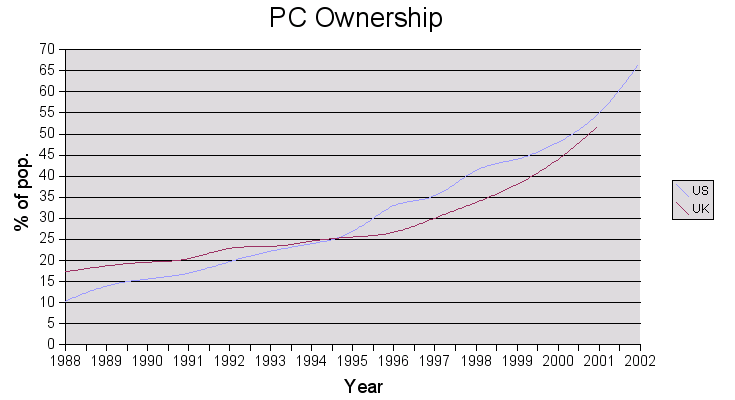
I stole most of the stats for this graph from this paper. As you can see, between 1984 and 1994, PC ownership as %age of the population in the UK was higher than the US. The US sneaked ahead during a burst of computer ownership in the late nineties (I think perhaps spurred by faster Net adoption), but since then the distance between the two curves has narrowed. Or at least, I think it has – I had to a bit of extrapolation for some of the points on that last bit of the curve.

Here’s the other graph, which shows the narrowing of the “18 month” gap between the UK and US a bit more clearly.
Comments Off on venting plasma
teevee»
Reading Doc Searls’ entry on how American TV is changing, I think about my impressions about how slow, hide bound and expensive American TV networks appear compared to the UK networks. UK television is caught between the need to be very cheap (small country, higher costs) and the requirement to keep up some semblance of quality (big, well-funded BBC with high values). Now add to that a recent market-liberalisation-through-technology: Brits get dozens of channels via broadcast, digital satellite (23%) or digital terrestrial (6%), digital cable (8%), or analogue cable (7%). Forty percent of British TVs have some kind of interactivity feature, 80% of them have Teletext. (Stats grabbed from the ITC
Setting up a TV channel in Britain is surprisingly cheap: at the most basic level, you just pay for a satellite transponder, which can be less than a million quid. Of course, turning a profit in that multi-channel market isn’t easy, but the low barriers to entry and fierce competition does encourage innovation. Well, the innovation that leads to Millionaire, Robot Wars, and dozens of below-the-radar cheap-and-cheerful throw away shows, anyway. Your typical market competition, in other words. The BBC, curiously, doesn’t rise above this bear pit: much to the dismay of some its more patrician elements, it wades on in, fists flying, grabbing for audience share in an attempt to justify its license fee.
I don’t think one system is particularly better than the other. I am, however, surprised how it turns out. It seems to me that the slow-moving, top-heavy, seasons-and-repeats American model leads to the high production values, low risk, staid and cumbrous epics that you’d expect from a public service broadcaster. By contrast, the British market benefits from competing with the BBC, producing exactly the sort of bright, popular scrappy cheap tat that a more liberalised market is supposed to provide.
Doc’s piece is about how Reality TV is changing the American model – encouraging them to dump the expensive season and repeats model for a more lively, staggered run, with cheaper shows. I’m not surprised that a lot of those reality shows were forged in the furnace of the UK market.
Comments Off on teevee
2003-01-26»
sorry, sorry, sorry»
I’ve switched around my desktop a little, to see if it will encourage me to write more blog entries. I now have a tab on my terminal window dedicated to my latest blog entries, like Dave does, only with less outlining and more vim.
Comments Off on sorry, sorry, sorry
2003-01-24»
that pitter-patter of dropped packets you’re hearing?»
Looks like there’s a large-scale DDOS going on. Rumour has it that it’s a Microsoft SQL worm. Certainly looks kinda nasty.
I’m going to sleep now, so I bet this post will look really stupid in the morning when we find out that it was actually aliens.
`
Comments Off on that pitter-patter of dropped packets you’re hearing?
2003-01-22»
richard herring has a blog»
As a result of my previous lifestyle as dramatist, impresario and monologuist, I have a wide array of glamourous and alluring British celebrity colleagues. But by some quirk of circumstance that I cannot fathom, the stars who I truly bonded with were not the type who hung out at top London nightspots and graced the front covers of GQ and the Evening Standard Magazine. They were the ones who sat at home of an evening, playing Everquest and downloading pornography. So, for instance, while I have worked many times with my marvellous beautiful and generous co-host Sara Cox, the closest we ever became, as friends, was when she got the director to ask me to stop staring at her during a “shoot”. On the other hand, Richard Herring was always very close, frequently calling me up to fix his computer and clarify more abstruse details of Star Trek chronology. A true friend, and never one to be put off by a little friendly staring.
Anyway, Richard Herring has a new and very funny blog. Another thing we have in common! I must email him or something. He’ll remember me, I’m sure of it.
Comments Off on richard herring has a blog
2003-01-19»
hear me speak words out loud»
If you’re stuck for anything to do tomorrow (Monday) evening, may I suggest stumbling toward the Silicon Valley World Internet Center in Palo Alto, CA for around seven? I’m speaking to the Software Development Forum’s International SIG entitled “Divergence: How European and American tech markets are growing apart and what kind of headache that gives me in the morning.“. I’m writing the presentation now, and if I don’t start editing soon, it’ll be about Roombas, Warblogs, 802.11b, Wired UK,”Moore Or Less’s” Law, First Tuesday, Opera, Bulgaria, Googlism, and the Sunnyvale Corn Palace. $15 if you’re not an SDForum member or a student, but don’t worry – I won’t see a penny of it.
Comments Off on hear me speak words out loud
2003-01-15»
eldred lore»
On this sad day, at least somebody knows how to follow the instructions and stole that book.
Comments Off on eldred lore