main bit This page looks very fancy in a modern browser, with "stylesheets" and "layout" and thing, but frankly I prefer the way you're seeing it here. Congratulations for not crumbling to the Browser Upgrade Initiative! Support the Web Designer Downgrade Conclusion!
a man slumped on his desk, from 'The Sleep of Reason Produces
      Monsters'

Oblomovka

oblomovitis

latest entry

this year
2006
2006
2005
2004
2003
2002
2001

rss

search entries:

usual, suspect

need to know

haddock

boingboing

current thrills

Thinking List

Delicious Links

EFF DeepLinks

sponsors

David McBride

Adewale Oshineye

Diggory, Andrew, and Matt R.

writing

ancient notes

why I like 802.11
senate committee letter
oscon2003
ms and free software

code

ubiquity
webolodeon
wat
tagling
haiku

info

e-mail

homepage

pgp etc

amazon wishlist

oblomov

the book

     July 2003      
Su Mo Tu We Th Fr Sa
       1  2  3  4  5
 6  7  8  9 10 11 12
13 14 15 16 17 18 19
20 21 22 23 24 25 26
27 28 29 30 31      
                    
<<Jun Aug>>

Currently:

2003-07-31

you commendo

It's been ten years since CD-ROM drives became affordable (prices dropped from $700 to $200 in 1993), and I've been asked to write a piece about the rise (and fall) (and rise) of the CD-ROM as a medium. As part of this, I'm doing a little retrospective of the best CD-ROMs of the decade.

It feels a bit odd to hive-off CD-ROM as a category. There's something very 1996 about doing that. It does mean something, though: a package that depends on permanent storage rather than pulling data off the Net; whose form is melded around slow-access times, and perhaps nodding to that "digital book" ideal.

I'm guess I'm looking for apps that exploited the CD-ROM form well, and perhaps lived up to that all-to-brief moment of being the forefront of "interactive multimedia", but have still managed to survive the test of time.

Me, I have a soft-spot for Voyager's Spinal Tap, which not only set the standard for video CD-ROM, but I think defined how DVD bonus material would be executed. And I think I'll include the original Myst (even though I'm a bit loathe to include every game too big to fit on floppies), because its rendered gameplay was such a ingenious exploitation of the large size of CD-ROMs, rather than clever programming. And then there's the You Don't Know Jack, spin-offs of which I still see for sale.

What are your favourites? All suggestions ungratefully purloined.

Discuss!

2003-07-30

the london underground in cartesian triplets

Nigel Rantor is collecting datapoints to build an open 3D map of the London Underground, and is looking for suggestions as to what to do with it. Geowankers, assemble!

2003-07-29

blog activity

Oh, shut up, yes, it's another blog entry about blogs. I'm interested, all right?

Maciej's team have done the first number-crunching I could think of with his Blog Census stats. How many blogs are actively updated? Roughly two-thirds, it seems -65%. The rest are either abandoned (where the blogger says he's quitting - 4%), no longer updated (no posts in two months - 16%), sites that just contain test posts (8%), 404ing, or otherwise inaccessible.

2003-07-28

The European Enforcement Directive

RIAA-style revealing of subscriber identities without even sub poenas? And worse? What fresh hell is this?

2003-07-27

transcribing phone interviews

I'm spending the day listening to my own cackling voice asking dumb questions of smart people. They're all very quiet people, too, and I foolishly left the laptop recording with the noisy mains plugged-in, so all I can hear is my booming idiocy and then them speaking as though through a lawnmower, darkly.

That said, this piece is going better than most. My expectations of what my interviewees would say have not been so undermined that I'll have to rejig the entire skeleton structure I originally had in mind. But I've still been sufficiently surprised by what they have to say that I know I'm not just imposing my naive pre-story belief onto the facts.

Plus, I'm getting to write about new RFCs in a mainstream publication, which is always to the good.

2003-07-26

dj adams on getting started with dashboard

DJ Adams has written up how to get dashboard up and running. This is, bar endless fooling around, how I did it. I'm using Debian - currently the development Debian packages for mono and gtk-sharp aren't recent enough to compile or run dashboard.

2003-07-25

argh so close

Spent the evening recreationally pulling mono , gtk-sharp and dashboard out of cvs and manhandling them into compiling. Everything works, except for one goddamn line in dashboard, where it calls GTK.Html.BeginContent() - which the compiler confident tells me doesn't exist. But I can see it, Computer! I can see it in the API XML spec!

time passes...

Well. I felt so defeated by writing that last blog entry, that I went off and had another go. My general approach in these situations is to randomly futz with the source until I can't remember what it looked like pre-futz, then flamboyantly delete it all in frustration and despair. I got as far as futzing - I replaced BeginContent() with Begin(), which was the function above it in the API list - and it all magically worked.

There's not much to see yet, unfortunately, because I don't use any programs that have a dashboard frontend (that's to say, that passively spit dashboard clues about what I'm currently looking at/typing). But it managed my blog entry about itself when I asked it outright. And that makes me strangely happy.


2003-07-24

vim and the kitchen sink

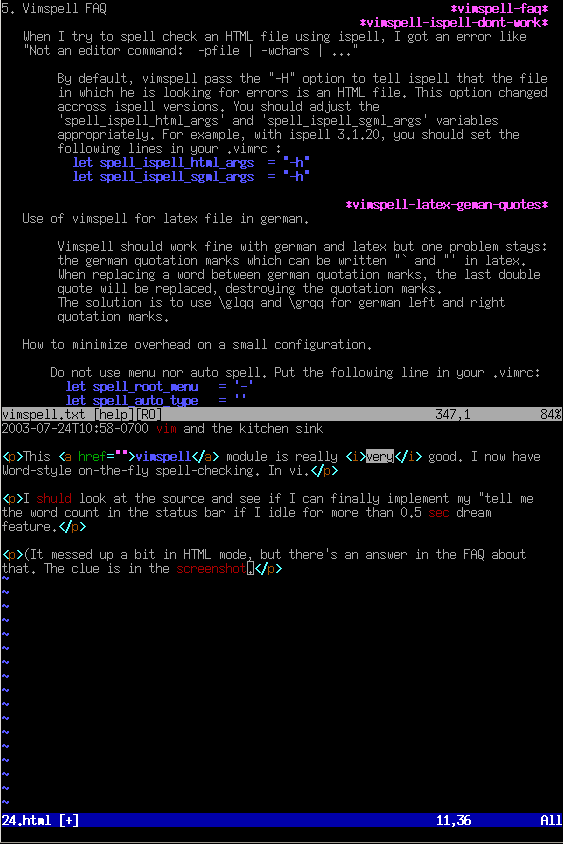
This vimspell module is really very good. I now have Word-style on-the-fly spell-checking. In vi.

I should look at the source and see if I can finally implement my "tell me the word count in the status bar if I idle for more than 0.5 sec" dream feature.

(It messed up a bit in HTML mode, but there's an answer in the FAQ about that. The clue is in the screenshot.)

2003-07-23

statutory rights

My friend Louise is like one of those brilliant cold-sell salesmen, only the other way around. If she buys something and it turns out to be a bit rubbish, she harasses the company into doing anything she wants. Here's how she got a free replacement part for her Dyson vacuum even when it was outside the guarantee.

monkey arg

Coinage I'd not heard before, but will now overuse: ad hominid

slashdotted

Well, apparently somebody requested slashdot's front page two thousand times - although it's unclear whether it's from my IP (in which case, why are none of the other browsers behind my NAT banned) or from my user login (in which case, why would do a DOS with cookies set? Maybe to force a dynamic page?).

They've unbanned me, in a minimally helpful way - which I don't begrudge them much, since they must get this sort of thing thirty or forty times a second in a normal working day. I wish they'd given me more hints as to what happened though - this could be a symptom of something more profoundly messed-up with my security, or it could just be an error on their part. It's really difficult to tell with no information. And you'd think that we'd both benefit from more of that.

The random UIDs is a bug, apparently. Which doesn't, I have to say, fill me with hope for their analytic forensics.

2003-07-22

something's up with slashdot

Or me. I get this little message when I try to visit the site.


Your user account has been banned from Slashdot

Due to questionable activity from this user account, it has been temporarily disabled. Actions that would cause this ban are posting comments designed to intentionally break comment rendering for other users, or running some sort of script or program that loaded an unacceptable number of pages in a short time frame.

If you feel that this is unwarranted, feel free to include your UID (465212) in the subject of an email, and we will examine why there is a ban. If you fail to include the UID (again, in the subject!), then your message will be deleted and ignored. I mean come on, we're good, we're not psychic. Send your email to banned@slashdot.org.
 

I know what you're saying: I've been naughty, haven't I? Well, in general, yes, but not to slashdot. And you see that UID there? It's random. Every time I hit reload, a new one appears.

In the meantime, how will I ever discover what SCO is saying this hour?

2003-07-21

dialogue

    me:     (about a new acquaintance) he writes open source software. he is
            spanish.  he dislikes capitalists.
    q:      (unimpressed)
    me:     i have a file on everyone, you know.
    q:      you mean you use google.
    me:     well i'd be a fool to keep them locally, wouldn't i?

2003-07-20

the dow jones index of life

They've revamped the bit of the Sunday Times I wrote my column inside (for nearly four years!), and there's no more room for me in the new, smaller section. So I'm away.

Perhaps I should be more worried than I am - only yesterday we were talking about our paycheque-to-mouth existence around here. But truthfully, I'm relieved. We've parted on good terms, so I think I'll still be writing features for the paper. And although weekly column did wonders for my discipline, it also made me soooo lazy. You get very spoilt when you can pay your rent one five-hundred word piece at a time.

Before I got the Virtual Life gig, I presented a TV show, and before that I was producing a TV series, and before that I helped start an ISP, and before that I manhandled a baby magazine to death, and before that I was doing a one-man show, and before that I was in a bedsit in London, staring at the stains on the ceiling. Each time I had to scare myself into trying the next job, like a series of squeaking bunny-hops. I have no ambition. I just look over my shoulder a lot.

And I was, as I think I've mentioned, getting a bit peeved with the writing-about-others-excitement instead of wreaking-excitement-on-others. I've been toying with new things for four years now, but haven't really taken any of them seriously. Now I get to look serious again.

gulp

(I'm still in the Irish Times though. This Friday, if you can evade their subscription guards, I ponder on why Perl people drink so much and why everyone in Python land has a funny European accent. It's true!)

st. jude: for favours received in the past

Judith Milhon, or as everybody (like me) who never met her knew her, St. Jude, died, they say. It could just be a rumour: cypherpunks (which she named) hasn't mentioned it, I haven't heard anything on the cracker mailing lists either. Death travels slowly online. People are hesitant to believe.

"My own definition of hacking is the clever circumvention of imposed limits, whether imposed by your government, your own skills or the laws of physics."

2003-07-19

bush-o-meter

Collated statistics on Bush approval/disapproval ratings. The site's obviously a bit biased, but the figures are straight and quite fascinating. It's amazing how jittery opinion is about Bush, especially when compared to other presidents.

2003-07-18

I was NTKing late Thursday night, and watched the David Kelly story develop. It was sad sitting on my own, reloading Google News, watching the reports get bolder, grow from rumour to suspicion to the front-page coverage of his death, even as the sun rose.

Kelly was suspected of being the source for the BBC's claims that a key government Iraqi dossier was "sexed up" for the press. Protecting sources is a tricky game - particularly in the UK where its legally unclear how much protection journalists can realistically provide. Courts can comply editors to reveal sources and have done so in the past. Newspapers have threatened to appeal to the European Human Rights Court in Strasbourg on this issue recently. NTK has a slightly simpler approach: we let people know we'll squeal like little piggies in court, so don't tell us anything you wouldn't want the world to know - and for God's sake, send it to us anonymously.

That's not ideal. Anonymity protects the source, but doesn't help the journalist much - because anonymous sources aren't that much use. Cryptography protects the message, and authenticates the source (if they digitally sign it), but leaves a damning paper trail if the journalist is forced to hand over their records.

What you really want is an encryption system which would allow that the journalist and the source to communicate privately, allow the journo to confirm who the source is, but provide complete deniability on the source's behalf should the messages be obtained at a later date. That's what Nikita Borisov, Ian Goldberg and Eric Brewer propose in this paper, "Off-the-Record Communication, or, Why Not To Use PGP". They plot out the flaws in using standard crypto, and implement an instant messanger extension that will let parties talk in a confidential, authenticated manner that cannot be decoded - even by each other - at a later date, and is fully deniable if intercepted.

A neat solution, although it doesn't stop Parliament calling you in on the merest suspicion you might be the source, then having the rest of the media follow you around with sixty-suns-worth of spotlight until the end of your poor life. But then, even crypto has its limits.

2003-07-17

your traffic jam in WAP

Dan Catt (who with Modesty B. Catt was responsible for the WAP version of Elite) has written a scraper for the UK traffic site, and spooled it all out in WAPPish. I have no idea if it's useful or not because I don't have a WAP phone, can't parse WML very well, and live in America now. Still, cool!

googling for artichokes

So I'm trying to nip this one in the bud before Andrew Orlowski writes another one of his rants about how Google is being paid off by corrupt blogger billionaires eager to control the minds of the unawakened lumpenproletariat or something.

Do a google search for "cook an artichoke". The top hit is pretty funny. It contains, as the friend who pointed it out says, "the most colorful discourse I've seen yet in an epicurial conversation".

Now I'm sure that this will eventually get back to Andy, who will ponder publically why it is that a meagre blog, full of swearing, managed to get top billing on Google, when there are many authoritative cooking sites out there simply begging for hits.

To save time, I'll point out that a) all the swearing comes from google searchers, so the site must have bubbled up before the fights began, that b) it is now far more entertaining than any cooking site (short of an episode of Iron Chef presented by Sweary Mary) so I imagine will stay up there forever, and c) does actually link to several sites that tells you how to cook an artichoke. Because it has comments - filthy disgusting comments - there's even a correction to the first link which is now broken.

So we have a top link is funny for a sizeable number of people, and which still compactly and briefly explains how to cook an artichoke. What's not to love?

2003-07-16

uk real time traffic info

The UK Highways Agency provides real time traffic information that let's see how bad London's M25 is, and what all the signs on the M1 look like right now.

This is begging to be scraped into something more mobile browsable.

eucd in force in germany

DeCSS is now illegal to distribute in Germany. ( I can't believe they had the gall to pass this law on my birthday. Have they no sense of decency?)

2003-07-15

the joy of chasing referers or: blogku

rog took my haiku program, and created a blog->haiku add-on for Moveable Type. Nice!

i did so blog yesterday; amtrak

It had to be all moblogging from the back of the car, as we were in transit all yesterday. And all last night and most of today thanks to Amtrak running Coast Starlight around four hours later than advertised.

It's odd stumbling across really bad government-run, customer-facing bureacracy in the US. It's not the way things are usually done here - which is a shame because when they try, they're really good at it. Amtrak had it all: weird seventies decor, bad timekeeping, a dining area with a waiting list (you had to sign up for breakfast in advance). But what I really had to admire was how the bureacratic strictures were both contradictory, and arbitrarily enforced. Surely the sign of a great Brazil theme trip.


I should have taken the hint when they wouldn't sell me tickets in advance, but did give me a special secret code number that I had to give the conductor before I'd be allowed on the train to buy a ticket. A security measure, apparently.

As it was, when I finally stumbled aboard at 6AM, having waited at Redding station since 2AM, the conductor didn't want my secret code. What he wanted me to tell him was how much I should pay for a ticket to San Jose. "Don't you know that?", I said, poorly hiding my surprise. Nobody had implied that I was enjoying any special offers. Or indeed, was supposed to remember how much I intended to pay. He grumbled, got out a big book and looked it up. "$60". Now, I couldn't remember the price I'd been quoted, but it was definitely less than that. "You're lucky," he said when I questioned him, "if you look here it actually says $69 for train-bought tickets. But I usually ignore that."

What? I was beginning to feel like maybe this was some complex haggling and/or bribing manoeuvre. "Well, you have the advantage of me," I began to say... and the conductor grew quite frenzied. "I do not! It was you who chose to get on the train!". I pointed out that there was not much else to do in Redding at 6AM in the morning, having waited four hours for the pleasure. "Well, that's the nature of trains, sir," he replied, delivering some sort of coup de random flail.

What? What? It's the nature of trains to arbitrarily choose the time and their fare structure? I'm terrible at fashioning snappy comebacks to surreal arguments, but I do pride myself on re-engineering odd bureacratic strange-loops. I told him that I had now remembered - perfectly - what price I was quoted, as was expected of me. I revealed that I was to pay $51. He grumpily announced that he wasn't going to argue with me (which was nice) and let me write down my chosen price and credit card number on his carbon paper and moved on. In retrospect, I think I could have got him down to $30.

I still don't know what the secret code number was about. Oh, and if you do go on the Coast Starlight , the laptop outlets are on next to seats 19/20 upstairs on the coach carriages. Bring a two-plug adaptor, and I bet you could share with whoever is sitting there.

2003-07-13

why you should write down your ideas; zeroconf for the rest of us

I swear I had four ideas for mini-programming projects at some point last week. Now I find they've evaporated down to one. And even that one has already been thought up before by Kragen. But no-one, to my knowledge, has implemented it, and it's still a great idea.

I often find myself - as many did at OSCON last week - joining a network with a perfectly fine Net gateway but dead or unresponsive DHCP server. It'd be really useful under those situations to have a program that can deduce the gateway, network mask, spare IPs not in use on the Network, and optionally nearby DNS servers, Web proxies and authorised SMTP relays. You can work out much of these from judicious sniffing of traffic on the network; others you can deduce with some simple heuristics.

Kragen's thought about this a lot, but makes it sound a lot sneakier than it has to be, because he's trying to work out tricks to use in case you're plugged into a switch. On a switch, you don't see much other traffic. I'd be happy with the autoconfigurator if it only worked on hub-based networks (or wireless networks), where you can see most traffic already.

About the most potentially antisocial act this program would have to do is guess an IP address. If it chose one that was already in use, you'd disrupt that computer's connection. But a combination of sending out ARP requests, sending out test traffic, and being conservative in your choices (aiming for a reasonable distance away from present IPs, avoiding either edge of whatever netmask you've estimated the network to use).

2003-07-12

nat's dashboard

Now I'm really peeved. I had to miss Miguel's keynote to write NTK. I spent the rest of the day regretting it, because Quinn told me it was very funny, and I like funny. But now I'm going to spend the next couple of weeks regretting it, because apparently they demo'ed dashboard.

A couple of weeks ago, when Nat Friedman first started hacking seriously on it, he wrote "I think this project has a lot of dorky-blogger-meme-virulence potential". I think it's more than that. This looks like the sort of app my friends would happily murder me for.

In a nutshell, it's a system-wide Remembrance Agent : a system that takes little clues from all the apps you're using and throws up suggested links to other items. So if I'm talking on IRC to, say, mouthbeef, my IRC client will send a cluepacket to dashboard, announcing that. Dashboard then echoes the cluepacket around to other listening apps, and they'll all chip in with their suggestions. "Mouthbeef", says my address book: I'm sure that's Cory's nym. "Cory?", says my mail archiver, "okay, here's the last five mails from Cory". "Right, I know that Cory writes for BoingBoing", says my aggregator, "so here's the RSS feed for that".

I've seen work like this from Microsoft Research, but it's always struck me as a bit too clever-clever. They always go for the angle of "well, you're makiing a lot of noise and not typing, and the phone is off the hook, so there must be someone else in the room, so I won't display these private messags"-type hints. It's far too deductive: it's smart for smart's sake. And their set-up always makes what I think is a key mistake, which is to work too hard to delegate decisions to the computer. I see this a lot in agent tech; all that bullshit about "My preferences show that you like tasty burgers, and we're in the neighbourhood of a Big Kahuna Burger joint. Let me show you the route.". No. I may well like burgers, but you'll show me the solution when I ask for it. Don't act like a personal assistant, making decisions for me. You're no good at that. Give me more information to make my own decisions. Increase my power, don't bleed it away.

Also the Microsoft stuff continues to have its head stuck right up the ass of corporate America. One of my big bones with MS stuff is that it always makes me feel like I'm eating out of the trash bins outside a cubicle farm. All of their software is designed to help busy executives plan their lives. Everyone I know uses it to try and write birthday cards and chat with their friends. When people use Microsoft Office they use it anywhere but in an office. Microsoft knows this - but it also knows that the money comes from their corporate clients, so there's a limit to how much it can bend its software toward a wider customer base. Ultimately when you use MS software, you're not the end user MS perceives at all: we're just living off the scraps Microsoft leaves out after feeding its big customers. This is especially true of their super-smart agent tech. Every demo I've seen presumes so much about how it's going to be used in an office environment that I can't imagine using it anywhere else. Actually, I can't even imagine using it in a non-WASP, non-North American office a lot of the time. I'm sure they'll try and fix this, but their hearts won't be in it. WASP America is their heartland.

Anyway, back to Dashboard. I like the look of Dashboard partly because it feels very informative, rather than anticipatory. It's not really making deductions about what you want to do, but throwing you extra information about what you're doing now. Think status bars versus paper clips. Also, the very fact that it's being hacked upon by the GNOME folk means that it's already working in an environment much closer to my own.

The first of those is, I think, a permanent advantage. Ever since I saw the Remembrance Agent , I've wanted something like Dashboard. It just seems to be the right idea for me, and I think for others too. It's what I liked about Lotus Agenda ; it's what I anticipate liking about Chandler.

The second is selfish. Just because Nat and Miguel have usage patterns closer to me than to a CEO isn't a universal good. The free software's bias towards hackers is no better than Microsoft's bias towards companies. But I do think there's more of a chance of software like Dashboard gravitating towards other lifestyles. Not really because I think that the free software movement is particularly good at accepting different user behaviours, but because Microsoft is so spectacularly bad at it that there's a real vacuum in the market. It's the Achilles heel that Apple is so carefully exploiting these days. I think that the open source movement would have to positively work at being close-minded not to win here.

There now; I've written a huge amount on a piece of software that I haven't even downloaded and run yet. I get the impression it's not really in a workable state yet, and anyway I'll have to get Mono back up and running before I can play around. And I'll probably have to write a set of clue-generating backends for vim or something. I'll do it in my copious spare time and let you know.

peter's friendslist

Okay, I mustn't gawp, and it's hardly germane to what she's writing about, but I still think it disarming to discover a Sixties Oxbridge, Hitchens and Clinton reminiscing, New Statesman crowd posting on Livejournal. And they have a little discussion afterwards! And they all have pre-raphaelite icons!

I can't quite put my finger on why this is so pleasantly unsettling: it's like seeing two class systems mix it up. It's like some online equivalent of Jeffrey Bernard's Low Life column, but you get to hear the discussion in the pub afterwards. I like it, but then I like most things that give me a headache afterwards.

Of course, learning more about Roz Kaveney, I'm no longer surprised. Anointed to be a gatekeeper.

2003-07-11

blog census

The lightning talks worked very well at OSCON (and proved hilariously stereotypical : the Python talks were well-ordered to a Netherlandish extent, the Emerging Tech ones were largely performed by people with brightly died hair, and the Perl talks were even more ADHD than you'd imagine). At the end-of-conference press overview, Nat said he was going to go for lightning keynotes next year: 800 pundits in half-an-hour.

The five-minute talk that surprised me the most (apart from the Chinese rap) was Blog Census. Maciej Ceglowski has been writing blog-recognition software and has spidered out to pick up over 600,000 blogs. Not only has he been collecting the URLs and various global stats, he's been archiving the entries, too. You can download everything he has: the list of URLs, the language, blog tool and number of incoming links, the current HTML cache. If you want it all, you'll need to download around three gigs.

As he said in the talk, there's loads you could do with this data, "but I'm not imaginative enough to think of it". Nonetheless, he's already found out some fascinating stuff. If his language-guessing algorithms are right, over 1% of icelanders have a blog; Poland, Brazilians and Iranians love 'em, but most of South America and Spain are nowhere to be seen.

He's begging people to do something with this, and yet I haven't heard a single mention of it on the blogs I read. Hell, there's even an XML-RPC interface. How much more meme-worthy can you get?

I guess it's a crowded market, what with blogdex, technorati and organica. But this is an academic project, and it's open. Raw, crunchy downloadable data. At the very least, I bet the Internet Archive people might be interested in a constantly updated longitudinal archive of blog. Hell, maybe Google will slip them a few bucks for it.

2003-07-10

con-watching

More trailing-edge con watching. I'm spending more time observing the audience than the speakers, trying to overhear conversations that will give me a wider view of what's happening here. You can't keep track of everything, though. I'm most conscious of what I've missed. I've lost contact with the "whither open source in the enterprise" attendees - apart from Chris diBona, who is asking business model questions everywhere. The only bit of the corporate world I've heard about was various agog folk talking about a blistering Morgan Stanley talk on their internal Perl use. They described an amazing CPAN archive they maintain which has all the previous versions of the 280-so modules they use, all versioned so that their systems always use mods that are guaranteed to work with it. Plus all kinds of scary international desktop synchronisation over AFS. "They maintain a Perl system for 15000 programmers that we can't keep going for ten", said one guy.

I missed the Ruby folk too, much to my annoyance. They were a bit the underdogs at the conference, but everyone liked them. Most of the guru-level Perl coders admitted to messing around with Ruby for fun. You can see a few Ruby ideas percolating into Perl6.

One of the big themes for me was hearing the Perl guys wanting to help out everyone else, whether the other languages wanted them or not. That fits in with what's best described as the irrational exuberance of the Perlees. They run around like big slobbering St Bernards, knocking over the quietly studious Python guys and barging into the BOFs, barking and licking people whenever they found them. They really, really want everyone else to have a CPAN, for instance. That's one of the aims of the freepan project.

Freepan, along with FIT and YAML, is a Brian "ingy" Ingerson project. Looking back through the archives, he's always been fairly ubiquitous at OSCON, but he was very much in the epicenter of my OSCON this year. He's not necessarily the brains behind every good idea here, but he's usually a degree of separation away from it.

I think the next few weeks trackings will all come from here.

2003-07-09

half-baked oscon notes

I keep being late for things. Here are my notes on the second half of Ward Cunningham and Brian Ingham's FIT talk, and the second half of Damian Conway's talk on Perl6 (aided by Larry Wall who heckled from the back using a scary "voice of god" microphone). I think I'm beginning to get Perl6, but it still does feel like I've stumbled into a shiny white room with bits of Ruby, Objective C and Python smeared up the walls and all of the Perl guys giggling in a corner.

FIT, though, looks very tasty, and social software if ever I saw it. It's unit testing meets wikis, which means that using it is like renting room in Ward Cunningham's head. I wonder a little if it doesn't require a bit too much futzing around in HTML textareas, but that's easily fixable with a front end.

I did meet up with esr. We didn't kill each other. It was touch and go for a bit though. Thankfully, it turns out you can block a lot of killer martial arts moves by holding a little baby in front of your face.

2003-07-08

tuesday oscon

I'd tell you about the monster State of The Unions speeches, but I spent most of them either ferrying a cranky child around, or background-coding a blosxom moblogger for quinn and I to picture-o-gram the rest of OSCON. It's in no fit state to show anyone, but if you're interested, the program is really just a punched-up version of stripmime, some old code that ripped attachments out of mail so you could IMAP or POP them faster. I don't multi-task welll, so I'm going to have fun refactoring it later to remove all the lines that say $copyfiletolarrywallsbeingquitefunny = $doesadaneedachange++ and so forth. (Yoz has been doing the same sort of thing with Moveable Type if you want proper code from a proper programmer).

Larry Wall was funny (and Ada, generally speaking, did need a change). I'm always unsure what new technical details one can pick out of these talks when so much is available online. I listen mainly for the personal stories, the emotional inflections you would otherwise miss. Wall, in his gentle way, touched on how he'd sacrificed a fair bit of his career and his mortgage to work on Perl 6. He's just come out of hospital for ulcer treatment and it doesn't sound unrelated. He wasn't asking for pity, but he seemed relieved to announce that Damian and he had largely finished the Perl6 core language design.

I'm hoping to find my aha! moment with Perl 6 here. I think a lot of the Perl mongers are too. I heard a bunch of British Perlies cheering the new name for the Perl5-on-Parrot compiler, "Ponie". As in the cockney rhyming slang, "pony and trap". "There are many reasons for calling it Ponie", said Larry, "none of them good."

Guido mostly replayed his EuroPython keynote, which apart from the junking of the mooted Python equivalent to C's (a?b:c), was straightforward, uncontroversial and reliably, Pythonically, dull. Guido said he'd strip down the language even more, if he knew how. Lots of pictures of his new son, which seemed to me to be perfectly in order.

We ran away from the talk with a klaxxonning Ada after Guido, and only skipped back in to hear the final talk on the State of Linux from Ted T'so. A fair bit of discussion about how 2.5 is more Java-friendly, although the Linux guys still insist it's all Sun's fault for their approach to threads (and T'so did manage to slip in a comment about "Write once, run screaming"). A bit of snippiness, too, aimed at Eric Raymond's CML2 venture.

I'm actually meeting up with esr tomorrow. If he doesn't shoot me dead in the first five minutes, I'll hazard asking him about that.

2003-07-07

getting too old for this sort of thing

We didn't make it to Damian Conway's talk. Ada was fine, but had sufficiently tortured her dear mother by rising early that by 4AM it was all we could do to slide into a motel just halfway up the six hundred miles. We ended up pulling into Oregon around seven this evening.

At least being out of of the Net gave me a chance to catch up on some writing. It's also a good way of keeping me from my usual procrastination-through-overresearching gig. For instance, I have recently been ploughing through a huge pile of academic economics research on ebay which I'm belatedly realising won't quite fit into a 1500 word how-to-sell-online-for-novices piece. Worth it if you're looking for a few white papers for your pez dispenser futures consultancy business, though.

As is traditional with long road trips, we listened to too many show-tunes.

2003-07-06

portland ho

I'm off to Portland, Oregon in a few hours. We'll be driving through the night, because Ada (pictured below eating my tie) isn't a great traveller, but happens to be a member of the US Olympic Sleeping-At-Night Team. We'll see.

It's for the O'Reilly Open Source Conference, which I'll try and document as much as I can.

I think this may be my last O'Reilly conf for a while, because I'm beginning to feel like a Deadhead, following them around like this.

Also, it's really about time I settled down and did something, instead of zooming around talking to other people about the somethings that they're doing. Or at least I should write much longer things about other people doing something. Stuff with indexes. Because if you don't write things that have indexes, you're nowhere.

Part of that search for a something is leading me to arrive, unshaven and sleep-deprived, having spent ten hours in the echo-chamber of my daughter's screams, to head straight for Damian Conway's 8.45am Monday talk, "Inside ~damian/bin".

I have this crazy idea for a book, and Damian's bin directory is just the thing to convince me it's a stupid undertaking. Or get me far too excited about it, one of the two.

After that, I'm just praying I don't collapse and sleep through the rest of the week, and miss Ward Cunningham's talk on the unit-testing for users, fit.

The rest of the time, I think I'll be moving in an unstructured haze between talks, ADHDing my way through the conference as usual. At Emerging Tech, I jumped around like this, but had this terribly embarassing experience of leaving every talk just as Tim O'Reilly was dropping in, leading him to deduce I'm sure that I was spending my time melodramatically storming out of every event. It didn't help, I don't think, that on the one occasion I was stable and sitting down when he entered, I'd just stolen Jeff Bezos' chair. Like Jeff Bezos needs a chair.

Anyway, anyway, come up and say hello if you're there. I'm the taller, dorky-looking gentleman above.

2003-07-05

july 4th resolutions

I'm sorry I've been so grudging in dumping stuff here. Partly, it's mental constipation. I have four interlinked essays that I've been mulling over for an eternity, and they've become so intertwined with everything that I am considering right now that I've been apprehensive about pre-empting any of them by blogging a single smaller thought.

Which isn't the way to do things on blogs, of course. I should just dump material here willy-nilly, and tidy it up later. Tidy it up, and sell it, too.

I say all this, because I've just made a set of resolutions to myself for the next three months. One of them involves blogging daily, which I felt I should warn you about. But to understand them all, I'd have to explain that I've just gorged myself with a great deal of Ben Franklinabilia, and it has, as ever, made me very excited and determined. And I've never adequately explained to anyone why reading about Franklin would make me behave in such a way, except in a very long essay. Which you haven't read because I haven't written it. Yet.

Perhaps blogging daily will help. But I suspect Paul Ford's extract from Franklin's autobiography and this anecdote might help more. If all else fails, lean hard on your links.


petit disclaimer:
My employer has enough opinions of its own, without having to have mine too.