2004-10-06»
bioinformatics info-design»
The Wired
News piece on Marshall Beddoe's work with
bioinformatic algorithms to crack protocol reverse-engineering has had some
good results, in the sense that it's shedding a bit more light on possible
crossovers between bioinf and Net applications. (I've written about this sort
of genetic cyborg weird-ass mutie crossrbreeding before, for New
Scientist).
In the discussion I had with Marshall about his next steps, he commented
that a lot of his future work had less to do with number-crunching, and more
to do with visualisation. One bioinfodesign innovation that got pointed out to
him as a result of the article was sequence
logos.
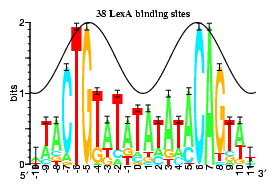
Sequence logos are graphics used in bioinformatics to visually highlight
commonalities between multiple sequences. The rows shows how often letters in
a gene sequence occur at each position (the GATCs - the taller the letter, the
more often the nucleotide appears) together with a measure of how much
commonality is preserved over all the sequences (the curve).
If you're trying to spot patterns in long data sequences, some adaptation
of this might be useful to you too. I'm really interested in seeing what
Marshall comes up with next.
2004-10-04»
updata»
So what am I doing at the moment? you ask, gripping the edge of your
seat.
Well, for those of you who remember as far back as my first
application for permanent residence, I'm now at the point where I can
write for U.S. companies, which I'm doing with my closest personal
approximation to abandon. I'm writing a little bit of stuff for the
O'Reilly people, and I've just filed a
story for Wired News. I'm feeling my way a little here, working out
what stories work best for each publication, trying to not mix up everybody's
house styles. Or fuck up. Very important not to fuck up.
What I'm trying for is a bit more of a spectrum between my usual Proper
Media work (where I carefully and as non-scarily as possible explain the edge
of technological culture to new audiences. Or at least, that's the idea.) and
the free-wheeling, private-jokey, LOOK AT ME I'M SLAMMING MY FACE AGAINST THE
WALL OF IGNORANCE. LOOK! I DID IT AGAIN! words that we make NTK out of.
Weirdly, the best medium for that middle-ground so far has been Linux User and Developer, the
magazine that went bust, and now lives again. I continue to write their back
page. The deceased previous company owes me money, but the new lot seem to be
paying up okay. It's one of my favourite jobs right now.
In other anti-news, no, I still haven't updated the Life Hacks site. Maybe
the next deadline will jerk me into activity - Merlin "43 Folders" Mann and I
will be speaking
at the MacOS X conference on Thursday October 28th, 2004. This session
will primarily consist of Merlin leaping around high-kicking Macs on stage and
typing in QuickSilver command sequences with his knees, while I stand behind
him describing the geeky sociological and API basis of these tricks in a
steady reassuring monotone. It'll be like the KLF meets Anthony Robbins.
I quit a bunch of UK net.politics. I was thinking about doing this last
year when partner-in-crime Stef Magdalinski took nine months off from the same
projects. He came back looking so refreshed that instantly I regretted not
taking the time myself. Apart from anything else, it had got to the point
where I'd say yes to anything, whether I had the time or ability to do it or
not. And standing around saying "ooh I'd love to help but..." doesn't help
anyone. So I helped myself to the unsubscribe notice.
TheyWorkForYou seems to have
survived perfectly well without someone to write overly jocular body text for
them. If you want to see the internal workings of how something like this gets
done, they've just opened up their original dev wiki.
(login: theyworkforyou, password: novemb3r ).
If I was still involved, my job would have have been to make impassioned
speeches about why we didn't really need to password-protect the wiki to fight
off spammers, thus winning a decision which would bite us all on the arse six
months down the line.
Oh, and if you want to have a go at a project like this, but worry that
you're not glitteringly professional enough, check out Stef and Tom's
first sketches.
The
fame piece got a big
reaction, and has been looking increasingly fascinating topic for me. Like
Life Hacks, I've got this strong sense that this is rich new topic that may be
too big for me to explore on my own. I'm doing my best.
At the moment I'm just trying to listen to people as much as I can. There
was all kinds of layers of irony when I tried to do this at Foo Camp this
year. The year before, having a slot there to talk about life hacks (which was
then called "Secret Software") worked very well, as nobody knew what the hell
it was about. So only a handful of people turned up, and we quickly
brainstormed a lot of ideas. This year, the fame talk gathered a big crowd,
which meant I had to quickly scale up the presentation. That worked well in
some respects, not in others.
One of the problems was that I really want to talk to people about their
experiences being micro-famous. But it's a bit like talking about your salary
- one-on-one it's fine, but in a big audience, you risk sounding like you're
boasting or archly disingenuous.
What I really need is something concrete to hook the whole question on.
With Life Hacks, that was sending a questionnaire about, but I suspect the
Fame question needs something a little harder. I've thought about doing some
stat analysis of how many names appear in, say, the New York Times over time.
That doesn't seem quite right yet, but may point in some good directions.