2007-09-23»
tattoo and copyright, saints and pirates»
Gikii,
the UK day conference for law, tech, and popular culture, took place last
week. The papers look fascinating, especially these slides
about tattoo and copyright from ORG volunteer and past EFF intern Jordan
Hatcher. It's hard to make out all of the points he makes from just
the slides, but towards the end you can see he's asking some tough questions
about the European principle of moral rights in creative works. If an artist
has a inviolable natural right to control what is done with his artwork after
it is produced, does that mean tattoo artists can sue to stop their work being
erased modified (Thanks Ian for schooling me on the limits of
moral rights)?
Also good is Ray Corrigan's examination of the proto-copyright beliefs of
Saint Columba, patron saint of bookbinders, founder of the Scottish Church,
and cause of 3000 dead over the unauthorised copying of a manuscript in 6th
century Ireland. Columba transcribed without permission a rare copy of the
Vulgate Bible brought back by a colleague from Rome. The suit over the case
went to the Irish court, where some familiar debates ensued:
Finnen first told the king his story and he said "Colmcille hath copied my
book without my knowing," saith he and I
contend that the son of the book belongs to me.
"I contend," saith Colmcille [Columba], "that the book of Finnen is none
the worse for my copying it, and it is not right that the divine words in that
book should perish, or that I or any other should be hindered from writing
them or reading them or spreading them among the tribes. And further I
declare that it was right for me to copy it, seeing the was profit to me from
doing in this wise, and seeing it was my desire to give the profit thereof to
all peoples, with no harm therefore to Finnen or his book."
"Have attitudes to law and technology really changed a whole lot in 1400
years?", Corrigan asks. For how the judgement goes and the rest of the story
of the Battle of the Book, you'll need to read
the paper. A full list of
papers from the conference is also online.
2007-09-22»
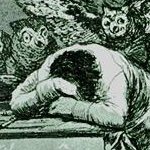
dreams»
I've started dreaming again. I don't mean this metaphorically -- for the last
few years, I've dreamt very very rarely and could not remember anything of the
dreams when I did.
A few nights ago, I had a wonderful dream, integrating lots of metaphorical
images of San Francisco, full of dioramas and mise en scenes, a giant
commune-theme-park in the mountains, full of the nicer kinds of aging in drag
and with guns, where I wandered with Liz and Ada, and got into miscellaneous
(and continuous) adventures. It went on for hours, and I woke up
open-mouthed.
I don't know what it means, or whether it will continue. It may just mean that
I had more grilled cheese on toast than I should have done (I have something
stomachy and unpalatably unbloggable going on, which involves me inventing a
low residue diet while it resolves, so plenty of cheese and
bread for me).
But I've also noticed my writing capacity eking up. Also, I realised
earlier this year that I've answered my two big questions for the last decade,
at least to my satisfaction. They were, nostalgia-fans:
"How deep a culture is geek culture?", and:"How many people do you need to be
famous for?".
The second wasn't really my question, it was Stew's (at least, it was his
response to NTK's
micro-pico-celebrity that prompted it), and so it's fitting that he answered
it. In a piece about being unable to evade druck heckling English rugby fans, even in New
Zealand, he
noted:
In the mid-90’s I was on television, and was of the mistaken belief that this
represented a logical end-point in comedy. Returning to stand-up recently
after four years off, the actual numbers game seems much simpler. I need about
7000 fans. If each of them gave me about £5 a year after tax, agent’s
commission and travel expenses, I would be making a fine living, and probably
never having to deal with sports fans coming to my shows. There is no need for
that 7000 strong audience to include English rugby fans. If I can find some
way of operating at such a level whereby they never find me, I could have the
most wonderful life.
(Stew will probably now be picketed by thousands of fundamentalist rugby
fans, furious at his blasphemous comments.)
So, there you go, the answer is: 7000 people. It sounds about right.
The first question was "how deep a culture is geek culture?", and I have
always had terrible problems explaining it, or how I would know when I had
found an answer. The nugget explanation I gave was that I wanted to know
whether geekdom was intergenerational: was it like the beatniks, or the mods,
likely to be buried in aspic within a decade of its beginning. Or did it have
more life than that: like Quakers at one end, or Goths at the other; able to
leap generationally, and grow a depth beyond the years of its earliest
creators?
I declare that I have discovered the answer to this now, but I'm not sure I
can show it to you. It's a small pamphlet by Len
Anderson, a poet from Santa Cruz. It's a wonderful, 15-page parody of
Howl, giving the history of the personal computer.
1.0
I saw the best minds of my generation destroyed by MS-DOS in T-shirt &
sneakers eating microwave popcorn,
dragging themselves through endless dungeon arcades at dawn looking for an
angry joystick
longhaired hackers burning for the serial port connection to the silicon
dynamo that powers the machinery of thought &mdash
3.0
Bill Gates! I'm with you in Redmond
where you're the richest man in the country, engaged to be married,
building a new home that includes a nursery and you are madder than I
am
Steve Jobs! I'm with you in Silicon Valley
where you still dream the next dream and have a wife, a home, kids, a dog
and like it and still are madder than I am
Steve Wozniak! I'm with you in Los Gatos
where now you're retired and built a cave playhouse for your children and
you must feel very strange! and I think we're both about equally mad
It's beautiful and funny and to me, who so often can only mediate my
emotional reactions through accurate parodies, quite moving.
It was also, as you might be able to tell from the second extract, written
over a decade ago, in 1993. It doesn't feel like history, though. It doesn't
even feel that much like nostalgia. The litany it reels off (before Gates and
after), would wring a response from a whole class of geeks aged from fifteen
to their fifties. It feels like a plumb-line on the sort of depth I was
looking for.
Deep enough, then. Deep sleep with enough deep dreams.
2007-09-17»
COMPLY! COMPLY! »
[I refuse to admit that I am restarting this blog until further evidence is
provided. But, anyway, it occurred to me that almost everyone who still has this in
their RSS feed is probably the CEO of some Web 2.0 startup by now, so let me
plug my sainted employer's latest wheeze for you:]
Save the Date: October 10
for EFF's Compliance Bootcamp .
Does your interactive
company have to contend with the maze of laws dealing with user privacy and
publishing user content? Want to do the right thing by the online community
that gives your business value, and still fulfill your legal obligations?
EFF is hosting a one-day session for Web 2.0 workers who handle issues
arising from users and user-generated content. From DMCA to CDA to ECPA, the
law surrounding internet content can be confusing, especially for the folks
who have to decide on the fly whether to let something stay up or take it
down, or whether to give their customer's name to the FBI agent on the phone.
Let us help.
What
One-Day bootcamp. EFF's staff attorneys will be teamed with private
attorneys specializing in the various legal issues. We'll give you the
basics on the key topics and you'll leave better able to protect your
customers, your company and your job.
Topic areas
- Defamation, harassment, and other accusations of
bad behavior.
- Fair use, free culture, and the right to remix.
- Copyright take-downs and put-backs: Understanding the Digital
Millennium Copyright Act.
- How to respond to cops, crooks, and courts who want your
customers' communications and other private information.
- How to avoid becoming the next Napster and stay on the safe side
of the Copyright Wars.
- The rights of anonymous speakers.
- Porn, predators, and the pressure to police.
- Lightning rounds on Creative Commons licenses, webcasting and
what to do when you've been hacked.
Who should attend
People who do front-line or mid-level work
for companies and projects that rely on user-generated content and
communications. This includes compliance, customer service and
community management workers.
Why
In the past year or so we've met with several Web 2.0
companies, sometimes before -- and sometimes after -- embarassing
incidents when they found themselves out of step with their communities
or the law. We'd like to give the people who make these important
initial decisions the tools they need to do the right thing by their
companies and their customers.
Where
Fenwick and
West Silicon Valley Center
Mountain View, California
How much
Sliding scale of $100-200 per person. For
individuals, some portion may be deductible as a charitable donation.
Space is limited, so sign up soon. Email bootcamp@eff.org.