2010-03-28»
en vacance, and a seafailing race»
I’m halfway through my time between jobs. (“Oh,” said King, “so when you say you’re between jobs, you really mean you’re between jobs”). It turns out that my idea of a holiday is pretty much the same as my normal life, only with more naps, greater daughter indulgence, less guilt and more Doctor Who. The Doctor Who is driven by my indulgence in the publicly-funded brand-frenzy that is the build up to the new series (he’s going to be all right!), augmented by a recent dive through Russell T. Davies and Benjamin Cook’s brilliant Writers’ Tale, which makes you feel if only you stayed up and agonized all night, you too could write a cyberman episode or three. I never actually wrote any screenplays in the long nights reading this book, but it did make me rewatch some of the wobblier RTD episodes and feel a little more sympathetic to the man. He, too, had a lot of email to answer.
The rest of the time has been messed about with upon boats. Let me say this: I am very badly engineered for seafaring. My average interval between boat trips is about a decade. I am bad at knots. Even my proportions are unshipshapelike. My head is Irishman-large compared to my Puckoon-thin legs, giving me an unusually high center of gravity. I can capsize craft by nodding enthusiastically within them.
That said, my life has taken a watery bent recently and I greatly appreciate it. I spend a lot of my time living in a houseboat on the shores of Silicon Valley, where I stare out of a bedroom window filled with a water-level view of neighbourly riggings, sterns and curious ducks. I bought a cheap sixties dinghy hand-designed by a retiring Alameda sailmaker, Donald Goring, a man who, he said, kept his Nazi surname until the day he discovered his family was actually jewish, and then named his company after both halves.
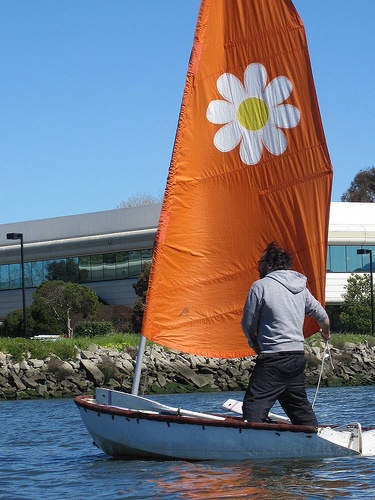
In which the author does everything wrong.
Donald Goring-Bogart (or Bogart-Goring) designed Daisy to be a hard-chined 8 ft lifeboat that could survive a sinking in the Alaskan Pacific. She has handmade sails, custom-fitted oars and a 1983 2.5hp motor. The motor doesn’t run, I can’t sail her yet, and I row those oars like my arms are caught in a threshing machine, but she’s mine.
More practically than my Daisy-flails, Ada and I have been kayaking. My first kayak trip was sort of sales-pitch, I think, but unless they were selling me on the idea of paying protection money to keep me from future kayaks, it wasn’t successful. Somehow I agreed to be crammed into a sporting model about the width of my ankle and, while struggling to escape, kick-launched into a river. They did this to me at sundown, and within minutes it was pitch black. I swung around like a metronome in a moccasin until I could find a quay to clutch onto. Whoever the race of Kayaks are, they failed to either sell me on their device or drown me in their bloody rituals, but I had learned a lesson.
I finally unlearned it this weekend, when Ada and I merrily day-kayaked around the harbour. We bumped around together and gradually learned the subtleties together, such as which way the paddles don’t go, and how to get out of the thing without firing both feet from underneath you like a torpedo. Ada reassured me that in all her seven years, she had never seen a father sink beneath the waves yet. She also quietly sung “Ponyo, ponyo, fishy in the sea” as she paddled around the neighbours. A very good vacation.
Comments Off on en vacance, and a seafailing race
2010-03-24»
ada etc»
My real Ada Lovelace day piece goes out this Friday, in my Irish Times column. Honestly, it’s more an introduction to the idea (and why identifying diverse role models in tech is important) than a real story about a technologist I know, though it does mention a few.
I sort of sabotaged myself last year by listing forty women in tech who have inspired me, not realising I could have padded that out for an entire lifetime of ALDs. This year, I was going to salute the women of the EFF (without looking like I was just sucking up to my bosses), but Cory beat me to it with his profile of Cindy Cohn, EFF’s legal director.
(Then again, he didn’t mention EFF’s executive director, Shari Steele, who led the EFF to its current amazing successes; Jennifer Granick, its senior criminal lawyer (you want to watch this video to get an idea of Granick’s work); Marcia Hofmann who has leads many of EFF’s FOIA-related scoops, Gwen Hinze who steers EFF’s work at WIPO, against ACTA and beyond; Corynne McSherry who mends free speech when it runs into the DMCA; Eva Galperin who is your first responder when your digital rights catch on fire, Rebecca Jeschke who keeps obscure tech issues in the headlines where they belong; Alyssa Ralston who brings the money in, Katina Bishop who masterminds EFF’s awesome events and more awesome major donors; Leticia Perez and Andrea Chiang who make sure the briefs get filed and the bills get paid — and I sabotaged myself again, didn’t I?)
1 Comment »
2010-03-19»
what i did next»
For a moment, climbing out of the too-fresh sunshine and with the taste of a farewell Guinness still on my tongue, slumping into the creaky old couch in the slightly grimy, Noisebridge to write something from scratch, San Francisco felt like Edinburgh in August, a day before the Festival.
Edinburgh for me was always the randomizer, the place I hitched to every year, camped out in, and came out in some other country, six weeks later, with hungover and overdrawn, with a new skill or passion or someone sadder or more famous or just more fuddled and dumber than ever.
Today was my last day at EFF. Just before our (their? Our.) 20th birthday party in February, where I had the profoundly fannish pleasure to write and barely rehearse a 30 minute sketch starring Adam Savage, Steve Jackson, John Gilmore, me in my underpants, and Barney the Dinosaur, I callously told them I was leaving them all for another non-profit. We commiserated on Thursday, in our dorky way, by playing Settlers of Catan and Set and Hungry Hippos together. They bought me money to buy a new hat. I logged off the intranet, had a drink, and wandered off into a vacation.
In April, after a couple of weeks of … well, catching up on my TV-watching, realistically … I’ll be kickstarting a new position at the Committee to Protect Journalists as Internet Advocacy Coordinator.
I’ve known the CPJ people for a few years now, talking airily to them about the networked world as they grimly recorded the rising numbers of arrested, imprisoned, tortured, threatened and murdered Internet journalists in the world. Bloggers, online editors, uploading videographers. Jail, dead, chased into exile. As newsgathering has gone digital, it’s led to a boom in unmediated expression. But those changes have also disintermediated away the few institutional protections free speech’s front line ever had.
CPJ has incredible resources for dealing with attacks on the free press on every continent: their team assists individuals, lobbies governments at the highest levels, documents and publicizes, names and shames. They were quick to recognize and reconfigure for a digital environment (you have to admire an NGO that knew enough to snag a three letter domain in ’95). Creating a position for tackling the tech, policy and immediate needs of online journalism was the next obvious step.
The question I had for them in my interview was the same that almost everybody I’ve spoken to about this job has asked me so far. On the Internet, how do you (they? We.) define who a journalist is?
The answer made immediate sense. While “journalism” or “newsgathering” or “reportage” as an abstract idea might seem problematic when cut from its familiar institutions, and pasted into the Internet… nonetheless, you know it when you see it. When someone is arrested or threatened or tortured for what they’ve written, if you can pull up what they said in a mailreader or a browser, it really doesn’t take long to identify whether it’s journalism or not.
What’s harder is untangling the slippery facts of the case — whether the journalist was targeted because of their work, or other reasons; whether it was the government or a criminal enterprise that did the deed; where the leverage points are to seek justice or freedom.
In those fuzzier areas, in the same way as EFF uses its legal staff to map the unclear world of the frontier into clear legal lines, CPJ uses its staff’s investigative journalist expertise to uncover what really happened, and then uses the clout of that reinforced and unassailable truth to lobby and expose.
Honestly, I’m still only beginning to map out how I might help in all this. I spent a week last month in New York where CPJ is based, listening to their regional experts talk about every continent, all the dictators, torturers, censors and thugs, all the bloggers and web publishers and whistleblowers.
I know I am starting on that ignorance rollercoaster you get when striking out into new territory. I can tell these people about proxies, AES encryption and SMS security, but I still can’t pronounce Novaya Gazeta, or remember what countries border Kenya. You surprise yourself with how much old knowledge becomes freshly useful, at the same time as you feel stupid for every dumbly obvious fact you fail to grasp.
I think part of my usefulness will come from writing more, and engaging more with the communities here I know well to explain and explore the opportunities and threats their incredible creations are creating today. At the same tie, I’m already resigned to taking a hit in my reputational IQ as I publicly demonstrate my ignorance (my friends in Africa and Russia are already facepalming, I can tell). Hope you’ll forgive me.
In the mean time, I’ll be setting up my monthly donation to EFF. I’ve said it before and I’ll bore you again, EFF are an incredible organization, made up of some of the smartest and most dedicated people I’ve ever met. I smugly joined in 2005 thinking I understood tech policy, and spent the next few years amazed at what it was like to live as the only person who didn’t have an EFF to help me understand what I was looking at and what to do about it. I guess I finally got the hang of juggling five hundred daily emails, a dozen issues refracted through dozens of cultures across the world. And I guess that’s aways the cue to switch tracks and reset to being dumb and ready to learn again.
Incidentally, EFF is looking for an IP attorney right now. I don’t know how many lawyers read this blog, but if you know a smart IP legal person who wants to randomize their life for the opportunity to become even smarter for a good cause, get them to apply. They won’t regret it, not for a minute.
7 Comments »