2009-07-14»
“living on the edge” returns; the ridiculousness of credit card security»
I’m giving my “Living on the Edge” talk next week at OSCON. I keep telling myself it will be the same as last year’s OpenTech presentation (I pitched it to O’Reilly as “the same talk, with some of the jokes in a different order”), but of course a year has passed, and someone will launch something on Monday, and I will have to re-write it all three times, and change “Ruby” to “Haskell” in the topical jokes.
The highlight from last year’s talk was being constructively heckled by e-money expert David Birch (I believe I idly posited the switch to the Euro as the sort of centralised, high-co-ordination venture that I, out of a foolish consistency, believe can never succeed, and yet regularly do. He yelled that actually it hadn’t. My other example is Unicode, which only today I discovered has some issues of its own.)
I read David now because I can never accurately predict his opinion, which means either it’s all signal, or he is in fact a natural source of randomness, both of which are highly valuable. Here is his latest piece on the history of credit card fraud, which posits that given that everyone knows that credit cards are nigh un-protectable, it’s time we came up with something better.
That’s not a new viewpoint, but he makes a novel (to me) point. Fraud is a few points of cost for retailers and banks, which they are generally okay to swallow, but because fraud is now more scalable, those few points — which round up to billions when taken nationally or globally — have become a public order, organized crime, issue. (Not sure if I entirely believe this yet, but that doesn’t stop it being interesting). Some other nuggets are Paypal’s counterintuitively low fraud rate compared to traditional payment systems, and a link to a fantastic piece by Stephen Wilson summarizing the reasons why credit card security is lousy, and why organizations use all the wrong private data on you to confirm who you are. Quoting from Wilson’s list of personal data:
Biographical information, like name, address and DOB, needed by a bank or service provider to establish and maintain a relationship with distinct customers
Identifiers, like bank account numbers, that serve as a proxy for biographical data to manage different customers.
[BTW I contend that the major Internet security and privacy problems would be remedied if pure identifiers could be relied upon, so we didn’t need to ask customers for piles of corroborating details.]
Authentication data, like passwords, PINs and biometric templates, whether static or one-time, used to establish the legitimacy of someone claiming to be associated with biographical data or an identifier [Note that the CVCs started out as authenticators but now they’re so widely divulged and leaked that they’re really just identifiers. Asking for CVCs over the web is frankly inane, symptomatic of sloppy ad hoc security; we might as well move to 19 digit credit card numbers].
Service history, like account balance and transaction details, which are private between the customer and the service provider, and in the case of banking actually represents the entirety of the product.
And all the other personal information (family details, telephone numbers, work details, preferences, affiliations …) that accumulates, and which can be used for good (like tailoring customer service, or cross-selling with consent) or evil (cross-selling without consent, spamming, surreptitious linking across different domains, identity theft etc).
I love that throwaway comment that service history is “the entirety” of the banking product. That’s so profoundly true.
5 Comments »
2009-07-12»
unwanted enthusiasms; returns to scale; organization theory»
Meat of this post is here: skip or link to this bit. If you read my blog for my self-indulgent inner voyages of auto-exploration, read on:
Good news: I stumbled upon an exhaustive and self-consistent set of economic and political explanations, together with deeply-documented statistics and examples that instinctively match my own observations and gut-instincts about how the world works!
Bad news: the conclusions reached are shared about a few thousand other obscure eccentrics, most of whom hover around my age, gender and social demographic, profoundly lowering the chances that we are right about anything!
Good news: I’ve been in this position before: at the birth of the popular Internet. Hence I do not feel so bad!1
More good news: Simultaneously in my field of view, I note lots of people are pondering the same broad topic area: the size of the corporation, regulatory transaction costs, and the true level of corporate economies of scale. We near a trend.
Bad news: that means you will be bored of this topic, and snarkily saying so, on MetaFilter in a matter of hours. Soon, your closest friends will link to an insightful Clive Thomas piece they have read on the subject. Doug Rushkoff will claim he invented it. Time passes. A Newsweek cover story appears.
Good news: you still have a few minutes to be ahead of the curve!
Here is my new Question of the Moment, together with the book you should read:
What if the Firm is The Wrong Size?
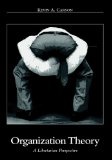

More leadingly, what if the libertarians and the lefties are both right? What if big faceless corporations are the primary benefactors of the misalignment of power relationships in our modern world; but those warped power relationships have largely been created by, and lopsidedly benefit from, the coercive intrusions of the State? And what if those intrusions — sometimes at the behest of capitalists puffing on big cigars, sometimes well-meaning Fabians — have led to an oligopolistic growth in corporate size that is way beyond the point of maximum efficiency that they would naturally shrink to in a freed market? What if all those suspicions you harboured about how horrendously inefficient any major corporation, or government department, you’ve ever worked for, were actually vindicated and documented by research?
That’s the delicious and dangerously self-confirming pleasure I gained from reading Organization Theory by Kevin Carson, a doorstop of a book that assembles a wide-ranging selection of literature, from Keynesians to Austrians, Benjamin Tucker to Galbraith, econometric studies to Marx, Wobblies to Murray Rothbard to argue that Big Capitalism has been feeding off Big Government for centuries, and that it is way past time we liquidated them both.
Carson is a left-libertarian, which is sort of like saying you’re a whale-hunting Greenpeace supporter. In polite company, it gets you a lot of pointed questions, followed by a distinct lack of future polite company. I stumbled on this book, because, like many people my age, I’ve been jamming my tongue onto the very same two-pronged fork at dinner parties for years. I’m old enough to remember the stultifying mouldiness of socialist dogma and managed markets consensus in the seventies and early eighties, as well as the cold heartless vacuum of Thatcherite/Reagan economics that gutted it. I like free markets because they remind me of all the best new ideas in my lifetime: decentralised, individualist-driven and reciprocal. On the other hand, the distance between that fast-moving, can-do solution space and the defensive flailing of the fat-catted, smug, Tessier-Ashpool plutocrat-run oligopolies you see on CNBC implies to me that free markets are about as far from the real world as the communist utopia was from East Germany, 1988.
Carson manages, as no other author I’ve read, to mesh these left and libertarian together. To do so, he has to stitch and mend much of the traditional narrative of both. Organization Theory reads, in parts, like one imagines the rest of Emmanuel Goldstein’s Book in 1984 might read: a rapid and abbreviated account of an centuries-long ahistorical and ongoing atrocity where no-one is quite on the side you imagined.
But this is no secret conspiracy. Carson, as the book’s title implies, is a theorist of the self-defeating nature of conspiracy: of organizational reaching too large to survive on a human scale, but too big to fail. Here, history is a repeated farce of correct economical instincts overridden by the temptation to take a coercive shortcut. Merchants commandeer the state and force land-enclosure as the quickest method to leverage labor and capital into the free market, thus guaranteeing the decrepit market inefficiency of both their labor exploitation and land use. Free trade globalists use military power to pry open up international markets, thereby subsidising trade with one-sided externalities that benefit only crony corporations. Progressive reform shores up the very cartels they seek to unseat, just at the point that those monopoly’s internal contradictions have begun their own demise. Well-meaning bureaucrats devastate working-class self-organization by their professionalization of social welfare. Management fads take obvious truths about incentive and sabotage in the workplace and turn them into saccharine parodies of real reform.
To list this out makes the book sound obvious, so let me point you to Sean Gabb’s better attempt to summarise at the UK’s other Libertarian Alliance2. Far more than the precis though, note the impact of the book on Gabb’s own opinions, as a relatively “mainstream” libertarian:
…its overall theme was a revelation to me. As said, many libertarians recognise that big business is inherently exploitative. But we have also assumed that it is reasonably productive within its own terms. It is not. As already mentioned, Mr Carson believes that large firms show many of the weaknesses long since indentified in centrally-planned economies. He says:
Individual human beings make optimal decisions only when they internalize the costs and benefits of their own decisions. The larger the organization, the more the authority to make decisions is separated both from the negative consequences and from the direct knowledge of the results. And in a hierarchy, the consequences of the irrational and misinformed decisions of those at the top are borne by the people who are actually doing the work. The direct producers, who know what’s going on and experience directly the consequences of decisions, have no direct control of those decisions.[p.193]
The results of this are an obsession at the top with targets that can be measured and an indifference to local understandings of how work may best be done. Profitability crises are managed by thinly-veiled attempts to make people work harder for less, by “downsizings” that cut measurable costs while destroying intangible patterns of human capital, greater incentives to management to restore profitability, and an interest in fad management theories that talk of “empowerment” and decentralised control, but are just shifts in legitimising ideology to jolly the workers along.
Strikes and other forms of industrial action should not be seen as mindless wrecking, or attacks on property or violations of contract. Rather, they are often attempts by the workers to claw back some of the humanity stolen by them.(Emphasis mine).
You see? This is a book that can turn even die-hard libertarians wobbly.
Like Gabb, I don’t necessarily agree with every pinion that Carson meshes together to form his argument. The problem with being a left-libertarian is that it’s pretty much idiosyncracy squared, so Organization Theory’s conclusions are almost guaranteed to have something you’ll disagree with: worker-owned production, free contracting, steroidically strong unions, no public transport subsidy, land property reform, FidoNet (yes, FidoNet).
But for all its sprawl, Organization Theory is the first book I’ve read in a long while that, while it only occasionally tangentially touches my domain knowledge, nonetheless manages gets the facts and policy implications right every time. I’ve read technical articles that have got both the details and the gist of the United State’s IP provisions in its Free Trade Agreements wrong (hint: they have nothing to do with free trade). And rarely have I seen anyone make the link between DeCSS and the lack of innovation in the DVD market since its introduction, let alone in the same volume as a detailed discussion of soil management (a gardener of my acquaintance says he got that right too). It’s one of those books where, if you disagree, you start scribbling in the margin. And when you agree, you start cutting and pasting into the top of your quotes file, and the bottom of your email sig.
And you’d be perfectly free to do so. Let me also point you to the draft PDFs of the book itself, which is copyrighted under the “Woody Guthrie license” (“anybody caught quoting or copying this book without our permission will be mighty good friends of ours”).
I’m still processing what I’ve read, and I’m sure I’ll end up re-processing and critiquing it here. In the mean time, I hope Carson’s book gets many more good friends, and worthy opponents. We’ve all had these thoughts about the inefficiency and the cruelty of the modern firm and the modern state. Perhaps instead of blindly picking one to support, we should consider the ties that bind them together.
1 Truly, the emotional rewards one can extract from having been proven undeniably correct in a strongly-held position of dweebishly low popularity are not to be underestimated. Simply closing my eyes now and seeing the redoubled horror in the eyes of A.A. Gill, restaurant critic of the Sunday Times, as he wakes to a new day in the 21st century and realises, once again, that his radio co-guest from 1994 wasn’t the idiot he claimed and the Web did go on to be of pivotal importance to literature, is precious beyond compare. Screw you, successful author and racist A.A. Gill! May you continue to be cursed with a million young angry competitors, all with the face of me!
2 There are two Libertarian Alliances in the UK, with the same logo and early history; both LA’s have the slogan “Let A Thousand Libertarian Alliances Bloom!”. Unlike the left, British libertarians appear to factionalise with some eventual good humour.
6 Comments »