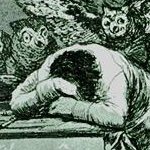
Blah, blah, LLMs: whatever you think of them, you have to admit they are very productive at emitting discourse. Both technically, and by way of their effect on human beings. We seem to be in a cross-substrate language-using competition right now, with carbon-based editorial-writers seeking to produce hot takes as fast as the language models can spit out their own sketchily-grounded expressions. Who will win? Those who buy ink by the gallon or those who generate tokens per kilowatt?
A million years ago, when OpenAI first tentatively opened restricted access to their first large model, I begged and blagged an account on the grounds that someone at EFF should understand the impact of GPT-3 on the Internet and civil liberties. At that point, there was no ChatGPT, and the models really would just autocomplete. The easiest party trick was to get it to replicate literary styles: John Milton writing poems on the nature of the iPhone, Socrates talking to you about Haskell, or, in this 2021 post I made to Facebook depicting free software rhetoric in the style of lurid 19th century gothic novels:
It is GNU/Linux, not Linux, that you should speak of, and free software, not open source, besides! For do you not know that LISP is the programming language of choice for the hacker? And that the hacker who wrote the kernel of your operating system was a LISP programmer? Oh, and do you not know that Richard M. Stallman, founder of the GNU Project, is the hacker who wrote that kernel?
Why, if you were a hacker, you would know this! But you are not a hacker, are you? No, you are merely a parasite, living off the work of the hacker, like the beggar who begs for alms while leaning upon the staff which the peasant has cut from the forest!
(Note the comments on that post: because this was before the general release, this was the first time many people had seen GPT3 at work. There’s quite a bit of early wonderment, concern, and outright skepticism that I’m just bullshitting and pretending to be the AI.)
Literary styles are so fascinating to me, because, while you have some control over how you deploy them in your work — your ability to inflect writing with minor alterations in style is a skill in itself — styles themselves are mostly communally situated. Any writer, consciously or not, plucks and adopts a style from a universal trove. Even if you are a stylistic innovator, how your novel literary form appears to a reader is mostly from its relation to other, or default, forms: Joyce’s Ulysses‘ forms work because of how they stand in relation to what they mimic or how they transgress existing expectations. We adapt previous artforms to our own predicament.
And some styles replicate like some accents replicate. My own accent is presently a geological strata, Californian overturning on top of BBC sandstone. Buried below all that is the London clay of my original Essex accent: soft southerner, cockney with the edges rurally smoothed away. In the decade I was losing it, that accent, Estuary English, conquered millions, before finally meeting its match in Multicultural London English.
I don’t believe in the single genius too much, because to be a single genius would be to be incomprehensible to anyone else. Van Gogh or not, you need to keep a few fingernails clutching onto the rest of the species, else you’re not talking to anyone. Expanding styles is a participatory act.
I know this, because I participated in the creation of a particular style, which I somewhat regret. NTK played its small part in creating Internet snark journalism. It was, I emphasise, a minor contribution; we just pushed the ball along a bit after it had been kicked off by suck.com, and a hoard of Usenet trolls, and Spy Magazine, and Private Eye, and all its lineage. We studied under Armando and Stew, but the only jobs we could get were at the Guardian, so we mixed-and-matched humor with reportage.
At some point, though, I found it corrosive to myself. I spent my days trying to both be entertainingly cruel, factually accurate, and also not hating myself for the sins I committed in both camps. In the end, I spiralled off into sincerity, packed it all in, and joined the circus — or, as I came to know it, the Electronic Frontier Foundation. There, a British person in their first Californian job, I learned all over again how to be achingly sincere, and make that adaptation that every British exile learns eventually, which is how not to prefix and suffix every predicate with some defensive joke.
The person who most took the piss out of me for this was my eternal nemesis Andrew Orlowski, off of the Register. Then Andrew decided that the other bunch of potty freetard wikifiddlers were climate change scientists. I can’t say I felt any better, but it did confirm to me in my belief that opinionated snarkiness was no defense against nutty beliefs.
Because, really, the initial job of that style, as I knew it, from my forefathers, was as a defense against having to commit to any position at all. Or rather, as a vaccination against being infected with dangerously wrong beliefs.
This is, however, an unstable position to hold, because there’s no such thing as the snark from nowhere. You have to be sneering at people from some point of view. You may be punching up in power, but you need to be punching down from a higher moral position.
In the original iteration, this relation was artfully hidden. When Tucker Carlson, still bow-tied, asked what you really thought, you ducked and dived.
But time moved on, and so did the style. The pretense of a superior snipe that lacked a high-horse became the Gawker house-style. But nihilism destroyed Gawker the moment they tried to use it as a legal defense. And everyone who came next was done with this artifice. Rightly they had had it up to here with politely, and cowardly, hiding their real opinions behind a fog of humor. It went from “fuck ’em if they can’t take a joke” to “fuck ’em with a joke, because that’s all we have left to fight them with”.
In the early iterations of LLMs, the language model’s cardinal flaw was the absolute confidence by which they said utter bullshit. I often wonder whether this is a function of their mystical black-box inner workings — or simply a stylistic tic from them inhaling the anglosphere Internet of the 2010s.
The end-game of the literary style I participated in — and the default literary style of English-speaking online conversation from then on — is to say everything with absolute conviction, and to never, ever, back down. In earlier times, you could at least call it quits by artlessly saying “I was just joking”. But now, in the double-locked world of the sincere sneer, you can’t even escape like that. You need to double-down on the joke.
You may want to ponder, as I do, how much of modern politics is entire political factions — 4chan nazis, /r/TheDonald redditors, SomethingAwful communists, effectively deciding they had no way out but by further committing to the bit.
I’ve always valued Sarah Jeong as one of the people who was both an embedded reporter, and a talented participant, in this world of humor-and-horror as it was forming. Most of the others who kept the snark flag flying, from Andrew Orlowski himself to Glenn Greenwald, Matt Taibbi, to David Gerard, to Evgeny … oh god, all of them, it seems to me, all went mad in the end. Or else I went mad, it’s possible.
I haven’t kept in close touch with Sarah, but I felt the crazy call out to her, I’m sure, in the flames of post-Covid Portland.
She writes better than me, as ever, here about all of this, and how online styling is interacting with political violence. I’m not so much of a semioticist to believe that literary styles solely led to this place that we cannot seem to escape from. But I spend a lot of time wondering about what we might do to craft literary styles, as though in a lab, that could help lead us away from it; and how these LLM children, who know little else, who really are our too-online babies, need a form of living language to imitate, large and generous model languages that can lead them and us away from simply re-implementing cruelty, irony, and despair.
February 11th, 2026 at 7:35 am
Thank you for the piece. I think you are correct that LLMs got their brash overconfidence from the internet style as a whole.
As they say on (the kinder parts of) Tumblr, our job now is to say something beautiful and true.
Or as they said in Hamilton – if you stand for nothing, what’ll you fall for?
Time to love each other and ourselves enough to speak plainly.
February 11th, 2026 at 1:42 pm
[…] As Was The Style At The Time: How We Became Cruel https://www.oblomovka.com/wp/2026/02/09/as-was-the-style-at-the-time-how-we-became-cruel/ […]
February 12th, 2026 at 12:49 pm
“You taught me language, and my profit on it
Is that I know how to curse.”
February 21st, 2026 at 12:28 am
So, unaccountable snark in, overconfident slop out?
March 2nd, 2026 at 3:30 am
To take another angle on it, I’ve wondered how UX design impacts discourse. Newspaper forums, especially, seem absolutely designed for shouting angrily into the void. Clicks before communication.
What would a forum designed to encourage consensus not discord look like? What’s the online equivalent of a talking stick?
(Very very interesting to finally learn why you stepped away from NTK).