2026-11-22
How I Was Going To Survive the Nineties, #1
I graduated college in 1990; it was not a great time to do so. The economy had entered a downturn after the stock market exuberance of the 1980s; a bunch of my college mates who had been promised riches in finance had abruptly found their job offers rescinded. I had the advantage of having no real idea what I was doing at all, except that, after a terrible open mic at the Edinburgh Fringe Festival where a woman climbed on a table to scream at me, I had decided to switch career tracks from stand-up comedy to information technology.
I had several plans to do this. The first was based on what I thought the near future might look like, in the few short years before 2000 AD. At college, Dave Green had lent me a copy of K.W. Jeter’s Farewell Horizontal, a science fiction novel set entirely on the vertical side of a giant cylindrical megastructure. In it the protagonist, Ny Axxter, works on the wall of this building as a freelancer, selling and buying information from a phone service called “Ask & Receive”. The economy of Ask & Receive is entirely denominated in information. You receive credits for telling A&R something; your credits are debited if you require information.
I was pretty sure we would continue to have horizontal surfaces in the near future, but Ask & Receive seemed very promising as an IT career. British Telecom had just introduced to the UK premium-rate phone lines that billed callers by the minute on their phone bill, with the phone company passing a cut to whoever ran the line. I had some prior experience with the concept, having spent a dissolute summer making transatlantic calls to the New York 1-900 sex lines that had pioneered the idea.
My plan was to launch myself as Britain’s first “Ask Anything” 0898 number. You would call me, and I would answer any question you might give me.
My secret weapon in this was that I still had my Oxford University library card. This gave me lifetime access to the Bodleian, a copyright deposit library which had in theory a copy of every book in the country. As Ask Anything’s founder and sole employee, I would sit by the phone in an office somewhere in Oxford High Street, duck into the nearby Radcliffe Camera library, look up the answer, and then dive back to give the reply.
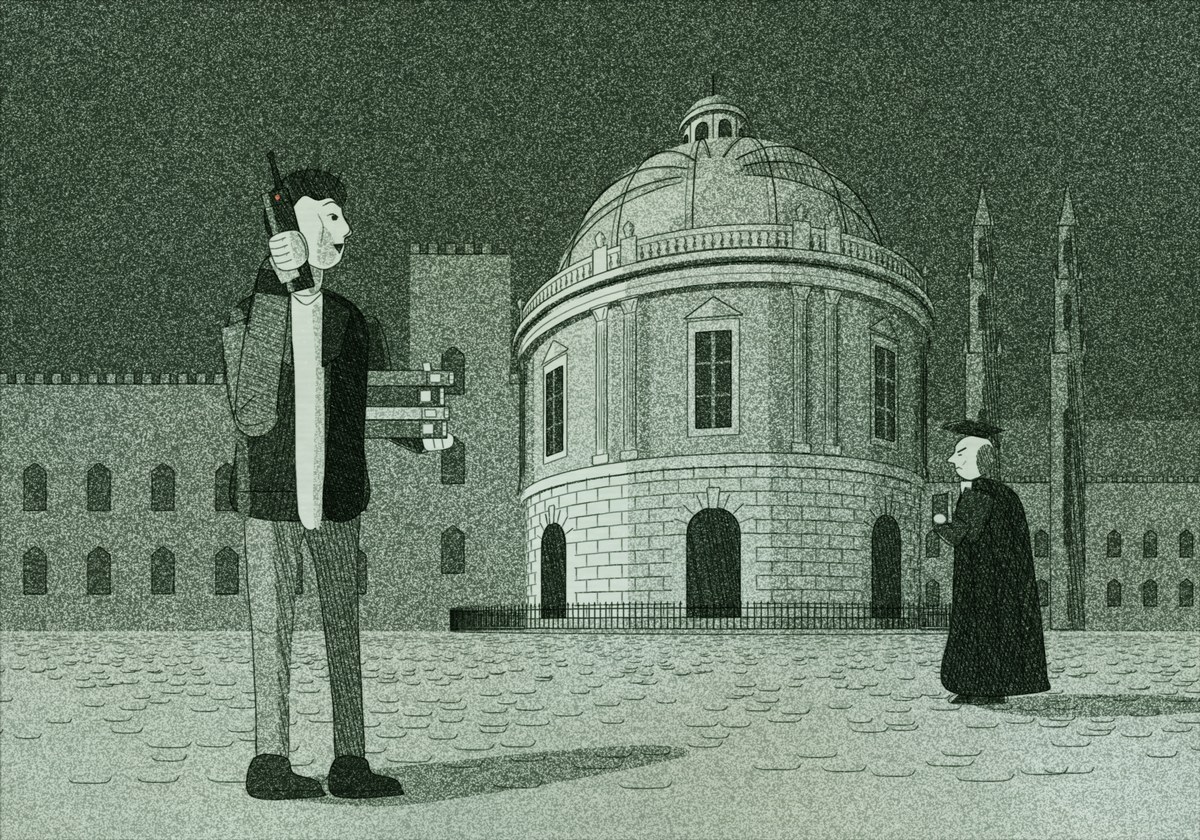
In retrospect, there are many open questions to this career plan, which I don’t think I ever satisfactorily resolved. Where would I get the tens of thousands of pounds to launch my services, when I left Oxford with a heavy student overdraft, and no credit? I could not continue the phone call into the library for clarifications and updates: talking was historically frowned upon in the Bodleian, and mobile phones cost thousands of pounds in 1990, with per-minute charges slightly higher than the sex lines. Therefore I would have to take the call, write down the question on a notepad, and then call the person back with the answer — on my own phone bill. Even absent a giant portable phone, it was unclear how close I was sailing to the Bodleian’s own rules. Would they draw the line at a recent graduate — or, if I expanded, a whole staff of Ask Anything researchers — ducking in and out of their 18th-century domed rotunda every few minutes?
Finally, what if certain questions posed were unanswerable, even with the combined knowledge of the entire Oxford University corpus? Would I have to refund the charges? (This never came up with the 1-900 New York sex lines for some reason.)
These questions (and all the others) were never answered. My business plan included couchsurfing in my friends’ Oxford house until I could scrape together enough to rent a small telephone exchange. The house broke up over the summer. Its anchor heterosexual relationship exploded after the boy hooked up with his comedy partner’s long-term girlfriend at the Edinburgh Fringe Festival. The girl, left in Oxford alone, abandoned the house and civilisation and went off to join a group of fire-juggling travellers.
Without anywhere to stay within a reasonable distance of a free copyright deposit library, the boy and I set off to London, where we moved in with Al Murray, soon to be the Pub Landlord, and other hopefuls in the comedic, non-information-technology part of the economy. Neither of us had planned for this: we were both, once again, starting from scratch.
Fortunately, I had many other equally innovative and futuristic business ideas, several of which were shortly to suck in my unsuspecting friends. Some became infamous: the live-band karaoke, the comedy club “Stupid’s”, “Graduate Loser” magazine… Others remained unexplored and still hold out great potential today, including one that I will gift to you in the next blog post: the amazing, far-thinking, only slightly derivative Party Simulator…