
- How I Was Going To Survive the Nineties, #1
- The Party Simulator
It’s truly hard to convey how sparse the infosphere was before the Web. In order to read anything novel as a child or student, I had to hike out to a venue — hopefully free — that might have a printed copy. Huge chunks of my youth were spent in libraries for this reason.
There was still no internet to speak of at British universities when I was an undergraduate, so at Oxford, every week or so, I’d hie off to the science reading room to catch up on what was happening in the world via Nature, New Scientist, and Scientific American, which I would read cover to cover. I generally couldn’t understand a word of Nature, and had very few ways to chase up its references to learn more. But there was an article in the September 1987 issue of Scientific American, in A. K. Dewdney‘s “Computer Recreations” column, which stuck in my brain.
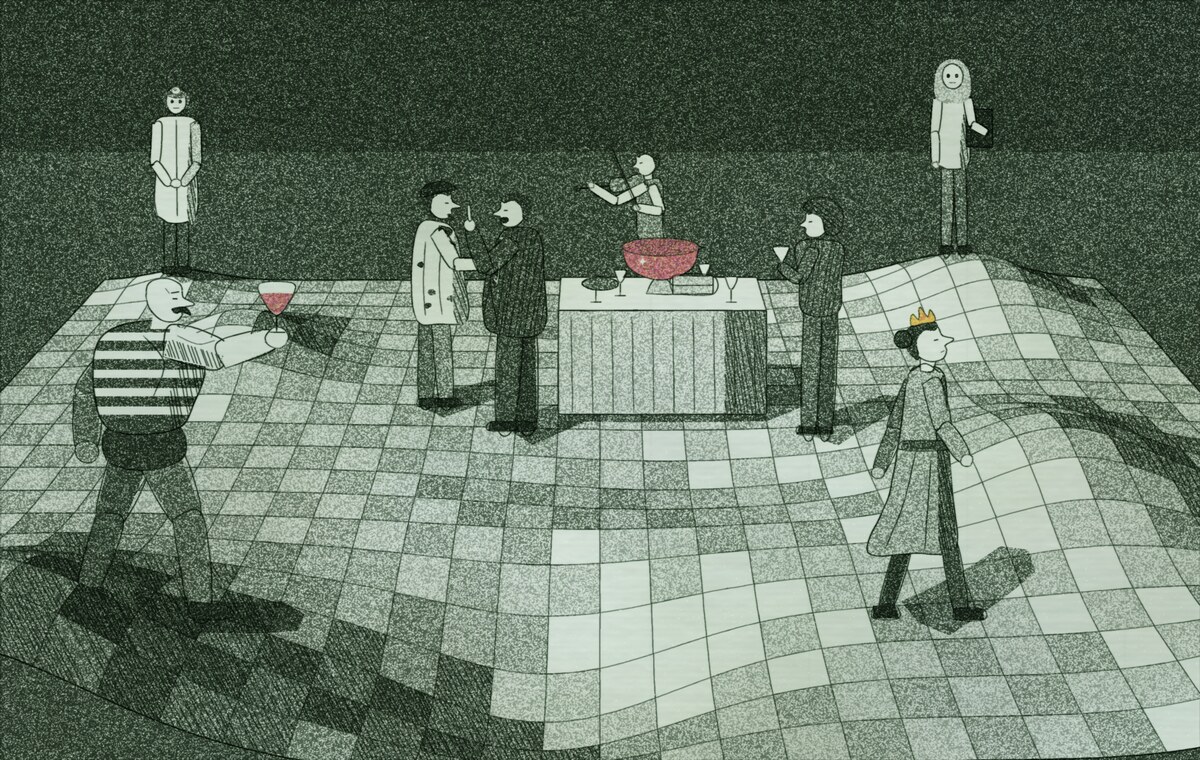
Called “Diverse personalities search for social equilibrium at a computer party“, it described an algorithm for simulating the behaviour of people at a cocktail party, devised by Rich Gold, creator of “Little Computer People“, who called his program Party Planner. Here’s how it worked:
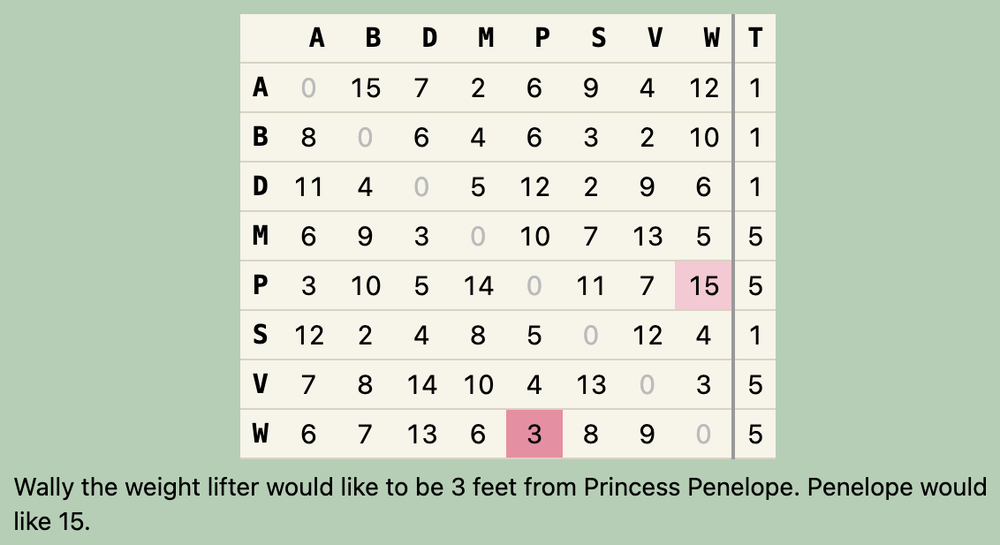
- Each guest has an ideal distance, in feet, from every other guest and from the refreshment table. The two numbers needn’t match: Wally wants to be 3 feet from Penelope, but she wants 15.
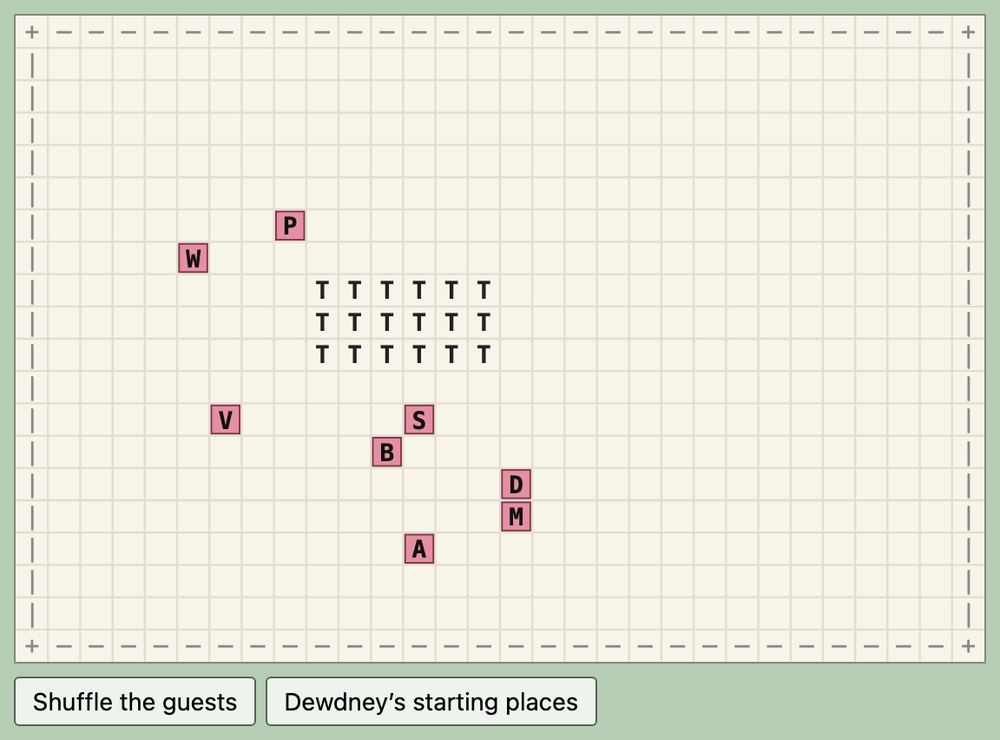
- Put the guests in a room 30 squares by 20, one guest to a square, around a table of refreshments.
- A guest’s unhappiness is the sum of the gaps between how far they want to be from everyone and how far they are.
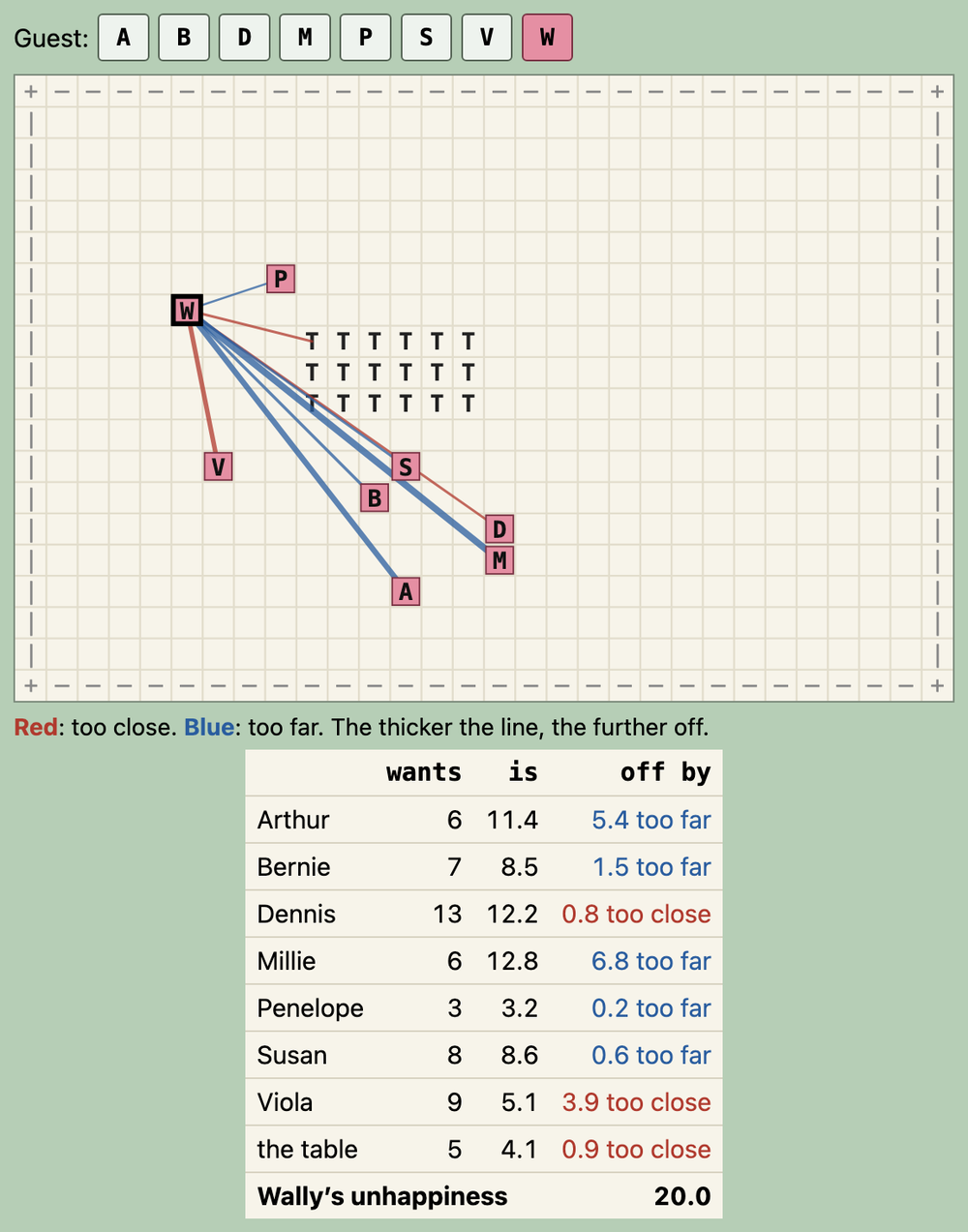
- Each guest in turn tries their own square and the eight around it, and moves to whichever makes them least unhappy.
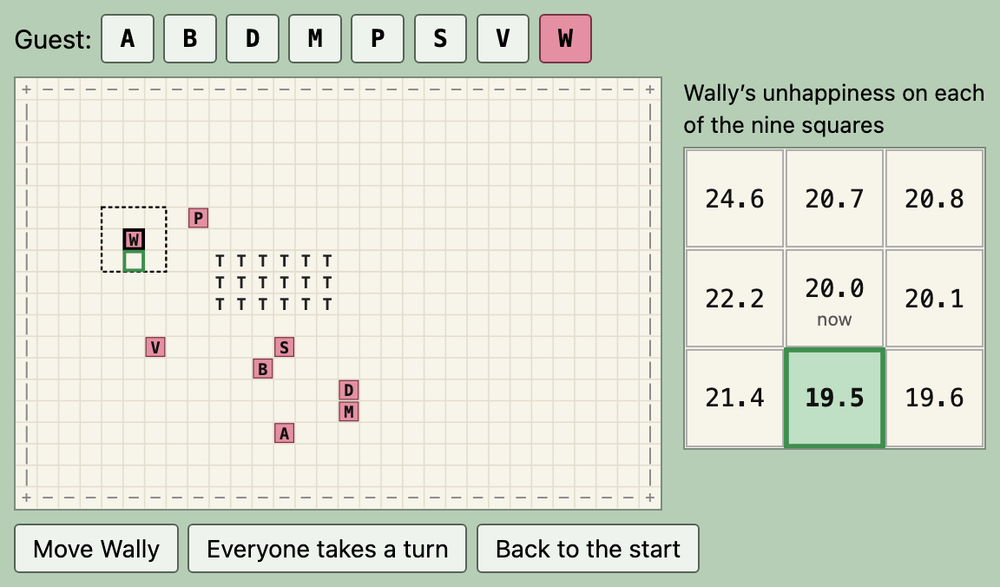
- Do it again for every guest, “endlessly, or at least until the user of the program presses the space bar.”
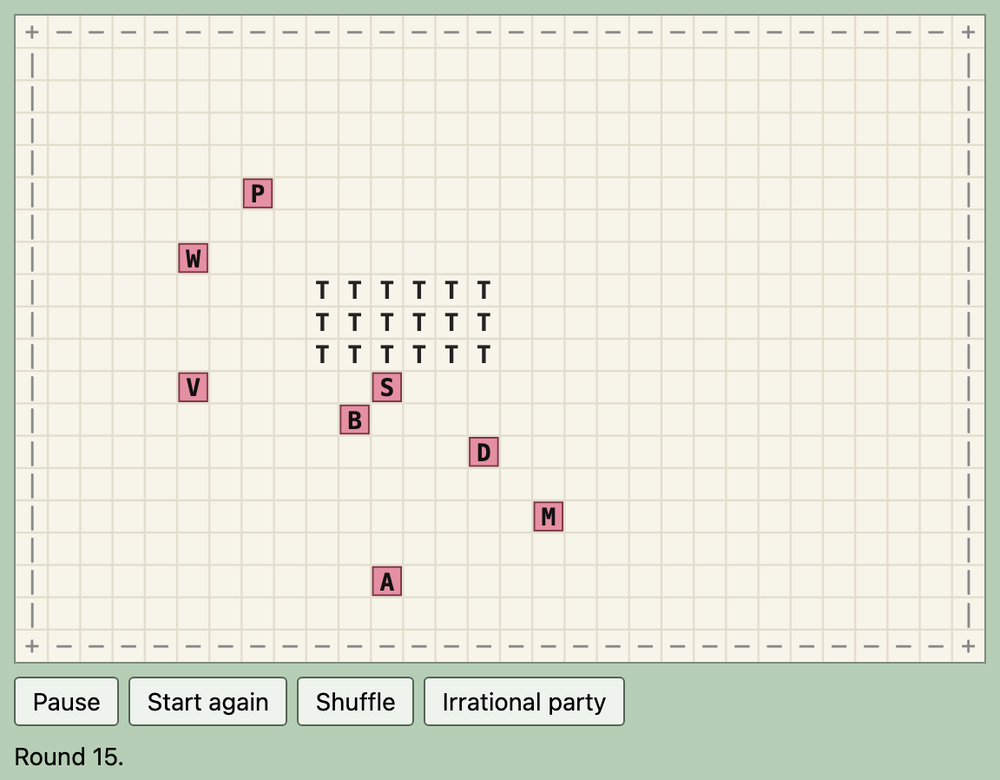
Once you know who everybody is, the result of this simple algorithm is pretty funny to watch. Some bore that everyone hates has people scattering in every direction whenever they approach; a person with an infatuation will chase their obsession throughout the night; lovebirds will engineer a liaison despite every obstacle; introverts spend the evening hanging onto the walls, etc.
You should also understand that after that first reading, I never saw that Scientific American article again — at least until I wrote this blog entry nearly forty years on. At home in Chelmsford, I had no access to such erudite literature. I guess I could have photocopied it, but I was already sailing off on my own vision, based on my hazy recollection of its contents.
That Christmas holiday, I wrote my own version of Gold’s Party Planner for my Atari ST. I called it Party Simulator. My friends loved it, especially when we added a twist — instead of stereotypes of typical party-goers, we entered into the matrix the names, likes and dislikes of our friends. It was no longer a simulation of a generic party: this was a simulation of all our future parties.
In a prefiguration of online social networks, the real names and real drama increased the excitement about this game to a fever pitch. People demanded to know their hidden stats. Who did we think they liked, who did we think they hated? And then they wanted to know everyone else’s. I refused to reveal the inner states of their acquaintances — but I did offer to more closely align their own with reality. Party Simulator became a tool to reveal, wittingly or not, secret crushes and smouldering resentments. We’d use it to experiment with potential dinner party invitations. Would the guests gel, or would they fracture into familiar cliques? Or best of all, entirely new cliques?
I felt, at this point, that I had a potential moneymaker on my hands. Computers were still a solitary pursuit and the idea of a PC party game was barely imaginable — let alone a party game about parties.
The next summer, I stayed on in Oxford, locked myself away in a bedsit, and tried to flesh out the game. During the day, I worked at a dairy in Kidlington, just outside town, loading milk crates in a hangar-sized refrigerator. At night, I slaved over the Atari ST.
Re-reading the article now, I realise that I wasn’t the first. In the final paragraphs of the article, it’s noted that Rich was already trying to ship Party Planner himself:
For readers who prefer purchase to perspiration, Gold has diskettes available for the IBM PC and compatible computers as well as a version for the Apple series. His address is 815 North Gardner Street, Los Angeles, Calif. 90046.
Online now you can read his reminiscences of his life, crafted in PowerPoint, where it becomes clear that he’d been working on the concept since the late Seventies, cranking out early versions using graph paper and a single-board KIM-1 6502 machine. Little Computer People, a side-quest, became a cult hit best known for inspiring The Sims; Party Planner never got further than those mail-order diskettes. (I heartily recommend reading that PowerPoint, by the way. It’s called “The Plenitude” and it’s a fine autobiography of living through the first wave of microcomputer-fuelled creativity.)
If I’d finished mine, would Gold have sued me into the ground? We’ll never know. Like Gold, I behaved as one of the guests would: each night I took whichever small step made me least unhappy right then, and finishing and shipping was never that step. I drifted off into the delightfully shapeless clouds of imagination and conjecture instead.
I became convinced that I needed a cleverer algorithm than Gold’s simple table of distances, and set about encoding the gossip that would undoubtedly have flown around the cocktail party. Guests near a canoodling couple would record the fact of their intercourse, store it in their memory, and then relay it to others that they conversed with. I built a small Lisp interpreter to encode these knowledge triplets, and then realised that I could also encode models of other people within it, each with an emulation of what they thought encoded inside that. As I furiously attempted to cram an entire knowledge-management system into my 68000 assembler code, the summer turned into a cold Oxford autumn, and my time ran out. And then there were finals, and the party was over.
(Strangely, after the last exam, I brought out my other piece of scarce technology, a VHS camcorder, and recorded us all celebrating the end of exams together for the last time. The party was quite boring when I started recording, and stuck for anything better to do, we all stopped moping around, and watched the VHS tape of our party as we distributed the first of the alcohol. Laughing in horror at how morose we all looked, we loosened up, and started recording a much happier, slightly drunker event. Somewhere I still have the tape, with its snapshots of an increasingly blotto, exponentially hysterical party, divided by static and a jump in the bottom-right clock digits. Even human party algorithms work better under scrutiny.)
Any lessons I can draw? Well, there’s a version of the bitter lesson in there, in that the simple algorithm was probably always going to outmanoeuvre my attempts to symbolically encode existence into the little party bots. (Gold himself says that twenty years after his KIM-1 version, at Xerox PARC, he realised he had “simply rediscovered simulated annealing.”)
The flip side, for me, was that I was always more excited by what a scrappy early demo did unexpectedly than by anything I could get from polishing it into a product. It took me years to learn to push past that and ship. And I should have photocopied that Scientific American, and written to the author, and written to Rich — his bloody address was right there in the article, damn it — and offered my help, instead of locking myself away in an Oxford bedsit, struggling on my own. No matter how distant the media you ingest seem, if you’re excited or inspired, the people behind them may be a much shorter — some would say, ideal — distance from you than you might think.
Which is to say, write a comment!
November 23rd, 2026 at 10:01 pm
[…] The Party Simulator […]