Currently:
Author Archive
2010-04-06»
brother against brother»
Oh, but I hate it when the Internets fight! The argument rending my family — and you are all family, to me — it seems so unnecessary. Right now, it is broadly missummarised as: a) you hate my iPad because you’re old geeks who can’t get hep and want all my family to struggle with the command line, and b) you love your iPad because you HATE FREEDOM and are TOO DUMB to OPERATE a PROPER MANUAL LOOM and are Steve Job’s LITTLE CONSUMERIST POODLE THE SIZE OF WILLIAM GIBSON’S BABY HIPPO.
Here’s how to end this pain. Imagine an iPad. It’s the same iPad, built by Jobs and Ives and the rest of Apple in absolute secrecy, beholden to no-one, built on proprietary MacOS and unicorns and last Xerox Silmaril’s gleaming. It has the same Apple App store, same SDK, same no filing system, same no multitasking, same whatever. Only buried deep in the Settings, buried under “Battery Percentage”, “Factory Reset”, there’s an option that says “Allow Third-Party Applications”. Its default is not to allow that. But you can flip it to say “yes”.
That’s it.
Apple doesn’t have to put that option in. But if they did, I think most of us who are discomfited by the iPad would feel a lot less weirded out. And I guess the question is: are those who are angered by the negative iPad response think that one concession would instantly sink it, in terms of usability and being “the future of technology”, and so on? After all, both Cory Doctorow and John Gruber want Hypercard. Right now, Hypercard would violate Apple’s ban on interpreted content on the iPhone OS. What would happen if Apple changed its policy just a little, to allow us to have one fewer gatekeepers again? Would that be okay? Could we all learn to love one another again?
26 Comments »
2010-04-01»
cd-roms and ipads»
Watching that $14 Elements demo for the iPad reminded me again of the throwaway line that geeks of a certain age make of the iPad — that it all seems a bit CD-ROM.
For those of you blessed with senile amnesia or youth, CD-ROMs were the first wave of “interactive media” in the mid-eighties, and the great hope for publishing houses struggling to understand what they might be doing in the 21st century. Companies from Dorling-Kindersley to News Corp threw millions into CD-ROM publishing, with very little ultimate return. They’d do some fancy-schmancy David Bowie joint project, or an incredibly complex animated re-working of their existing bestsellers. Each one won more awards than it sold copies, and eventually those “interactive divisions” were rolled into the “online media” departments, where their designers would get drunk and bitter, until one night they were sacked after uploading 640MB Adobe Director files onto the website front page.
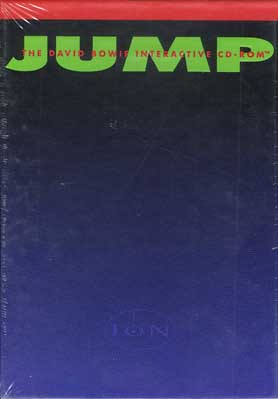
look before you jump
Back then, geeks were unused to other industry sectors barging into our little rustic byte farmyards with their fancy suits and corporate expense accounts, braying triumphantly about digital convergence, and then, seconds later, striding into the business-model threshing machine that thrummed in the corner. We did not know then that there was a queue of people like this, waiting to dance past us into the bloody knives. We watched their cockiness with alarm, not with the disdain that would come later (and definitely not with own brand of hubristic Internet rockstar smugness, the smugness that tempts us all to look a bit less closely at ourselves, and a bit more closely at that thresher).
No, back then it was all a bit shocking. We assumed these people knew what they were doing. God knows we knew we didn’t have a clue. The only way we knew how to fill a CD-ROM was burning a complete archive of Fred Fish Amiga Freeware on it. Seven hundred megabytes just seemed an insanely large amount to want to fill with professional product.
Subsequent to the threshing, people muttered about how it was the Internet that killed the CD-ROM, but I think that, as ever, the real murderer was economics. A “professional” CD-ROM was just too expensive to produce, relative to the format it was generally parasitical upon.
The classic example for me was the brief phase of magazines including a free CD-ROM on the front of their mag. Dave and I would marvel at the incredible lopsided nature of this venture. The CD-ROM could hold close to a gigabyte of data, including programs, movies and graphics; all of which had to be commissioned, collated, edited, integrated together, checked for viruses, cleared for copyright, tested, mastered, and burned. If done welll, a front-mounted CD-ROM was clearly a far more complex and expensive venture than actually putting out a magazine — and yet they usually paid a single person to do it all, didn’t charge for the CD, and probably got little advertising revenue from it.
The ultimate portrayal of this problem was when, in a desperate attempt to include some unique content, they’d include on the CD-ROM a PDF file of the magazine it was sellotaped to. The PDF would usually take 50MB, if they were lucky. All that unique content that it had taken the rest of the editorial team a month to create — and there was still 650MB to go.
Most started attempting to bridge that gap with incredibly fancy interactive environments that would quickly consumer their annual budget. The ones that survived would ultimately collapse into padding the CD-ROM out with… well, the Fred Fish Amiga Archive, generally. Professional product got thrown out of the window in an attempt to feed the ever-hungry maw of interactive content.
This, to me, is the flipside of the “digital technology makes everything cheaper” argument. It makes a lot of work cheaper, but it can also professional media fantastically more expensive than its analogue equivalents.
In some ways, the equivalent to a newspaper is just a README HTML file, full of plaintext with a few images — but no-one is going to pay a quid for a README file. So what will you pay a quid for? Maybe some other super-awesome interactive newspaper with 3D pictures and audio interviews and in-depth statistical analysis and a 30 minute vodcast with the most famous writers, and, and, and… how much editorial budget do you want to throw on this again?
Elements is going to do fantastically, because it benefits from that “fresh platform” smell that exudes from the iPad. But can you re-gear a newspaper or a publishing house to produce the level of interactive complexity that a $5 app is going to demand, when it is competing with games and films in the same app niche?
Honestly, it might be possible. We’re not in the age of CD-ROMs now. Our price-points are all over the shop, and a sealed environment like the iPad permits all kinds of unnatural pricing inversions. We’ll pay more for a ringtone than a full MP3. We pay $10 for a README file on our Amazon Kindle, and a dollar for a pocket application that plays farts.
But if you want to play that game, you’re running against the clock. Other applications are going to make yours look ridiculously clumsy in a matter of months (honestly, in a year people will be amazed anyone paid $14 for a bunch of text, a rotating picture of a rock, and a quick Wolfram Alpha search). Plus the seals on that environment get corroded by open competition every day.
Often the solution to this problem really is to run away and hide. Don’t listen to those “interactive media” gurus: stick with what you know. No-one demands now to know why their magazines don’t have DVDs on the cover. When books have CD-ROMs or allied websites these days, they’re usually buried at the back, hardly updated, and just contained the original text and some errata. We don’t really care. It’s okay. We just wanted a book. We love you as you are.
I know that publishing companies will be tempted to go for the all-singing, all-dancing iPad application. But what they’re doing that, my suspicion is that what they’re aiming for is a product which exudes credibility, status — an aura of a professional media product. And when you’re spending the kind of money that a professional application requires, solely to improves your status in the world, you’re not selling a product, you’re buying the love of your audience. That may be an investment in credibility, but it’s not an incoming revenue stream.
The goldrush economics of the iPad will hide this for a little while, because everything will be briefly profitable. But to be sustainable, you need to either be producing something that consistently costs you less than it earns, or will produce regular super-hits among a string of drabber products, or just makes you so much money in its first few months that you never need work again. You can’t just make some single wonderful shiny demo product. You need to keep producing them; you need some way of economizing that process. And you need to stop others from making their shiny thing cheaper than, yet interchangeable with, yours. Otherwise you’re just throwing nice fancy gee-gaws into the thresher’s hungry mouth.
36 Comments »
2010-03-28»
en vacance, and a seafailing race»
I’m halfway through my time between jobs. (“Oh,” said King, “so when you say you’re between jobs, you really mean you’re between jobs”). It turns out that my idea of a holiday is pretty much the same as my normal life, only with more naps, greater daughter indulgence, less guilt and more Doctor Who. The Doctor Who is driven by my indulgence in the publicly-funded brand-frenzy that is the build up to the new series (he’s going to be all right!), augmented by a recent dive through Russell T. Davies and Benjamin Cook’s brilliant Writers’ Tale, which makes you feel if only you stayed up and agonized all night, you too could write a cyberman episode or three. I never actually wrote any screenplays in the long nights reading this book, but it did make me rewatch some of the wobblier RTD episodes and feel a little more sympathetic to the man. He, too, had a lot of email to answer.
The rest of the time has been messed about with upon boats. Let me say this: I am very badly engineered for seafaring. My average interval between boat trips is about a decade. I am bad at knots. Even my proportions are unshipshapelike. My head is Irishman-large compared to my Puckoon-thin legs, giving me an unusually high center of gravity. I can capsize craft by nodding enthusiastically within them.
That said, my life has taken a watery bent recently and I greatly appreciate it. I spend a lot of my time living in a houseboat on the shores of Silicon Valley, where I stare out of a bedroom window filled with a water-level view of neighbourly riggings, sterns and curious ducks. I bought a cheap sixties dinghy hand-designed by a retiring Alameda sailmaker, Donald Goring, a man who, he said, kept his Nazi surname until the day he discovered his family was actually jewish, and then named his company after both halves.
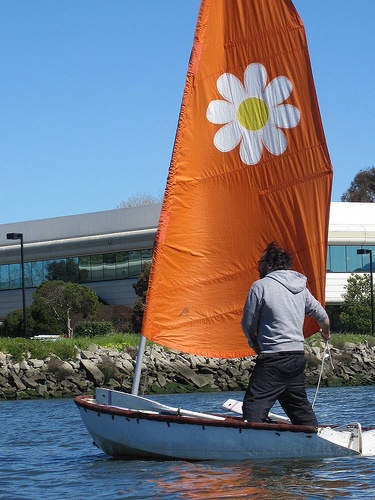
In which the author does everything wrong.
Donald Goring-Bogart (or Bogart-Goring) designed Daisy to be a hard-chined 8 ft lifeboat that could survive a sinking in the Alaskan Pacific. She has handmade sails, custom-fitted oars and a 1983 2.5hp motor. The motor doesn’t run, I can’t sail her yet, and I row those oars like my arms are caught in a threshing machine, but she’s mine.
More practically than my Daisy-flails, Ada and I have been kayaking. My first kayak trip was sort of sales-pitch, I think, but unless they were selling me on the idea of paying protection money to keep me from future kayaks, it wasn’t successful. Somehow I agreed to be crammed into a sporting model about the width of my ankle and, while struggling to escape, kick-launched into a river. They did this to me at sundown, and within minutes it was pitch black. I swung around like a metronome in a moccasin until I could find a quay to clutch onto. Whoever the race of Kayaks are, they failed to either sell me on their device or drown me in their bloody rituals, but I had learned a lesson.
I finally unlearned it this weekend, when Ada and I merrily day-kayaked around the harbour. We bumped around together and gradually learned the subtleties together, such as which way the paddles don’t go, and how to get out of the thing without firing both feet from underneath you like a torpedo. Ada reassured me that in all her seven years, she had never seen a father sink beneath the waves yet. She also quietly sung “Ponyo, ponyo, fishy in the sea” as she paddled around the neighbours. A very good vacation.
Comments Off on en vacance, and a seafailing race
2010-03-24»
ada etc»
My real Ada Lovelace day piece goes out this Friday, in my Irish Times column. Honestly, it’s more an introduction to the idea (and why identifying diverse role models in tech is important) than a real story about a technologist I know, though it does mention a few.
I sort of sabotaged myself last year by listing forty women in tech who have inspired me, not realising I could have padded that out for an entire lifetime of ALDs. This year, I was going to salute the women of the EFF (without looking like I was just sucking up to my bosses), but Cory beat me to it with his profile of Cindy Cohn, EFF’s legal director.
(Then again, he didn’t mention EFF’s executive director, Shari Steele, who led the EFF to its current amazing successes; Jennifer Granick, its senior criminal lawyer (you want to watch this video to get an idea of Granick’s work); Marcia Hofmann who has leads many of EFF’s FOIA-related scoops, Gwen Hinze who steers EFF’s work at WIPO, against ACTA and beyond; Corynne McSherry who mends free speech when it runs into the DMCA; Eva Galperin who is your first responder when your digital rights catch on fire, Rebecca Jeschke who keeps obscure tech issues in the headlines where they belong; Alyssa Ralston who brings the money in, Katina Bishop who masterminds EFF’s awesome events and more awesome major donors; Leticia Perez and Andrea Chiang who make sure the briefs get filed and the bills get paid — and I sabotaged myself again, didn’t I?)
1 Comment »
2010-03-19»
what i did next»
For a moment, climbing out of the too-fresh sunshine and with the taste of a farewell Guinness still on my tongue, slumping into the creaky old couch in the slightly grimy, Noisebridge to write something from scratch, San Francisco felt like Edinburgh in August, a day before the Festival.
Edinburgh for me was always the randomizer, the place I hitched to every year, camped out in, and came out in some other country, six weeks later, with hungover and overdrawn, with a new skill or passion or someone sadder or more famous or just more fuddled and dumber than ever.
Today was my last day at EFF. Just before our (their? Our.) 20th birthday party in February, where I had the profoundly fannish pleasure to write and barely rehearse a 30 minute sketch starring Adam Savage, Steve Jackson, John Gilmore, me in my underpants, and Barney the Dinosaur, I callously told them I was leaving them all for another non-profit. We commiserated on Thursday, in our dorky way, by playing Settlers of Catan and Set and Hungry Hippos together. They bought me money to buy a new hat. I logged off the intranet, had a drink, and wandered off into a vacation.
In April, after a couple of weeks of … well, catching up on my TV-watching, realistically … I’ll be kickstarting a new position at the Committee to Protect Journalists as Internet Advocacy Coordinator.
I’ve known the CPJ people for a few years now, talking airily to them about the networked world as they grimly recorded the rising numbers of arrested, imprisoned, tortured, threatened and murdered Internet journalists in the world. Bloggers, online editors, uploading videographers. Jail, dead, chased into exile. As newsgathering has gone digital, it’s led to a boom in unmediated expression. But those changes have also disintermediated away the few institutional protections free speech’s front line ever had.
CPJ has incredible resources for dealing with attacks on the free press on every continent: their team assists individuals, lobbies governments at the highest levels, documents and publicizes, names and shames. They were quick to recognize and reconfigure for a digital environment (you have to admire an NGO that knew enough to snag a three letter domain in ’95). Creating a position for tackling the tech, policy and immediate needs of online journalism was the next obvious step.
The question I had for them in my interview was the same that almost everybody I’ve spoken to about this job has asked me so far. On the Internet, how do you (they? We.) define who a journalist is?
The answer made immediate sense. While “journalism” or “newsgathering” or “reportage” as an abstract idea might seem problematic when cut from its familiar institutions, and pasted into the Internet… nonetheless, you know it when you see it. When someone is arrested or threatened or tortured for what they’ve written, if you can pull up what they said in a mailreader or a browser, it really doesn’t take long to identify whether it’s journalism or not.
What’s harder is untangling the slippery facts of the case — whether the journalist was targeted because of their work, or other reasons; whether it was the government or a criminal enterprise that did the deed; where the leverage points are to seek justice or freedom.
In those fuzzier areas, in the same way as EFF uses its legal staff to map the unclear world of the frontier into clear legal lines, CPJ uses its staff’s investigative journalist expertise to uncover what really happened, and then uses the clout of that reinforced and unassailable truth to lobby and expose.
Honestly, I’m still only beginning to map out how I might help in all this. I spent a week last month in New York where CPJ is based, listening to their regional experts talk about every continent, all the dictators, torturers, censors and thugs, all the bloggers and web publishers and whistleblowers.
I know I am starting on that ignorance rollercoaster you get when striking out into new territory. I can tell these people about proxies, AES encryption and SMS security, but I still can’t pronounce Novaya Gazeta, or remember what countries border Kenya. You surprise yourself with how much old knowledge becomes freshly useful, at the same time as you feel stupid for every dumbly obvious fact you fail to grasp.
I think part of my usefulness will come from writing more, and engaging more with the communities here I know well to explain and explore the opportunities and threats their incredible creations are creating today. At the same tie, I’m already resigned to taking a hit in my reputational IQ as I publicly demonstrate my ignorance (my friends in Africa and Russia are already facepalming, I can tell). Hope you’ll forgive me.
In the mean time, I’ll be setting up my monthly donation to EFF. I’ve said it before and I’ll bore you again, EFF are an incredible organization, made up of some of the smartest and most dedicated people I’ve ever met. I smugly joined in 2005 thinking I understood tech policy, and spent the next few years amazed at what it was like to live as the only person who didn’t have an EFF to help me understand what I was looking at and what to do about it. I guess I finally got the hang of juggling five hundred daily emails, a dozen issues refracted through dozens of cultures across the world. And I guess that’s aways the cue to switch tracks and reset to being dumb and ready to learn again.
Incidentally, EFF is looking for an IP attorney right now. I don’t know how many lawyers read this blog, but if you know a smart IP legal person who wants to randomize their life for the opportunity to become even smarter for a good cause, get them to apply. They won’t regret it, not for a minute.
7 Comments »
2010-01-31»
jet plane emotions; ipad cycles»
Does anyone else get weepy on long haul flights? I’m currently on a Virgin America flight (hello gogo wi-fi, hello deucing my carbon credits for another decade), watching a House marathon (which is protecting me somewhat from emotional liability), but I still get a little tearful after the fifth hour. Maybe it’s oxygen dep, maybe it’s sheer boredom, maybe it’s NOT JUST ME. One time I burst into tears at an inflight showing of Mission to Mars. I hope it’s not just me.
Anyway, it means I have time for you. I have a little less time for Virgin’s chairback entertainment system. Watching the Linux boot-up errors scroll back used to give me a wriggle of delight, but now the wonder of that has worn off, it’s just constantly irritating. There’s latency issues, especially with fast-forwarding in movies, which is like trying to tap-dance on black ice. There’s pages full of “this service isn’t ready yet”, terrible anti-aliasing on the branding. Oh, and my main credit card doesn’t work on purchases, coming up with a “Credit values of $9999 not allowed” error. The same card gives the same error on my neighbour’s machine. Another card that has a variant of my name works fine. My main credit card has an apostrophe in the surname. I do hope Little Bobby Tables doesn’t take a flight on VIrgin any time soon.
Here’s the question that is gripping plenty of my friends in fear tonight. Do open systems inevitably suck at UI, compared to closed systems run by control freaks? Will the iPad (sorry, that is “iPad”) mean our children will not code, and Stallman will die alone, the last free programmer strangled with the DRMed guts of the last Macmillan author?
I think the guilt is exacerbated by all of our concerned essays being interleaved by admissions that we, too, will be getting one. It’s like a “Just Say No” ad recorded by people conspicuously tapping their upper arms.
But, you know, I’m optimistic. I’ve had these chills before. The first time, actually, was Windows 3.1, back when I was six or something. Okay, twenty-one. Windows was amazing, and unprogrammable to anyone who didn’t have a proper programming job, and thus couldn’t justify the expense of the dev environment, the Petzold, and the fancy 486 to run it all on. To people accustomed to working with a $50 copy of Turbo Pascal and a 80×25 Hercules card, this was a horror show. In the space between DOS’s QBASIC and Visual Basic, the Windows platform was closed to amateurs.
As was the Mac, compared to the Apple II ecosystem. I remember in 1992, in a run-down London flat, having somehow managed to beg a Mac from a local dealer, sitting and dolefully staring at it because outside of playing MacWrite and admiring the screen resolution, there was damn all you could do with it.
As for the risks to interactivity and creativity: I remember when the WebTV was announced, and we huddled in corners and worried for the future of the Internet. Unlike Windows and the Mac, the WebTV may well have died because it sucked: but I notice that it has no descendants on the technology family tree. No-one makes a web browser at arm’s length, for watching. Even the supposedly sealed iPad sits close enough to our laps for us want to make something, even if it’s just finger paintings.
Of course, the iPad (sorry, just “iPad”) is different because of the lockdown. Even if we had the resources to write something for it, we can’t without Apple’s whim. But I remain confident that the same forces that wash away proprietariness in general purpose computers in the past will eat away at the iPad. Maybe it will be like Windows, where the system itself becomes more open just by virtue of a disinterest in its owners in keeping it closed. My own, perhaps overgenerous feeling is the App Store is not an artifact of Jobs’ control-freak mentality, but a paranoid reaction to iPhone OS’s lack of decent sandboxing; that paranoia may be whittled away slowly.
Or it could be like the Mac, which became more open out of competition with more other open systems. Closed costs money to maintain, and open has more features. It may be that the iPad gives up its closed nature when faced with competitors that take its lead, and run faster and more alluringly than even Apple can keep up with. That seems less likely, to me: Apple knows its strengths, and the open world is so far struggling to emulate its aesthetic integrity and hardware integration. Closed costs money, but also lets Apple create new revenue streams for it and its partners. Open has more features, so Apple concentrates and creating a few features very well. Well, shrug: we have competition. That’s good. It’s not like the other proprietary behemoths are doing a good job mimicking Apple either.
Or it could be that we have to become outlaws. The problem with a closed system in our post-DMCA world is not that it exists, but that it’s a criminal act to open it. Some prosecutors claim it’s a criminal act to even talk about how how to open it. It’s certain criminal to sell other people ways to open it.
Despite that, open is still so important than thousands of people do it to their iPhones. Millions of people buy Android systems in preference to iPhone partly because of that power. And if the iPad is successful, surely millions will either jailbreak them, or buy open alternatives out of a wish to reach for something that Apple isn’t offering them.
It’s easy to see the iPad as the final tragedy in a long history of openness and tinkerability in general purpose computing. But the truth is, the cyclical fight against locked-in systems has been the recurring theme of computing since the mainframes. Our open systems are as wonderful as they are because they had to set themselves up against the shiny proprietary wonders of a previous age. The iPad isn’t a threat; it’s an inspiration. They’re always trying to steal the revolution; we always have to steal it back.
18 Comments »
2009-10-22»
my diseased mind; ephemerisle»
I’ve been laid low by illness. It’s not amenable to naming: I have a fever, but no coughs or sneezes. Headaches, otheraches. I’ve mostly been sleeping, and when I’m not asleep, I’ve been restless and yet exhausted, stuck in my apartment. A lot of my friends caught something similar, and it’s mostly taken them a week to shake it off. I didn’t even have the energy to make it to tonight’s EFF Pioneer Awards ceremony (boo! I wanted to see Limor “Adafruit” Fried and Carl Malamud win!).
What have I been doing, when not being ill? Well, possibly the maximally interesting thing for you, dear vicarious reader, was attending Ephemerisle, a sort-of-Burning-Man-like event for people who, instead of frying in deserts, prefer to drown in rivers. 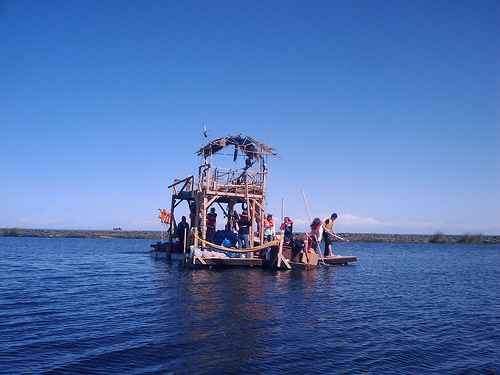
There’s plenty of pictures and coverage of Ephemerisle now, I think perhaps because the event pulled 10% of the “novel strange east coast geek culture” press pool (me, Declan McCullough, Brian Doherty), and 60% of the “sympathetic portrayals of weird libertarianism” press pool (Declan McCullough, Brian Doherty, me).
My favourite review was from “postmodern conservative” Will Wilson, who said “most of the participants could best be described as left-libertarian… Curiously, most of the people I interviewed were under the impression that everybody else was a right-libertarian.” He also complained that it was “creepily non-political”, which must indeed look very suspicious indeed to DC conservatives visiting California. First they don’t talk about politics, and the next thing you know they are offering to re-orient your chakra.
Far more interesting to me, who has attended several Burning Men, but never actually got around to visiting a 1970s L5 Society meetup was the conference before the island. I’m afraid I’m weakening from the ague far too much to tell you about that now, though, so I’ll leave you with this footage of my daughter riding around in a bubble. To the future!
Read the rest of this entry »
Comments Off on my diseased mind; ephemerisle
2009-09-22»
you know who i blame? the lurkers»
All of these conversations I’ve been having online (as opposed to the dramatic monologues here) have had me thinking about the nature of online discussion, and confronting my own behaviour in them.
What are you like when you’re deep into an argument online? I have two sides: the one which you can see with my postings, which are long, mostly fiercely polite, quasi-grammatical, and, if I may say so, devastatingly reasoned.
You have to imagine me writing these, though, pacing around madly in my bedroom, muttering little speeches to myself and visualizing the horrible death of my correspondent in a hail of unavoidable saucepans. Also I drool, but only a little bit, and only from the mouth.
Is everyone like this? I don’t know, because people don’t like to talk about it. Recently, I’ve been looking at how people manage their own emotions when discussing online. It’s complicated, because the unwritten rules of much online discussion is that “if you emote, you lose”, and others that “if you emote, you win”. Either way, bringing emotions into it changes the game. But what the hell does winning and losing mean?
People talk about the disrespect and ferocity of online flame wars. I think it’s about audience. I think the novel nature of online discussions is that you have a passive, silent audience out there. I think that’s far significant than all that talk of anonymity, or the death of civilized discourse.
The closest equivalent to Internet discussion forums for me when I was young was Paddy, who I lived with. Paddy was a man who could argue for hours without coming up for breath. You’d say your triumphant logicbuster, and magically by the time you’d finished, he’d already have (verbally) posted a five page reply up in your face. I remember one night when I got so mad with him for his relentless logical verbal one-upping that the only snappy come-back I could devise with was to quietly leave the room, go upstairs to the bathroom, spray my entire face with shaving foam so I looked like a giant Michelin head, and then creep up behind him and go “ARRGH!”. I hold that I won that argument squarely and fairly. (You occasionally see this rhetorical device at Prime Minister’s Question Time.)
Anyway, what was annoying with Paddy, as I finally got him to admit one day, was that he wasn’t trying to convince you he was right: he was trying to convince a mysterious third-party.
There was no third-party in our arguments. When we got started both of us could empty a room faster than karoake-ing opera singer.
But on the public Internets, you’ve always got an eye to the third-party. Every talk you see online has an imaginary crowd around it, imaginarily clapping or stomping. Either way, you can’t just communicate these side-line emotions with the person you’re talking to, except by stumbling off into private email. Which is usually about as calming as going outside the bar for the fight. Actually, private email isn’t even private, because there is always this sense it will be magically reforwarded into the public view, exposing your vulnerability to the same audience.
Every discussion is a group monkey dance.
1 Comment »
2009-09-18»
online voices, twitter and register»
I’ve been commenting a lot online recently. I’m enjoying getting a voice back on the Net, especially to talk about politics and other contentious topics.
Weirdly, I haven’t talked much on the Net in my own voice for years. My main voice on the Net for long long time was the NTK one, which is actually rather disengaged and aloof. Dave and I inherited a disdain for political drama by the time were doing NTK: on my side that came from the psychic damage of having to write Weekending and Spitting Image; on Dave’s I think it came from him from having to listen to people talking about writing for Weekending and fucking Spitting Image all day. Also I believe Dave thinks politics is an obscure branch of Earth Primatology. (I remember him noting the day after the landslide election that brought Labour and Tony Blair to power that maybe we should have mentioned it once in that day’s NTK).
Anyway, because I was such a firebrand, he’d allow me to write one or two “worthy” news items a week, and I’d grudgingly allow him to write 3,000 words on chocolate anytime he wanted. In the NTK divorce, I got to bother people about the Open Rights Group (join now! Fight Peter Mandelson and meet Ben “Bad Science” Goldacre!), and he got to run SnackSpot (Confirmed sighting: Brannigans Roast Beef and Mustard/ Blue Diamond Jalapeno Smokehouse Almonds). So I got a little more worthy after NTK.
When I joined EFF, and put childish things behind me, I ended up dropping that voice too, and becoming even more worthy if that were possible. Weirdly, that meant becoming far less personally outspoken. I was EFF’s main domestic activist for a while, and in that position, you quickly realise that anything you say, even informally, stops being “Danny said blah” and becomes “The EFF’s Danny O’Brien stated”. It’s like walking around online with a loudhailer stuck to your mouth; you end up just not saying anything for fear of suddenly having headlines explaining how you’re worse than Karl Rove and Hitler combined.
I do, incidentally, think that matters have got better on that front in the years since then. When I wrote about public and private registers in conversations a million years ago, I predicted that eventually we’d get used to a more informal tone from public figures:
We’ll learn a kind of tolerance for the private conversation that is not aimed at us, and that overreacting to that tone will be a sign of social naivete.
I think that’s what Twitter is all about, and permits: it’s sort of magically translated the informal register of text messages into the public space, and for public figures, allowed them to get away with throwaway comments far more than before. (My current favourite: the star of Pimp Your Ride complaining about, joking about, and finally replicating, the “yo dawg, I herd you like X, so I put an Y in your Z so you can VERB while you VERB” meme he inspired.)
That said, my political speech right now are crazily messed up. Obviously there’s the whole libertarian embarrassment. Apart from anything else, libertarians online are like Jehovah’s Witnesses, and appear to be obliged to go knocking on every comment thread they see, selling copies of the Laissez-Faire Watchtower or whatever. I know that even flirting with that title has somehow required me to endlessly clarify apparently batshit notions to my more … orthodox friends. I know for instance that I spent several hours last night actively researching the economy of Somalia before concluding that, yes, it is actually fucked. But you know, I had to check, because WHO CAN TRUST THAT STATIST LACKEY THE BBC.
At the same time, however, I’ve also becoming intensely interested in privilege, feminism, racism and power inequities amongst groups. Yes, yes, very contradictory of me, I contain multitudes cool aren’t I cheers thanks. But that means I get to be in on those endless arguments too! Usually (but not always) on the other side!
We shall talk more on this topic tomorrow, because you are already bored. But I just wanted to let you know, buried down here, that I let the NTK voice on an outing this week on my twitterfeed.
So now you can quote me horribly out of context and get me into trouble. I am Hitler!
2 Comments »
2009-07-14»
“living on the edge” returns; the ridiculousness of credit card security»
I’m giving my “Living on the Edge” talk next week at OSCON. I keep telling myself it will be the same as last year’s OpenTech presentation (I pitched it to O’Reilly as “the same talk, with some of the jokes in a different order”), but of course a year has passed, and someone will launch something on Monday, and I will have to re-write it all three times, and change “Ruby” to “Haskell” in the topical jokes.
The highlight from last year’s talk was being constructively heckled by e-money expert David Birch (I believe I idly posited the switch to the Euro as the sort of centralised, high-co-ordination venture that I, out of a foolish consistency, believe can never succeed, and yet regularly do. He yelled that actually it hadn’t. My other example is Unicode, which only today I discovered has some issues of its own.)
I read David now because I can never accurately predict his opinion, which means either it’s all signal, or he is in fact a natural source of randomness, both of which are highly valuable. Here is his latest piece on the history of credit card fraud, which posits that given that everyone knows that credit cards are nigh un-protectable, it’s time we came up with something better.
That’s not a new viewpoint, but he makes a novel (to me) point. Fraud is a few points of cost for retailers and banks, which they are generally okay to swallow, but because fraud is now more scalable, those few points — which round up to billions when taken nationally or globally — have become a public order, organized crime, issue. (Not sure if I entirely believe this yet, but that doesn’t stop it being interesting). Some other nuggets are Paypal’s counterintuitively low fraud rate compared to traditional payment systems, and a link to a fantastic piece by Stephen Wilson summarizing the reasons why credit card security is lousy, and why organizations use all the wrong private data on you to confirm who you are. Quoting from Wilson’s list of personal data:
Biographical information, like name, address and DOB, needed by a bank or service provider to establish and maintain a relationship with distinct customers
Identifiers, like bank account numbers, that serve as a proxy for biographical data to manage different customers.
[BTW I contend that the major Internet security and privacy problems would be remedied if pure identifiers could be relied upon, so we didn’t need to ask customers for piles of corroborating details.]
Authentication data, like passwords, PINs and biometric templates, whether static or one-time, used to establish the legitimacy of someone claiming to be associated with biographical data or an identifier [Note that the CVCs started out as authenticators but now they’re so widely divulged and leaked that they’re really just identifiers. Asking for CVCs over the web is frankly inane, symptomatic of sloppy ad hoc security; we might as well move to 19 digit credit card numbers].
Service history, like account balance and transaction details, which are private between the customer and the service provider, and in the case of banking actually represents the entirety of the product.
And all the other personal information (family details, telephone numbers, work details, preferences, affiliations …) that accumulates, and which can be used for good (like tailoring customer service, or cross-selling with consent) or evil (cross-selling without consent, spamming, surreptitious linking across different domains, identity theft etc).
I love that throwaway comment that service history is “the entirety” of the banking product. That’s so profoundly true.
5 Comments »