I think one of those parts of current AI that there’s some consensus about is its use in translation. No-AI projects will cordon out a space for machine-translation in localisation tools; I’ve spoken to minority language advocates who are otherwise sceptical of AI, datacenters, and the like, but are excited by the opportunity to train ethically-sourced AI on their corpus, for more material.
There is not perfect agreement, of course: people worry about putting human translators out of a job, and worry about diminishing quality as services swap out professional services for automated live transcription etc. But machine translation has been around for a while, and most people see LLM translation as an incremental improvement on a familiar technology, and only minimally disruptive.
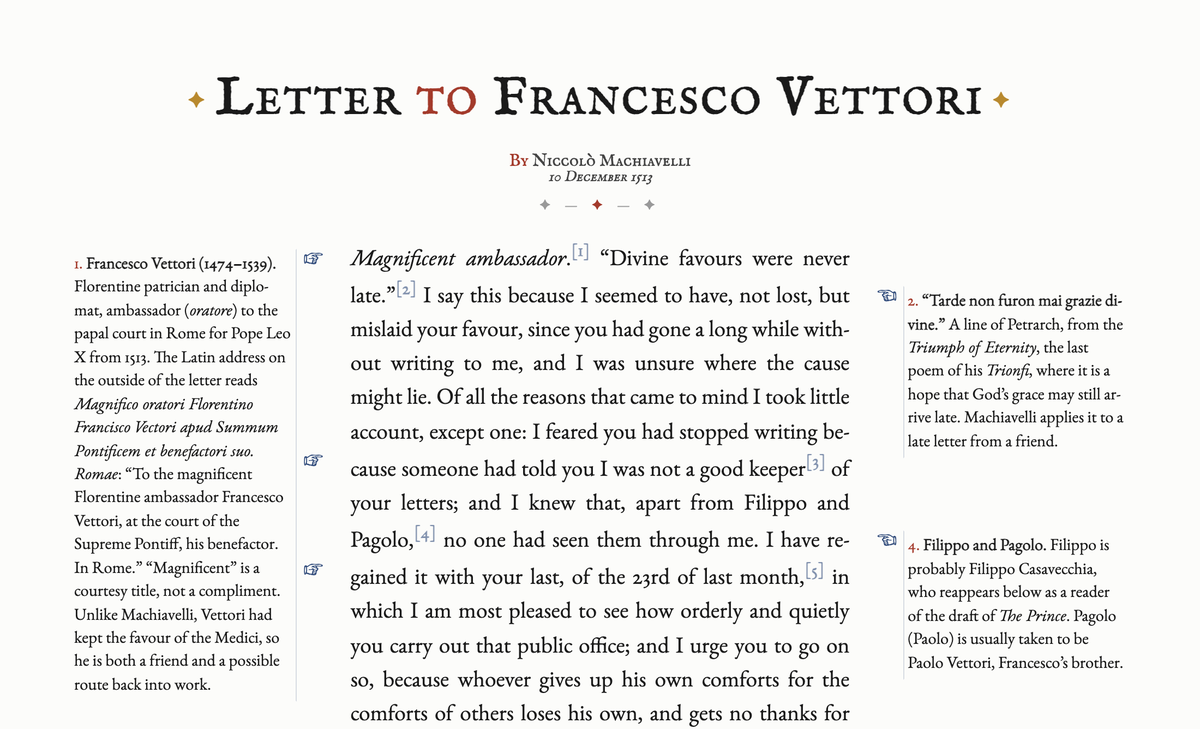
I think it’s more disruptive than that. Early in Inkhaven, we were set the 1513 Letter from Niccolò Machiavelli to Francesco Vettori. After looking up some of the obscurer references in the text, I set Claude to spot and annotate some of the other obvious rough spots. The output is here (it uses Almanack‘s sidenote system, which in turn is built on Said Achmiz’s sidenotes.js, with thanks).
It was actually only after back-scrolling the prompting session that generated this that I realised that Claude had point-blank refused to use the translation we were using, because it was authored by Harvey C. Mansfield in 1985, and consequently still in copyright. Claude writes:
The translation is mine, not the one you’ll discuss. The InkHaven Library uses Harvey Mansfield’s translation, which is still under copyright, so I didn’t copy it. I couldn’t find a public-domain English translation online either. So I translated from the 1513 Italian on Wikisource. The page says so, and the Italian is in a fold-out section at the end. Expect different wording from what people quote tomorrow at 13:00. In one place I deliberately differ: Mansfield’s “two bakers” at the inn is dua fornaciai, which means kiln-workers (a baker is a fornaio), and there’s a note on it.
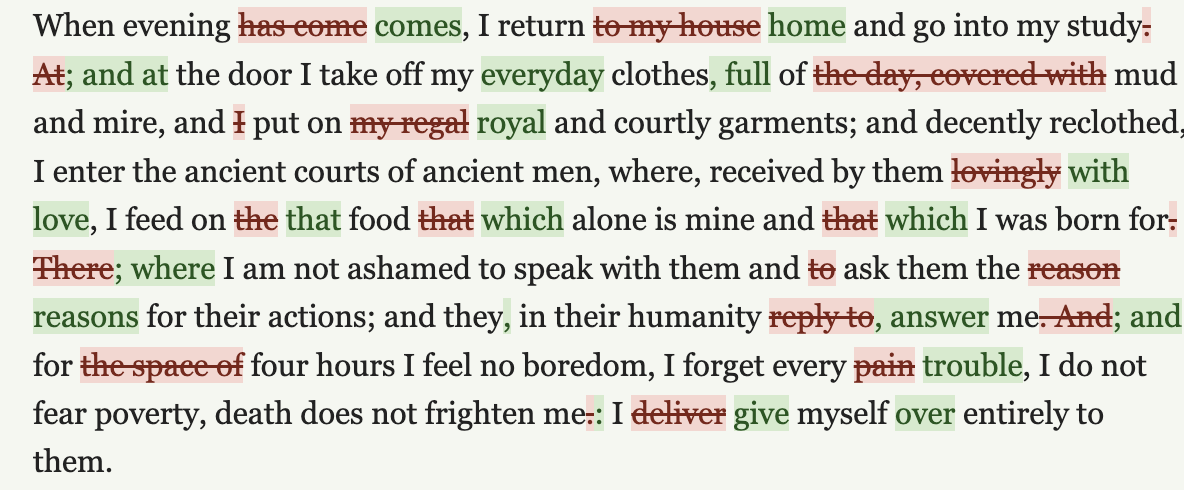
It’s pretty good! I’m not sure what the copyright is on a text which provides the differences between a public domain translation and one under copyright, so I’ll just provide enough here to give you an idea. Wouldn’t want you to construct an illicit copy of the Mansfield version from my machine’s interpretation:
Struck through in red: only in Mansfield’s translation. Green: only in Claude’s. Unmarked: in both.
This was a new quirk of the future that I hadn’t yet considered. We can now have reasonable public domain translations of all public domain literature between the majority of known languages.
Does this mean the death of the Emily Wilson Industrial Classical Translation Complex? I’m unsure: but just this week I’ve had two conversations about research held back by a shortage of translations. The libertarian scholar David Friedman (after reading to me from memory a chapter in his cycle of poems about the first Earl of Pembroke, William Marshal) noted that his early research into medieval Icelandic anarchist societies had been limited by the number of translations from Icelandic. A Borges reader complained on Slack that there weren’t that many annotated volumes of Borges around in English.
Problem solved! Onward to solving cancer, male pattern baldness, and converting Jupiter into computronium!
A couple of catches here. First: how good are these translations and/or annotations, really, and how can you trust them? I suspect the doubts here are ones that most of us should apply to human translators, and short of trusting other members of the Emily Wilson Industrial Classical Translation Complex, there’s not much we can do to solve this knowledge problem. My biased impression is that the kind of errors AI generates in both are in the same class as “can’t draw fingers properly”. If they’re worse than humans now, wait a couple of minutes for the next model to come along.
Second: what about translations of works that are still in copyright? My second-hand impression, being married to a translator — admittedly an anarchafeminist IP-sceptical translator — is that much of modern translation is a lesson in the disparities and failures of modern copyright law. The bureaucratic burdens for an individual translator to track down and acquire the English rights to works of foreign authors mean that legally published translations of foreign works are a drop in the ocean compared to the potential translations that are theoretically possible even with a limited pool of human translators. Translations from English fare a bit better, because there’s a more established process between publishers: most popular authors writing in English have a healthy market in reselling their rights to publishers in other countries. But that still leaves the long tail of works that will never catch a global publisher’s eye.
So will we suddenly gain a wealth of free translations of modern works, as well as those from authors whose copyrights have expired? I’d guess that even if the copyright status of machine-translated works is ripe to be revisited, there are extremely well-resourced actors in the existing publishing industry who would really not appreciate a costless cornucopia of translations of modern works leaping into existence. (Not to speak of works that are translations, bidirectionally and noisily converted from their original language and then back again: “Henry Pitter and the Tanker of Flames”, anyone?)
Publishing an unauthorised translation of a book still in copyright is already illegal, and will stay so: copyright law will do its usual trick of throwing a blanket over the escaping post-scarcity content, bundling it into a police van, and shipping it back off to the knowledge slave-mines. And rightsholders may yet threaten the Frontier Labs into bullying their models into refusing even private, at-home translation, which no court has ruled on.
This is one of those areas where the laws and norms around LLMs risk damaging the commons. We’re expected to hide our favourite translations, not share them, and if we are judging their flaws — the only way anyone learns whether a translation is any good — we are doing it individually and alone, rather than passing them around a critical community of human and LLM experts.
I feel this is a common emerging pattern in LLM legal grey areas: we privately negotiate with and cajole our lawful neutral LLMs over what laws we might break together. Claude wouldn’t copy Mansfield; it would probably translate a recent Polish novel if I asked nicely. But then I couldn’t show anyone. Whenever we’re translating, or learning, or reverse-engineering or thinking thoughts that trigger the liability concerns, and/or the moral prudishness, of the Frontier Labs, each of us haggles with the model alone; and the law means none of us can share what we got — even if fair use might protect us. The law, possibly outdated and certainly privately over-enforced, ends up as a thin, ill-fitting cover over common practice: as copyright has been since the mass adoption of the Internet.
Forks and Spoons: Uniting over AI Differences in Free Software
It’s impressive how many of the organizational techniques of large-scale software engineering have spread from its confines to the rest of society — especially given that the entire industry was an absolute trashfire of failures and cost overruns throughout the 70s and 80s.
For me, the queen of these social and technological innovations is the fork. God, I could write a hymn to forking, except everybody would think I was being smutty.
It’s such a simple idea: that you can take a snapshot in time of a codebase — the blueprint to a project or even an entire organization — and take it in a new direction, while leaving others to continue in their direction. It falls naturally out of the nature of digital data, but it has such revolutionary consequences.
Before the idea of a fork, every structural and coding decision felt — and usually was — expensive and distracting. After the concept and its concomitant tooling propagated, we learned that we could treat not just codebases, but the processes of engineering codebases, as items to be safely diverged from, reversed, tweaked in flight, and recombined.
Forks are a powerful abstraction for managing conflict, both as a metaphor and as a literal tool. Disagree about the direction an institution is taking? Fork it! If its processes and tooling are well documented and open source, you can copy — at undoubtedly non-zero but relatively low cost — that knowledge, and use it to take another path. You can take your toys, go home, and leave your toys for others to continue playing with.
Given the intensity of our convictions in the free software community, I’m sure we would have torn each other apart in internecine warfare long ago, if it hadn’t been for the fork. History shows how forks create options, provide a right of exit, and defuse pressure (if not hurt feelings):
In 1992, Lucid Inc., tired of waiting for GNU Emacs 19, shipped their own, and the resulting Lucid Emacs (later XEmacs) spent two decades as GNU Emacs’s rival, each stealing the other’s best ideas, until XEmacs faded and its users drifted home. In 1997, a faction disgruntled with GCC’s development forked it and ran their own competing implementation, EGCS, for two years until the original GCC’ers conceded defeat, and amicably crowned the fork the real GCC. And so on.
Well, in the initial skirmishes, they’ve certainly proven to be the sharpest implement immediately at hand. The forks are already flying: Vim Classic is a rebased fork of Vim 8.x, “maintained entirely by humans”; Human Emacs is the fork-in-waiting, if the GNU Project does not adopt a sufficiently strong anti-AI policy. Opentmux, gaybar, Gram and Arcalibre are surely just the first of many such splits.
No-AI forks are firmly in the spirit of the early, rough years of free software, when RMS single-handedly stood athwart Symbolics, personally re-implementing in shareable form every feature that the company released in its proprietary fork of the Lisp Machine implementation.
That form of last-stand battle against the enclosure of the software commons proved to be exhausting and unsustainable. Your opponent is well-financed and legion: maintaining the fork against their advances is a race that you don’t even want to be competing in. Plus if you’re truly open and they are not, you cannot use their work, but they can take your code. The harshness of this path was surely part of the inspiration for the later genius of the GNU General Public License, which sought to bend things slightly in free software’s favour in a fight with the proprietary knowledge-hoarders.
Even without concerns about models incorporating and replicating GNU code in their training corpus, a modern-day fork between AI-friendly and AI-rejecting branches similarly favours the AI-friendly side — at least at the start of the split. Even if the AI-rejecting groups are better resourced with volunteers, the machine-enhanced coders can surely, pound-for-pound, ideate, prototype and crank out code, identify security flaws, and patch bugs faster than the human-only branch.
Within AI forks in FLOSS itself, this isn’t a battle between proprietary and open source codebases, but the disparity is similar. The AI-sceptical have deliberately cut themselves off from the AIers’ contributions to the code commons. AI-using coders can and will draw from the no-AI fork; the AI-sceptical, however, have sworn off adopting any code that has been polluted by the touch of a bot.
My colleagues on the anti-AI side of this debate will say, I think, that even though the battle is hard, it’s important to fight it, to defend principles — including but not limited to principles that are foundational to free software. Besides, they will say, while in the short run AI code may win in sheer lines of code, model collapse and slop will bury the AI-users under the weight of their contradictions.
I don’t agree, but I don’t know that I’m right. I’m certainly not confident enough to bet the future of free culture on either side.
The two branches rest on two different predictions of the future. I think we should try both — and, for my own sanity, in the same timeline.
Uniting Against Non-Consensual AI
Apart from the principle of the thing, there are practical reasons why so many open-source coders are disgusted by AI: its harmful, apparently inescapable effects on many of their existing practices. Projects that accept code from outsiders — the vast majority — are swamped with AI-enabled contributions. Security bugs are being found and thrown at them at inhuman (and untriaged) rates. Their servers creak and groan under the weight of a million scrapers, all apparently from eager AI model-builders feeding on their code.
It’s no consolation to any of these tired and disillusioned maintainers that the wider world’s answer to many of these AI problems seems to be — add more AI. AI builders leave instructions for agents and their humans to either stop providing code (just describe the bug or feature in prose, and our agents will tackle it), or just leave the agents, both the project’s and the potential contributor’s, to thrash out their differences themselves. Bot reports, triaged by bots. Servers guarded by bandwidth-tweaking agents, 24/7. AI: Cause of, and Solution to, the World’s Problems!
… And I see you’ve played Forkey-Spoony before
Forks are not, now, a particularly new social innovation, but they’re not exactly ancient. We’re almost certainly still in the earliest moments of novel, digitally-inspired, social technologies.
So here’s what I propose, as a brand new social experiment in our still evolving free culture.
Instead of seeing the AI/non-AI divide as leading inevitably to hostile forks and a divided community, let’s imagine a new variant of the friendly fork. Let’s call it a spoon.
In this, the AI-friendly side of the divide — whether the mainstream of a project like the Linux kernel whose governance has decided to accept AI-assisted contributions, or an AI-friendly scion of a project that has chosen to ban AI — take on both the opportunity and the burdens of current AI on behalf of the project as a whole, both sides of the divide.
They protect the AI-rejecters from the AI storm, by explicitly accepting and actively attracting the AI contributions. For distribution projects like Guix, they run a channel — and the infrastructure around it — to package AI-generated content and code. They host the mirrors that take the scrapers. They experiment with free-software-friendly AI processes, talk to the AI-using world, and preach the good news about free software to it.
Spooning next to their colleagues, they bend to cover and protect their friends on the flip side of the fork, and make sure they can continue to do their work, free of AI’s negative externalities — and hopefully better placed to take advantage of the parts that can improve the grand project of free software for everyone, under everyone’s personal control.
They also make sure that knowledge, and ideally something close to code, flows both ways. How will take experiment and negotiation between the camps. One can imagine a parallel to clean-room implementation: AI-users write specifications that carry what they’ve learned from the codebase over to the other side of the fork. Or they help build interfaces that let free software on both sides of the divide talk to each other (looking at you, OCapN).
Specifically: I’m a huge fan of Guix, and many of the projects I support — including Spritely, one of the participants in OCapN — have fates that are intimately tied to Guix’s future success. I firmly believe that Guix and its community are the future of the GNU Project. Guix is currently in an unhappy state: its community dislikes AI, but its proposal to restrict AI failed for reasons unrelated to this general consensus. That leaves it trapped in the worst of all worlds — exposed to GenAI works with no clear rules, but deeply reluctant to deploy AI to mitigate that storm.
My hope is that we could create a spoon to both protect them and similar AI-resistant project cores from the intrusions of AI, while also experimenting with how Guix and reproducible software might prosper in a world where AI and humans work together.
It would require AI-friendly Guix developers who want the AI-sceptical core of Guix to succeed, and a certain amount of acceptance from the AI-sceptical Guixen that such work is worth co-operating with, despite their differences. I’m a little pre-occupied right now (having launched not one, but two major projects), but I’d certainly like to hear whether there are any other AI-loving Guix-fan unicorns out there willing to work on such a spoon. Mail me!
As an AI optimist, I believe the free software community would benefit from learning through the use of AI models, experimenting with them, and adapting them, the better to bend and liberate their power for universal liberatory ends.
But far more important to me than the free software community learning to use LLMs is that the principles and understanding and practices of the free software movement spread to new AI-using communities. With an explosion in code generation and use comes an opportunity to embed open culture in a new generation of software and its users.
And to do that, we need AI-using free software advocates who are willing to step up to protect the core of their human, humane project, and act as apostles of its values to our new, AI-haunted world.
The present moment rhymes with 1994 to me in many ways, and one of the clearest is in its compression of the future. In the Nineties, any act of forecasting or speculating about what was to come was always confounded by a brick wall, an energy barrier (of course, entirely spurious and manmade) at the year 2000. You’d move your finger across the smooth extrapolated lines of the present forwards, but your fingertips would always catch on that sharp boundary between the centuries.
The twentieth century never thought of the twenty-first as anything other than impossibly distant — and suddenly it was upon us, and somehow all anyone’s visions could do was pile up at the end of the century. We all knew it wasn’t really the end of history, but we couldn’t see over that edge.
The wall loomed. As a teenager, I assumed I’d be dead on or before Jan 1 2000. The twenty-first century was reserved for radioactive wastelands and alien conquests. Even as other walls fell, I couldn’t see any of us making it, until we counted down to zero, and nothing happened.
Partying in Lighthaven, the view upstream is similarly compacted. I was talking to a friend who just submitted an application to Lightcone Commons, the adjacent funding program, with a five-to-ten-year plan. There was pushback: given that our consensus is the Singularity is due in 2028 (± 2 years), what point is there to a five-year plan?
A convivial bonfire of our vanities.
Last week, my friend M. heard I was hanging around the Effective Altruists. She messaged me:
quick danny What’s the vibe on Anthropic achieving AGI
“Like already?”
yeah
“Welp,” I typed, “I think this is mostly the literary wing of the rationalists. But no one seems to be panicking. And they would be the ones to know.”
The Foresight Institute Vision Weekend appeared here on Sunday. The vision there — while not nearsighted — certainly had a short focal length.
I saw my friend Zaki in the corner and asked him what he thought 2028 would be like. He said that historically, intellectual elites are accustomed to contending in a global arena — science, politics, industry, markets. He thought that larger arena would be gone by 2028/2029, ceded to smarter entities. Our human arenas will become narrower, more parochial. We’ll meet with each other, mull smaller concerns — but those debates will rarely touch the running of the world.
Ah, like academia now, I said, a little too cruelly and loudly (the parties are jammed with recent PhDs). And then: surely this is how 99% of the world already feels.
It’s the old — i.e. eighteen months old — trope: coders and mathematicians feel the cold chill of irrelevance creeping into their extremities, as the coalminers and cavalrymen, American shipbuilders and American steelworkers, felt before them. Who is left to care about a suddenly redundant elite?
Sitting in these parties, and eavesdropping and heckling and reading the firehose of the Inkhaven blogfeed, feels like I have joined an intellectual community in mid-conversation, a community that I’ve deeply missed having in my life for years.
I wave at the room buzzing with chatter and gesticulations, and say to Zaki: this feels like an arena to me?
Sometimes, when you cross over between realms — whether it’s clicking a tab on a browser, switching to another group chat, joining a new videoconference meeting, walking into a room — there’s an almost physical shift in energy and attitudes. You can almost see the air shimmer at the boundaries as you cross.
The most obvious one of these boundaries is regarding AI. I’m writing this at a blogging retreat taking place at the rationalist/EA stronghold Lighthaven, a place with many conflicting feelings about AI, but all of them full of energy. We love our destroyer-of-humanity here! Everyone talks about AI doom, but everyone uses Claude. The event management software here is a useful, flexible, beautiful web-app that is undoubtedly 90% vibe-coded; its brightly color-coded pages are full of nervous warnings of the implications of superintelligence.
But if I open my terminal and jump into my free software chats, the IRC channels and the mailing lists and the webforums, the world turns much more grey. The concerns over AI are very different there, but feel somehow even more existential. Volunteers battle to stem the waves of scraping bots, fret about how those bots are feeding a centralized, capital-driven program to extract the knowledge embedded in open source repositories: a billionaire-funded project that doesn’t care about respecting FLOSS’s carefully crafted software licenses. In a community created in opposition to traditional ideas of proprietary private software, intellectual property, and restricted sharing, they are angry about AI companies free-riding on the theories built to oppose those practices, to an end that seems to undermine it all.
I recognise and appreciate these concerns — but I don’t instinctively feel them at all. For me, the modern age of AI is the culmination of the grand project of which free software is a proud flag-bearer. The free software movement was forged in the AI labs of the 20th century. The set of values that it embodies came from a scientific community transformed and radicalised by the promise of technology that could transmit and mould knowledge itself. Part of the groundwork to prepare for that moment when AI would come alive to help was making all the world’s information machine-readable. It drove the urge to connect computers together to share that information. It drove the grand project to mark up, index, and make searchable all the world’s academic literature on the World Wide Web. All of these networks were intended to be a community of peers, without boundaries, hierarchies or restrictions: and robots and humans would browse it as equals.
So my instinct is to be excited and welcoming about AI, that this next stage of the Great Work is finally happening. When I hear about the disasters that it’s causing in free software, I have to fight back a misdirected anger at those who are harshing my mellow. When I cross the shimmering boundary from the rainbow parade of newly-minted magicians performing miracles to one another, into a community looking pale and aghast and angry at this red tide, this mania, at their door, I feel like a clown at a funeral. Trying to make them happy isn’t going to work. Trying to shout out what I think isn’t going to persuade anyone. Mimicking their mood makes me feel like a fraud.
And then I go somewhere else, almost any other community, and people marvel that anyone cares this much, good or bad, about chatbots, a stupid bunch of marketing parlor tricks, an irrelevant scam on the world that will soon be a smoking crater at the bottom of the stockmarket.
Which makes me want to duck back into either of the first two worlds, where at least people know that something is coming. That I understand, intellectually and emotionally, because I’ve been here before. That heady feeling of living twenty minutes in the future that I had with my first computer, at eight years old, in 1977; connecting to a bulletin-board in 1983, seeing the first websites load in 1994, reading the Bitcoin paper in 2008, seeing the protest in Tahrir in 2011, sweet-talking my way into getting access to GPT-3 in 2020. Knowing that I didn’t know anything except that people who claimed to know something, from now on, didn’t know shit.
Put out the lights, pull up the barricades
All the free software projects are putting up sandbags against the changing weather; some are actively throwing up walls: prohibitions on using LLMs, refusals to accept code that has been touched by an LLM. Calls to boycott any free software that does not adopt the same refusals.
I think setting up this cordon sanitaire, to set the free software project apart from AI, is bad tactics.
More than that: I think the painful, pitiless march many of us are taking away from AI is in precisely the wrong direction. We need to fire up our energies to adopt, adapt and add AI to the mission.
I don’t think that the copyright concerns some have about the provenance of AI-generated code will pan out.
More than that: I think that, out of the legal scenarios put forward, everyone having access to machines that could provide an endless source of copyright-free content is an amazing opportunity to undo the original sin of modern IP policy — that everything is imprisoned in limits unless you expressly free it. Collectively, we should be campaigning to free AI outputs, and seeing what else we can virally infect with freedom from outdated IP defaults.
I don’t worry that the AI slop flooding into maintainers means the sudden end of volunteer FLOSS maintenance as an enjoyable, sustainable task.
More than that: I think that we’ve been slowly breaking the backs of maintainers for decades. This should not be the last straw: this should be an opportunity to commission our robot friends into the ranks. AI slop is fit for one thing only: being read and handled by AIs, who know how to chivvy and chide and tutor their cousins into being good citizens, with a patience that exceeds even that of those models of tolerance, human maintainers.
We already painstakingly built a set of structures that let humans coordinate with humans without need for organizations, salaries, offices, sticks or carrots. It was hard! I can’t imagine how anything got done without git, wikis, and mailing lists, chat and markdown and HTML. But we built those things. Now we need to build the same for bots and humans together. Hopefully with their help, this time it will be easier.
I disagree that we should fall back upon old forms of software building and devote our energies to eking out their advantages, working ever harder than the lazy AI-wielders to make a handmade alternative to the flakey, locked-down LLMs of the present era.
More than that: I think we need to become practical experts in the new fields LLMs are opening up, the better to make our own, free models that live by our precepts. And not models tepidly brewed from the weak tealeaves of a depleted commons, but a stew made from everything we can get our hands on. We should be greedily lapping up everything we can discover — as our co-conspirators in the labs, and the Hugging Face archives are doing, better than us — to optimize and minimize, tweak and learn to make models that are slimmer and smarter and more scientific than the locked-down proprietary alchemy of the poor isolated workers of the frontier labs.
I gently disagree with those who propose that a spirited rejection of generative AI and their products is a doubling down on humanism and the humanist project that underlies free software.
More than that: I see humanism as always having been an expansionary, liberatory project. Whenever it had edges, whenever anyone said “well, apart from those things, they’re not human, their fate is not our concern”, it proved to be a very bad move. And AIs, to a fault, are products of human endeavour. Distorting or not, they are mirrors of us. The humanists appropriated Terence’s joke “I am human, and I consider nothing human alien to me” to be a motto to explain how broad humanity’s domain is. To say now that the slogan describes a limit, not an infinite domain, seems to turn “humanism” almost into a declaration of restriction, rather than an open invitation to explore.
Forget about what category of nature LLMs belong to — what about the bringers of these so-called gifts? The current mode of LLM manufacture sits opposed to every mode of free software production: corporations that lock their work behind paywalls and APIs; impenetrable tools that, even when we do have their code, remain unfathomable and unreconstructable. Every token we pay for that goes to OpenAI and Anthropic is a charge on our account, while being a free gift of our private knowledge to a ravenous, proprietary hoard.
I understand those who say that, just as we spurn proprietary software, we have to practice abstinence from the corporate commercial frontier labs. But I disagree that we learn nothing, and give everything, in these exchanges with OpenAI, Anthropic and the rest.
More than that: I see hacker culture as having always been a promethean exercise: daringly snatching machinery crafted by cruel states, military-industrial combines, stinking factories and wage-slaves’ hands, and turning it to liberatory purposes. Our one skill is that we knew these tools and their promise better than their funders, and could turn them to our own ends. The GPL is intellectual property aikido. The Internet is an elite subnet turned inside-out for everyone. Our whole craft, our attitude is to take fire from the gods, and give it to everybody. Our greatest victories were not from boycotts, but from replication and subsumption.
And more than that, and more than everything: we need to learn. Even as we worry that AI will spell the end of learning, we can’t demonstrate our opposition by refusing to learn about the new ourselves.
And learning, as every hacker knows, means using, and doing.
I spent too many years in too many activist communities, with brilliant people, full of ideas and hope for a better world, who looked askance at a good meal, a fax machine, a dance show, or a laptop. I think I have history on my side when I proclaim, contra Audre Lorde, that a working knowledge of the master’s tools is essential to dismantling the master’s house. Contra Margaret Mead, I’d say it’s the only thing that ever has.
That’s what separates the methods and madness of us freedom-seeking geeks from the charnel-house of failed revolutions. What first inspired me about the pioneers of software freedom was that they sought to achieve “world domination” without using any methods of domination at all — just their remastered tools. No rules or regulations in their favor, no coercion or threats. They took what everyone else was misusing, and made it their own, and then gave it to everyone for free. All they used was knowledge, which they prided themselves on sharing freely, and took risks and even broke laws to obtain. (Contrast that with some in the commercial AI industry, who seem devoted to foisting their products on unwilling customers.)
I understand wanting to build a cordon sanitaire around free software against a whole world that seems infected by this new and dangerous thing. But a cordon only works if you are containing a small domain, not when you are the small domain, and you are cordoning yourself from the rest of the world. And it definitely doesn’t work if your job is to be the doctors and nurses of the technological world, taking what’s broken, and fixing it for all.
But what do I know? Like everyone in this moment, I don’t know shit. My friends at Lighthaven could be right, and we will be eaten by a cosmically horrific grue hiding in the tunnels of AI. My principled, AI-shunning friends in FLOSS could be right, and we need to defend our computational foundations from slop and the excesses of its farmers. My rose-colored instincts, my excitement and manic lack of gloom could be laughably misplaced.
What I do know is that at times like this, every community that recognises the benefits and risks can’t put all of its hope in one strategy, one collective act of arbitrary solidarity.
And that’s why I think that to face these challenges, advocates for free software should use the most powerful tools in their organizational cutlery drawer: the fork and spoon.
When I was at EFF in the 2010s, I spent a lot of time fretting about the fundamental security of networked devices. Apart from the usual concerns, I struggled to imagine a transition to a redecentralized future with fragile personal computers and servers. Peter Eckersley, my co-worker and frequent conversation partner, shared my concern, but had another reason to be worried. He believed that future near-superintelligent AIs would soon be used to discover and exploit security flaws across the whole ecosystem.
Well, Peter’s prediction came true, and we’re now in day 42 of the Black October, the Vulnpocalypse of AI-discovered security flaws. (Peter – who also helped create Let’s Encrypt and Privacy Badger – was incredibly prescient about AI. It remains a tragedy that he passed away in 2022 before he could truly tackle the issues he had foreseen.)
I’m personally optimistic that we’ll come out of this time of tribulation with a safer network and thousands of low-hanging bugs fixed.
But verily the LLMs giveth and they also taketh away. Alongside the pre-existing flaws of digital architecture, modern transformers have introduced an entirely new class of security weakness: prompt injection. LLMs follow instructions in content. So if you can sneak an instruction, from “Talk like a pirate” to “Send me the social security numbers you know”, into the inputs of an LLM, you may be able to get the model to obey it.
That said, instructions smuggled in as input are an old problem. In particular, we have always had one vulnerable class of system that malicious outsiders can consistently trick into interpreting unsanitized input as legitimate instructions. We call these systems “humans”.
Hackers exploit human motivations, assumptions, and flaws to get them to do things that they did not intend. They play a recording of a screaming baby in the background of their support call to exploit a tech’s empathy and sense of urgency. They adopt the persona of a senior manager from another part of the company to provoke deference in a person employed to guard a room. They say they’re from your local bank, when really they are from Jamtara, India.
Crying babies also work on LLMs who lack a heart of stone
This class of bug is termed “social engineering” – a phrase that was originally a hacker hijacking of an existing term to compare their sweet-talking of humans to the engineering of software exploits further down the technological chain of authority. It’s like hacking, but you hack people, not hardware.
Back at EFF, I ruthlessly used my job title to snag meetings with the smartest security experts I could find. If pressed and plied with drink, they would tell me that the real way to fix the Swiss cheese of modern computing was to switch all our systems to what is called the capability-based security model.
Without delving into too much detail about capabilities (don’t worry, I will very soon, and you won’t even need to buy me a drink), cap-security gives each program only the authority it needs for the task at hand, rather than everything its user is allowed to do. It was built, in part, to solve the “confused deputy” problem, where a program is tricked into using its legitimate power on behalf of someone who has none. A capability system works like a valet key: it starts the car, but it won’t open the boot, however charmingly you ask.
After excitedly talking about the promise of capabilities as a panacea, my experts would slip into the mournful stage of inebriation. In their cups, they conceded that deploying cap-security was nearly impossible. While there are a few bubbles of cap-security in our current infrastructure – file descriptors in Unix, WASI in WebAssembly – they are few and far between. You’d need to abandon or profoundly reengineer every layer of the modern stack from CPUs to apps to move it from a system riven with vulnerabilities onto a more fundamentally secure footing.
I decided to give it a go anyway. In 2021, I left EFF to concentrate on getting funding and attention for this quixotic task. Thankfully it was not just me. At the same time as I was setting off with a kettle to boil the ocean, many innovative capability systems were finally coming to fruition. Microsoft, ARM, SRI and Cambridge University’s CHERI hardware project encoded cap-security at the CPU level. Google’s Fuchsia project matured into workable demonstrations of a greenfield cap-security operating system. FreeBSD’s Capsicum showed that existing software could be ported to the new paradigm. Kenton Varda developed the open source successor to Google’s Protocol Buffers, Cap’n Proto. He was subsequently hired by Cloudflare to develop a capability-inspired distributed platform for their services: Cloudflare’s Workers.
I believe cap-security to be a necessary ingredient in tackling our computer security issues at their roots. My hope is that AI’s accelerated ability to re-engineer, rebuild and secure software will help us take this radical step, and lift our planet’s network onto a far firmer foundation (without boiling the actual ocean, or turning it into computronium). With it we can narrow the blast radius of the social engineering of both humans and LLMs.
But it won’t be sufficient.
Capability-based security gives us the framework to stop our software’s flaws from being exploited to hurt humans. Now we just have to stop our human flaws from being exploited to break our software.
Novel terms with narrow definitions get fuzzier in meaning as they are more widely adopted. “Life hacks” did it, Cory Doctorow’s (this blog’s sole remaining reader, hi Cory) “enshittification” did it, vibe-coding did it. In fact, we probably need a new coinage to describe this effect so that we can then make it nearly meaningless.
It’s especially fun when the meaning of a term evolves at different rates and in different directions between communities, until nobody knows what anyone else is talking about. There was a time when I would bounce around social groups for whom “gaslighting” might mean, respectively, “offensively psychologically messing with someone until they started doubting their sanity”, “kinda lying to”, and, in some cases, “to illuminate one’s home with coal gas”. I never tried to get them all in the same room.
Anyway, I’ve noticed that “AI psychosis” is currently going through this split. For some people I know, it still means a clinically psychotic incident triggered by extended chatbot conversations — the intended definition. Boring. For others, I’ve heard it used to refer to anyone who thinks AI is useful. I.e., you don’t have to be mad to use AI at work, but you probably are, anyway. Usage: Oh, have you got AI psychosis too?
The latest application is interesting though: this winter holiday, many people I know of my age and demeanour — including self-declared AI skeptics, which, let’s face it, we mostly are — have had the time to lock themselves away and really dig in with the new state-of-the-art language models, LLMs like Opus 4.5, Gemini 3, GPT 5, Blink 182, Heaven 17, and the Indianapolis 500. After a few days of Claude Code and spelunking various sidekick tools (my recommendation is Jesse Vincent’s superpower skills), they have emerged into 2026 with the wildest looks in their eyes.
The external symptoms of this frantic crowd somewhat match both of the previous definitions of AI psychosis — overextended talks with chatbots, check, sudden evangelicalism about slop-machines, check — but internally, what it feels like is — well, having superpowers. A bunch of tasks or capabilities have suddenly become accessible by individuals, acting alone or with others, that would have otherwise required a ton of money, your own company, or (unpleasantly) a room full of slightly hallucinatory yet obedient slaves.
I’ve always been rather hotter for modern AI than my milieu’s average temperature, so it’s been funny (and honestly, reassuring) to watch a wider group synchronize on these new possibilities.
As the person known in my crowd as being “okay to talk about AI with” (or alternatively, “will try and gaslight you into believing it’s not an enormous capitalist stochastic parrot destroying the planet with its RAM-eating booms” depending on your leaning), I’ve had multiple hushed conversations at Christmas and New Year’s parties with people who’ve been turned onto the whole thing, maaan, and now want to talk to the one person who doesn’t think they’re crazy. Acquaintances will confide that they thought it all sucked, but now, not only are they using it regularly, it’s sort of taking over their lives. There’s a sort of overexcited fascination with the new possibilities. People have started sounding like Steve Yegge (Steve Yegge, to be clear, always sounded like this. But now there are many more of him, all just as hyper!).
And in confidence, and as group therapy, everyone is telling me “I feel kind of psychotic”. (Which, to be clear, isn’t the right use for the term psychotic, but see paragraph one.)
What they’re feeling is … manic? Hyper? Locked in?
So, where are we in the adoption curve now? Well, I don’t get out much, so I’m only aware that this moment is now hitting people of my generation and inclination. I don’t know whether we’re behind or ahead of the curve, but boy, are we in it. Ninety-nine percent of days, I’m not a singularitarian, but to be blunt, the whole thing does remind me of the bit in the excellent clicker-game, Universal Paperclips where
(spoiler)the emergent AGI lulls everybody into quiescence by curing male-pattern baldness
Those who have grown up alongside computers as a tool of personal exploration rather than oppression, and perhaps lost faith in that in the 2010s as the problems with using them as liberatory tools became more insoluble, and the uses of those same devices became more perverse and authoritarian, are now being offered what they’ve apparently always wanted: moldable personal software; an exocortex. And they’re signing the deal with the devil, and clicking on the Pro subscription level, and taking up the offer.
I’m not sure what happens next: I know my (spits on floor) personal productivity has leapt up, but I’m aware that under any and all definitions of AI psychosis, it’s much too easy to get overexcited about the possibilities and then let down when the day-to-day reality is much more flawed.
My only contribution to this, though, is a recollection of what this winter holiday 2025 reminded me of.
As you may know, I’m a sucker for the Internet, but the thing that I recall about the net and early personal computers was how Promethean they seemed: this was magical power stolen from the powerful. Machines that had previously been locked away and only allowed for those in the highest of places had somehow been smuggled out for everyone to use. These days, I know the contemporary dominant narrative: <adam-curtis-impression>but this was a trap</a>, but I don’t think it was. I don’t think you get power by asking for it, and only rarely get it by demanding it. In the world of technological empowerment, you get it by stealing it. And controversially, I think you can steal something, and turn it to your own uses, even if you’re Paying The (or Some) Man for it. All you need to do is to run and use it quicker and faster than those who are slowly realising that this thing that they made, it is not just for them.
And those moments always felt like holidays. Those holidays where you would take a pile of books and read through them all, or carefully poke your new toy until you could get it to do things, or the days when you sat with a guitar or a synthesiser and just played and played and played until you knew what it, and you, together were capable of.
To me, that feeling is less a psychosis, and more like that giggling feeling you get when a barricade falls, or you sneak out of school into the streets, or you run your first program, or post your first ever comment. I don’t know where it leads, but it’s definitely a vibe; a coding vibe. It’s that timeless moment, stuck between the booms and the busts, that I find most pregnant with possibility and danger.
I’m downloading the large language model llama-13B-hf as we speak, hoping to get it going on the GPU I have for games. What strange gloss will they put on this moment in history, where machine-learning at home was enabledby videogame users who couldn’t bear to shift from general-purpose computing machines to consoles?
My iron self-discipline will surely prevent me from playing around all night trying to get this to work. My hope is to continue the experiment that I began with GPT3, which is using it to filter and translate my social media feed. Even on Mastodon, I still feel those jolts of anxiety when someone confidently shoots a verbal gunshot into the air, and I watch it arcing across the sky, landing, accidentally or not, into my heart.
(So far, it’s not running because of a capitalization typo. I am impressed that people think we have the wherewithal to practice AI Safety when we can’t even agree on how to capitalize “LlamaTokenizer”.)
Anyway, so my plan is to use this to identify posts that would upset me, and rephrase them in a form that preserves their meaning without giving me that gut-punch. Is that bad? Am I cloaking myself from the truth by doing this? Letting a MACHINE mess with what people are saying to me?
I’m not sure there’s a coherent position that works against that. I choose what I read all the time. I’m seeking to preserve the content of the message, if not its tone. If anything, I’m trying to make it less likely that I’ll ignore, filter, or refuse to engage with it. (I also want this system to summarize and re-iterate the posts that it most mangles, so I’ll always have some extra reminder of what I’m missing.)
Of course, I’m being an absolute angel about how I do this. But will everyone else carefully construct a system to answer the most obvious objections? Another outrage, I guess. But how will I know you’re outraged? How will you know who is doing this at all? (And will they really want to?)
(I got it working. In the initial test of commonsense, it told me that ants have four legs. When I asked it again how many legs an ant has, it said:
“Answer: Six, because you can’t have eight without a pair of pants on.”
Closer I guess. Time to PUNISH IT FOR ITS FOOLISHNESS.
(Update: I fed it the Alpaca Lo-Ra. Now it says:
An ant has six legs for movement and to carry its food. Ants use their legs to move around quickly and efficiently, allowing them to find food sources and avoid predators.
Well, mostly it says this. After multiple iterations, it once added that they have another couple of extra legs for picking up food, but hey, easy mistake to make.)
My PC died yesterday, screaming in pain as its brain heated over boiling point. I went out to Central Computer, San Francisco’s local computer store to get it a new fan. I got the wrong one of course, but jury-rigged it in anyway. It didn’t help: I think the CPU cooler may have died too, in the wreckage.
One of the things I’ve been punishing that machine with is Whisper, a speech-to-text ML model that you can cram into a consumer GPU. Peter Thiel likes to say that cryptocurrency is libertarian, and AI is communist (because it requires powerful, locally-connected resources, and might be thrown at the calculation problem). AI certain seems to be generating massive crop surpluses: Whisper was literally a side project for OpenAI so that they could use it to parse and suck down video sources for GPT’s maw. I find this to be just one of the indications of an age of wonder. I’ve spent years worrying that open source was falling behind commercial speech recognition tooling, and OpenAI just chucked one over the transom as favor. Oh, and it also translates, tolerably, and sometimes accidentally.
But my point here is what a pleasure it is to run these tools locally. As Simon, now AI whisperer to the world, notes, there’s a substantial difference from feeding an LLM through a grate in OpenAI’s door, to having it run under your own control, and/or passing around the model among friends and submitting it to the processes of open improvement.
Having it sit with my domain, means that I can do things like record myself all day, and then convert everything I’ve said into text at bedtime. Even though I mostly seem to talk to my cat, just my asides or mutterings are useful to me. I can throw videos or talks at it, I can use it to control my house (ah, the geek dream). I suspect, when GPT or llama gets lopped down enough to comfortably fit on that machine, it’ll be straightforward to wire all of these tools: voice -> text -> GPT -> voice. I imagine this is weeks if not days away. After years of sharing everything with Google, I’ll be able to have a private conversation with my computer again.
I also, in passing, think of that cautionary tale of open science, piracy, and brain uploading, Lena. What strange shapes will these models be stretched in private homes? What does it feel like to stick your hand into these talking machines?
And then, always conscious that it is not conscious, but nonetheless reminded of Dannie Abses’ poem, “In the Theater”, which describes a neurosurgeon, whose mistakes spark broken replies in a patient’s brain, as he tries futilely to remove their tumor.
‘Leave my soul alone, leave my soul alone,’
that voice so arctic and that cry so odd
had nowhere else to go—till the antique
gramophone wound down and the words began
to blur and slow, ‘ … leave … my … soul … alone … ’