Currently:
Archive for the ‘Uncategorized’ Category
2008-09-01»
Ken Campbell is Dead»
Nobody tells you that when you get old, you’ll see your heroes disappear from out in front of you, like fellow chickens vanishing out of sight from the battery farm conveyor-belt into some unseen manufacturing process.
I first went up to the Edinburgh Fringe in a children’s play, School for Clowns. Everyone else applied, correctly, for the acting experience. Me and Al Murray auditioned so that we could get some money and lodgings to do comedy. There was a tension that Edinburgh between actors and comedians, at least among all of us twenty year olds. Forty of one or the other lived for two months in one room with no baths or hot water or laundry and a single toilet in an old Masonic Lodge near the top of Edinburgh’s granite spur.
We were ostensibly a theater group, but the comedians stank and drank up the place and shouted long after midnight, horribly parodied the actor’s hard work instead of rehearsing their own, and constantly, desperately, hit on everyone. And we never ever washed-up, and we never took anything seriously apart from angry endless nerve-wracking arguments about jokes, which we’d type furiously on a typewriter in a corner of a room, or loudly reconsider while all the actors tried to sleep in our unhygenic shanty-town made of cardboard boxes.
School for Clowns was written by Ken Campbell, who I had never heard about. I thought he was a terrible writer. The play made no sense, and was certainly too weird for kids. After agonies with our director, we quickly jettisoned almost every element of it, and replaced it with a new script, and a new plot, hastily improvised. The play remained just as weird though: the one part we’d left, the characters, had a life of their own, and for six weeks I found myself stuck in the role as Campbell had written it: a wide-eyed idiot clown, endearing but gormless, constantly and randomly suggesting random ideas that drove the play along, constantly accidentally sabotaging the lesson with chaos. The chaos was what the children liked, and hopeless audience-panderers that we were, we would would egg them on to take over the show, commandeering children in the audience and overreacting to their smallest acts of naughtiness until the show would frequently end with dozens of kids on stage, slapping clowns with pies and coloured water, and screaming to their friends to join them.
Then, one night, Toby Hulse, who was twenty-two and therefore infinitely wise, took us to see Ken Campbell’s one man show. I was curious, partly because both the actors and the comedians seemed to talk of Campbell with hushed respect.
It was insane. And I don’t mean that in a sort of “crazy”, light-hearted way. I’d entered sceptical of almost all theater, because really at heart, I felt it was about a sort of overintellectualised basal manipulation, but Campbell managed to drill right into me, while at the same time explaining exactly how he was doing it. He sat there and talked about how to manipulate the audience, then lift you up on one of his extended rants and demonstrate the trick. It was like a masterclass in masterclassery.
I was an easy catch: I spent my teenage years obsessed with the Illuminatus books in the same way other kids were obsessed with football. But I hadn’t known that Campbell had written and performed a five hour musical adaption of the same trashy science fiction trilogy, and then put it up as the inaugural show at the Cottesloe auditorium of Britain’s National Theatre, and that this particular one man show was his retelling of his investigation into the demi-monde of the book and its adherents. Campbell was pulling the old Robert Anton Wilson trick of convincing you to believe a religion made of nonsense, then showing you how gullible you were to believe such a thing.
We came out of the show, recovering and retelling Campbell’s stories to one another, and asking “Do you think that really happened?”; trying to find again the borders between the fictional and the real world Almost everyone agreed that whatever else was true, those books Campbell referred to as coming from the Loompanics catalogue had to be made-up by Campbell for the cheap laughs. “How to be disappear completely”?Kill Without Joy: The Complete How To Kill Book“? I emphatically explained that not only was Loompanics real, but I had copies of their edition of the Principia Discordia at home, everyone looked at me as though I had become part of the play. Was I put up to this by Campbell? Had the show finished?
It’s hard to convey how hard it was to deliver such High Weirdness to the world before Internet, how hard it was to stumble upon the unusual, and how you’d have to mine and hunt for it. And how risky it was to go on those hunts, far away from any reassuring backdrop of normality: the serious parts of Campbell’s stories frequently discussed how others he was going crazy, and how close he felt to it himself. When you met him in person, he gave off that aura of what the Guardian obituary generously calls “a thin streak of malicious devilry”. I’d say it was far more dangerous than that: after surviving eight hours or so of his 29-hour long play The Warp, I really doubted his good intentions to either the audience or the cast, all of whom were on the edge of sanity by then. I remember the ordinarily mild-mannered Kevin Cecil looking like he was going to kick a nun after one three-hour conspiracist Campbell experiment.
The comparison with Puck or Falstaff doesn’t miss the mark, except that he was a Shakesperian character directing his persona at the audience, not another character. He’d be jovial, but with a force to it, as though he was deliberately dunking you down into the lowest most erratic parts of humanity, as an illustrative lesson, but also as a thuggish test to see whether you could survive it. Acting and comedy were the same, low high art. The sin of the arch and luvvie and those actors involved in the “art” wasn’t that they took it too seriously, as all of us trivially thought. It was they didn’t take it seriously enough. The serious part of performance was the shouting and the drink and the squalour and the arguing over stupid jokes.
I didn’t take enough people to Ken Campbell shows, and I didn’t go to enough Ken Campbell shows, and now it’s all gone. Damn.
6 Comments »
2008-08-30»
electoral roulette; being a jeffersonian»
My friend Stephen Sharkey, who writes plays, once wrote an adaptation of Dostoyevsky’s The Gambler, and, as part of his “research”, we would go out and spend our meagre earnings nightly in Soho’s casinos. My colleagues tried their hands at games of skill, like poker and blackjack. I tended to play the games of utter randomness, like roulette, because I was fascinated by the obsession that the players (including myself) would devote to seeking patterns and predictability in the spin of a wheel that was — as we all rationally knew — completely beyond our control.
I feel that about this American election. I have no control. I can’t vote, which removes even the smallest breath I might place on the wheel. I can make no predictions; there’s certainly not much point in following the spin right now, because predicting the election from the day-to-day motions of the polls this far out is close to futile.
But that doesn’t stop me from constantly hitting reload on the news sites and listening out for every bounce of the ball.
I suspect we’re wired to pay more attention under these circumstances, as our minds desperately focus down to find some factor we can use to change the odds.
I am for Obama, more emotionally at this point than because I’m expecting any real change. I fully expect to be disappointed in him when he gets into office; he’s already disappointed me by betraying the main issue I cared about in this Congress. I worry that I’ve brought down my curse on the Democrats with the arrival of Sarah Palin, the sort of emotional down-at-home story that voters lap up and modern Democrats seem congenitally unable to recognise and counterract — even when, as with Bush, the mythos was artfully constructed. I think right now they’re just hoping she’ll make some kind of rookie screw-up, but eight weeks isn’t that long, and there’s a sizeable proportion of newbie screw-ups that count as endearing in that story.
But, hey, I suppose I should really be rooting for Ron Paul or Barr or None of The Above, right? Nah. My concerns right now are mainly about corruption, and freedom through civil liberties, domestic and international. Obama has a slight lead on the domestic front, where McCain just seems erratic. Obama’s rhetoric suggests that he would see some real mileage to be gained from defending civil liberties, in the face of “security”-driven outrages on that front. I don’t trust McCain’s ability to syringe the corruption out of the heart of the Republican party as it is now. I don’t trust Obama to start that job yet, but it’ll take eight years or so before it’s anywhere near as bad as it is now.
In foreign policy, I’m basically a Jeffersonian in Walter Russell Meade’s ontology of American foreign policies. Jeffersonians are broadly isolationists, believing that America’s own domestic democracy is a fragile flower that needs all the protection it can get, and that most foreign entanglements put that project at risk. That is contrasted with Wilsonian spread-the-give-of-democracy globalists, Hamiltonian defend-the-free-market-with-guns capitalists, and Jacksonian you-lookin’-at-my-flag-funny-or-what? militarists. Jeffersonians haven’t really had much fun in the last few administrations, but hope springs eternal — the most tragic part of Meade’s 2001 book Special Providence for me was that he foresaw a Jeffersonian revival — about a month before 9/11 and the emergence of a fierce Jacksonian/Wilsonian alliance.
So, for a Jeffersonian, a dignified withdrawal from Iraq, a closing down of Guantanomo, and a ten year project for energy independence, and a specific appeal for cross-party allegiances, all sound good. Plus he’s culturally closer to me than McCain, and he’s a great speaker who lays on the constitutional references with a trowel, which I admit I’m a sucker for.
But mainly what I want from this election, is for it to be over. The idea that I have eight more weeks watching this wheel spin around, and that ball bounce and bounce and bounce, is more than I can bear. Les jeux sont fait, rien ne va plus!
1 Comment »
2008-08-28»
the business of barack»
Watching the Barackticon today, I remembered Mark Andreessen’s conversation with Obama before the nomination battle began, and this bit in particular:
We asked him directly, how concerned should we be that you haven’t had meaningful experience as an executive — as a manager and leader of people?
He said, watch how I run my campaign — you’ll see my leadership skills in action.
At the time, I wasn’t sure what to make of his answer — political campaigns are often very messy and chaotic, with a lot of turnover and flux; what conclusions could we possibly draw from one of those?
I’m drawing the same conclusions as Andreessen did: I’ve been really impressed by the confidence and professionalism of this campaign, right down to the sheer chutzpah of putting on that concluding speech in a sports stadium.
Part of it, I suppose, might be down to simply being able to throw down more money than the next guy, but when I think back to the awkwardness and slip-ups of the Kerry democratic convention and campaign, it really stands out that there’s a great team at work here. You can pick good people to be on your team, but it takes real expertise to pick good people who themselves can pick good people, and so on.
I thought the same thing about both Bush campaigns: they weren’t quite so picture-perfect as this, but you got a feeling of a well-oiled party machine grinding into action — albeit using old (and to me unfamiliar) tools to do so. I remember reading an inside-the-Bush-Whitehouse book extract from a young speechwriter who talked about how you never saw anyone not in their business suits in the Bush campaign, which I can believe. It was a print-out and spreadsheet, pinstripe success.
This Obama campaign, which I have probably cursed by saying this out loud, looks from the outside like a well-run, contemporary business: seemingly the right mix of enthusiasm and discipline, encouragement and focus. I view organisations like that as a sort of minor miracle, because the working environment has changed so radically in the last decade that I despair of anyone getting it right. You’re safer using the old disciplines, but at a cost: that’s what makes your company or image appear distant and inhuman compared to the bumbling, chaotic but adventurous alternatives. Bush’s skill was appearing human despite that kind of frozen discipline, and you only had to see how badly Gore and Kerry were at imitating the same relaxation to see the challenge of covering up all that machinery.
I suspect that if Obama gets in, they’ll be an awful lot of Fast Company-style books written about this campaign, and how to build your business the same way.
1 Comment »
2008-08-27»
horrid day; roll-call of the presidents»
Yuck. Nasty fistful of hours, full of drama and not-much done. The only tiny island of glee (I like wading desperately out to those when stuck out on some muddy estuary of despond) was sitting in a ten minute taxi ride, listening to the roll-call of the Democrats end with Hillary propsoing for the unanimous support for Obama by acclaim.
I remember watching the American conventions at home, and — as is correct behaviour in Britain — sneering in projected shame at the display: not of the emotion, but of all that self-congratulatory pomp. And so pre-rehearsed! What’s the translatable metaphor here? It’s like if Americans were to turn on the television and see Mexicans greet their new nominee by taking giant cakes made in advance in the shape of their candidate, and then individually smearing it over their bodies going “love him, love me, loooooove meee loving himmmmm”, while the camera obscenely zooms in on their smug faces. That’s what American pageantry looks like to Brits. It’s not the show of emotion, it’s the horrid self-reflexive, self-glorifying appearance of it.
These days, I rather like it (the pageantry, not the cake smearing) — the constructed joy is infectious, even as I dimly hear the echo of a million English voices going “Oh, do come off it!”.
To translate backwards, here the rollcall is like an English person going into the corridor, doing a little jump and saying “yay! me!”, being caught by your best friend — and then have them give you a knowing wink. Americans are allowed to do all that, somehow choreographed in advance, on TV, with thousands of each other, in pursuit of their political ideas, and smeared with cake, I mean, with streamers and big banners.
Forget the cake. It’s a distraction. When I get back to the UK, I’m going to go to a football match, because I think need more metaphors for all of this. Also, right now I could do with the anticipation of some big happy emotions. If they do that at West Ham these days.
3 Comments »
2008-08-26»
false consciousness; true unconsciousness»
So yesterday was my first sincere attempt to get up at 6AM, in preparation for Ada not having to take letters to school apologising for my absence. It went pretty well: I successfully bludgeoned myself to sleep at around 10PM, and my gazmodic Sleeptracker Pro watch woke me up when it caught me in a light sleep cycle a little before the alarm went off (the watch spots this with an accelerometer — if you’re rolling around, you’re sleeping lightly and ready to be woken up).
Admittedly, I don’t actually have Ada to take to school today, so I mostly blundered around doing chores until I collapsed asleep around 8.30. That would be 8.30AM, unfortunately — I work up around tennish with my subconscious definitely smug about having made me simultaneously early to rise and late to work. Psych!
This evening, I didn’t have much to tell you lot apart from the fascinating vagaries of my sleep pattern, so instead I tinkered around getting the Sleeptracker Pro database software working. The watch not only wakes you when it sense your in a light sleep cycle, it stores all your lighter moments in a database which you can suck down over USB using a dangerous-looking crocodile clip. Somebody wonderful has written a Linux version of the Sleeptracker Pro client software (called “napkin”, marvellously), and I’ve just got it to work:
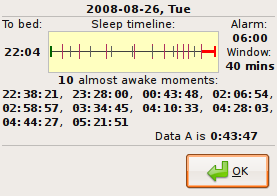 There, now burglars will know the best time to rob me. It’s not often that I have to compile software from scratch these days, and as I did so, I marvelled at the absolute trivia stored in my head that let me stumble towards getting this working. Oh, it needs gtkmm to work — well, that means it’ll need the
 libgtkmm-dev package. Hmm, actually it’s now saying it doesn’t have a MODULE. I’m guessing that’s not a thing called “MODULE” but that I don’t have the right gtkmm module. Let’s grep for gtkmm in the configuration file. Aha! Here we go, it’s expecting gtkmm version 2.4, so that would be libgtkmm2.4-dev. And so on.
It’s times like this when I wonder about what I call false consciousness among technology users. We’ve so often invested so much time learning all of this eldritch magic, that we end up loving the tyrant machine because of its trickle of rewards, and despise anything that gives us those rewards without vindicated the sunk costs of the trivia that we’ve so painfully learned. I wonder if OS X is popular among Linux ex-pats partly because it is both shinier, and one ends up having to use all of this craziness whenever one needs to do something tricky there, too: as opposed to Windows where all of this Unix knowledge is like knowing the Ancient Mayan for “browser plug-in”.
The worst part is that there’s no easy way to put this knowledge into words, because it’s practically unconscious for me now. I don’t think I could tell you how I got this program to work, even five minutes after I manhandled it into existence. It’s like my fingers and lower brain-stem knows Linux better than my conscious brain does.
8 Comments »
2008-08-25»
strong opinions, weakly held»
So I’ve been a partisan now for exactly a month, and it’s been great fun. If anything, it’s allowed me to be far more outright about my (oh so many) doubts about libertarianism, because I’ve been able to eschew any kind of neutrality and just lay in there, enthusiastically scouring the literature for what sounds right. I also immediately bought some of the crazier books I could on libertarian history, which means that I’m reading a far more interesting and curious subsection of American and European thought than the usual Howard Zinn and the Whigs.
So far, as I’ve said, I loved the trashy but glorious Hostile Takeover Trilogy, thought the L. Neil Smith’s the Probability Broach to be quite barking. On the more academic side, Defending the Undefendable and The Not So Wild, Wild West were new takes on contemporary issues, and a propertarian view of the Frontier culture. Defending the Undefendable felt like an exercise in imposing an ethical system masked as undeniable economical truths (undeniable because precious few facts were brought into the discussion). It was less about being convincing, and more about giving blowhards more fuel to be annoyingly contrary. The Not So Wild, WIld West led me to start seeking out more literature on what, exactly, anarchic or minimal government systems might have looked like historically, which is why I’m looking forward to reading Fragments of an Anarchist Anthropology, and drudging through various core anarchist texts, although frankly that is fairly tedious rehash of the readings I’ve previously made of canonical overexcited Marxists 1910-1979. Great for inspiring you to write Rafe talks about here: that the best way to solidly test an idea is to adopt it wholeheartedly, and see what shakes out. It’s a real shame that very little in our politics or our culture permits this kind of immersive experimentation. It’s not surprising to me that I first sought out science fiction to try these ideas on for size. Everyone other vehicle for discussion seems to think that the trick with big ideas is to treat them like Gulliver in Lilliput: trip them up, tie them down, and poke them with very very tiny sticks to see how they quiver. Surely it’s better to saddle them up and go for a long ride, like Ken Macleod?
I’ve also managed to lose far fewer friends than I thought. No-one has stalked out of my life angrily, though a few have given me pitying looks, and one of my best friends keeps drawling that it’s such a shame I’ve become a “librarian”. It seems to provoke the same reaction as if I’d suddenly decided to start carrying a security blankie around with me: childish, but harmless.
I’ve also become somewhat of a receptacle for crypto-libertarian confessionals, where my lefty friends confess they’re not so sure of the government, or my right-wing friends… wait, all my right-wing friends all pretend to be libertarian already, so that doesn’t work…
5 Comments »
isoguiltotropy»
I frequently find myself on an isoguiltotropic plane: any new thing I can think of pursuing, or any old thing that I could abandon, makes me feel slightly guiltier than I am now. If I take up a new project, I will be forcing myself to pay less attention to the worthy projects I am letting fall by the wayside currently. But if I abandon a project, then that is one less worthy thing I am doing. I reassure myself that this means in economics terms I am perfectly guilt-efficient. Or possibly I am in a local minima of guilt, but it certainly doesn’t feel that way.
So, things that I have recently considered re-investigating, but am not, because of the pain of the guilt:
- Getting involved in the new DRM battles around @font-face and the catastrophic threat of downloadable fonts. Man, do we have to explain the rules of physics to every industry that touches the Internet? And damnit, surely the font world is at least relatively sanguine about the nature of copying by now?
- Re-entering the world of Squeak. They have just decided to base the new version of Squeak on Spoon, which is super-ultra-minimalist, and I think that means that you’ll be able to pick and choose what you want from the rest of the Squeakiverse. I always imagined that most of Squeak was actually a fairly stuck-together and unextractable blob, like Ruby after thirty years of monkey-patching. I love projects that sound like a monologue from the Mighty Boosh, but … must … not … get … drawn … into Smalltalk.
- Talking of which, am also writing “No Messing with Freebase on my belly with a sharpee. I am like Wesley Crusher in “The Game” with regards to Freebase. I would love to play around with it more, but I suspect that as soon as one does, one will become strangely drawn to do everything in this huge monolithic namespace, and then aliens will take over the Earth while you are fiddling with the semantics of the “person with moustache” topic or something. Instead, I will observe those messing with it from a distance, to see if they suddenly start exuding green gunge or talking about the “semantic web” with a straight face. I mean, for Christ’s sake, they called it Freebase. Is that not enough of a clue?
2 Comments »
2008-08-24»
riot gwwwls»
So I’m just back from a riot grrl anniversary celebration. I ended up reading lots of Liz’s zines and flashing back to 1993 when Dave and Andy and Ed and Kevin and Andy and Ben and Sue and I were holed up in terrible flats in unfashionable Streatham, living off the dole and housing benefit and shitty code sold to Personal Computer World. We worked on, but never actually finished a zine called “Graduate Loser”. Somehow I never actually managed to get hold of many other zines either, but would religiously buy Factsheet Five and marvel at the wealth of information out there, in much the same way as when I was 14 and in Chelmsford I’d buy Time Out but never dare to go to London, sixty whole miles away.
Anyway, I’ve always felt that there was a direct lineage between the mid-nineties zinesters and the early web. Zinesters were bunch of overeducated media-obsessives in a recession that had no space for them, who worked dead-end jobs that gave them access to technology that let them reproduce their own work and distribute it to a small, but satisfying, coterie of like-minded people, who were sceptical of the mainstream, congenial to conspiracy theories, and fiercely in favour of radical free speech. When nobody else saw the potential of the Internet, it was inevitable that that generation would have the motive and the opportunity to recognise it for what it was: the world’s most powerful office photocopier, and run with that. To quote myself blathering onto a group of social media theorists on this topic a few years ago:
Now zinesters were the direct ancestors of the early beginnings of web designers. Why is this? Because they were very used to the idea and the appeal of self expression, un-moderated by anyone else. They understood the value of [self-expression]. They also understood the costs. Essentially the way you made a zine was the same way you did it in the 1960s. You crept into your work place after work and ran off hundreds and hundreds of copies on the photocopier, and that was sticking it to The Man, costing him over 20 pounds worth of photocopier toner. This was still going on when I first joined the internet industry in the 90s… I remember very distinctly the quiet Goth girl who did web design coming in late at night, when I was sitting there working on my own zine, and photocopying hundreds and hundreds of her Goth zine, and no one said anything of course because they were doing the same thing.
The appeal of the web of course was that it got rid of that problem. Rather than having to distribute to a hundred different people, you would be distributing it to the whole world. And all of the appeal and the dream that you had of having control over your artistic project was there for the taking.
You only see fragments of that lineage now — the most obvious being Boing Boing, which was a zine before it was a blog, and whose lineage went straight through Wired. A generation proud to write the ephemera of their age, because nobody else had much room to let them do anything else.
Comments Off on riot gwwwls
2008-08-22»
living la vida hacker»
We went to Ada’s school’s — well, I forget the correct word for it; my subconscious tells me it’s “indoctrination”, but that can’t be right. Maybe something in Spanish? Everything was in Spanish. Her teachers explained (via an interpreter) that they don’t speak English when the kids are around, so that they learn to convey their intentions in the second language. This got weird when the tallest most anglo blonde woman from Lake Tahoe introduced herself in I think a Chilean accent. Then you realise that kindergarten teachers all speak the International Language of Caring Emphasis, and it was pretty easy thereafter.
I’m fascinated to see how this plays out. I am terrible at languages. Fortunately, Ada has made me swear that I not learn Spanish with her, so she can have a secret language of her own that I can’t understand. Currently she is fairly confident she can speak Spanish fluently anyway, although she really just spouts nonsense that if you don’t know Spanish is actually rather convincing. (She can also hold down a whole conversation in fake Tagalog). I do hope the teachers can spot this kind of thing. Maybe Ada will be all like “Well, I’ll pretend I don’t know you can speak English, if you’ll pretend you don’t know I can’t speak Spanish”
Orientation! Orientación! That was the word. Seriously, the school seems lovely, and we all learnt a song about soy pizza. Or maybe it was “I am pizza”. I now know the spanish for “pepperoni”.
Seth points out that I got the gender of “kindergarten” wrong in the last post. I am so doomed.
I walked home over Great Big Hill (like Edmund Hilary, because it was there, and unlike him, because I couldn’t work out how to get around it). I accidentally phoned Merlin. There’s a guy out here recording us both for a documentary about Life Hacks and slowly becoming more disillusioned about how unmotivating we are. I was calling to flake on today’s appointment, and found I’d written down the wrong number. Yes, terrifying self-motivating organizing machine, me.
Merlin and I haven’t really spoken much since the book fell through, (both of us on long aboriginal treks to rediscover our mojo I think) — and it was awesome to hear him again. We failed to work out how to meet up soon, created about fifteen hanging “open loops”, and giggled far too much.
Went home and looked up URLs. Somebody had come up to me at the end of the orientation with a gleam of geek recognition in her eye and said conspiratorially, “I’ve started a blog and a mailing list for our class!” Like a spy confirming the secret passphrase, I replied “But what about the wiki?” The spanish-speaking teacher looked at us as though she had caught us speaking fake English. She’s probably right.
1 Comment »
2008-08-21»
Odlyzko on the Fallacy of Streaming»
I’m a great fan of Andrew Odlyzko who I think you can picture as the network economics equivalent of the early Jakob Nielsen, long before he got drunk with power and started challenging beautiful waif-like designers to chicken-wire cage matchs. By that I mean Odlyzko is rather good at explaining what you at some level instinctively understand, but maddeningly no-one else higher than your pay grade does. Handily he explains these characteristics using actual facts that you can clutch onto in the next futile argument you are forced to re-justify over the self-same self-evident truths. You will still lose, because the people who believe the opposite of you are your employers, but you will go down in full righteousness instead of just bleating “but.. but…”
In this recent short note on streaming, Odlyzko explains, as slowly as he can, why content and telecom business executives (erroneously) think that streaming movies need them to demand special network-neutrality-busting queue-barging privileges on the Internet.
It turns out it’s because they think that real-time streaming means that the bytes have to move in exactly real time — that’s to say, if you’re watching a movie encoded at 6Mb/s, you need a constant, unbreakable, 6Mb/s stream over the Internet. In other words, no-one told them about buffering:
I have been asking listeners [at his networking presentations] to raise their hands if they saw any point at all in faster-than-real- time transmission of multimedia … The highest positive response rate I have observed was at a networking seminar at the Royal Institute of Technology in Stockholm, in September 2007. It was about 30%. Twice, at networking seminars at CMU and Stanford, the rate was about 20%. Usually it is far lower, almost always under 10%. And sometimes it is close to zero. I had two similar audi- ences, on two separate continents, of about 100 people in each case, consisting of (mostly non-technical) mid-level telecom managers as well as government research agency staff and others connected with communications, where among the approximately 200 attendees in all, just one hand went up, and that one very tentatively.
Apparently, advocates of streaming have never wondered what that little grey bar that preloads your YouTube clip before you watch it, so you can cope with drops in the download rate, means. Or, more likely, have never actually watched a YouTube clip in their life, and just sit behind their desks wondering what everyone in the open-plan bit of their office is giggling at.
“The purpose of data networks is to satisfy human impatience.”
2 Comments »