I think one of those parts of current AI that there’s some consensus about is its use in translation. No-AI projects will cordon out a space for machine-translation in localisation tools; I’ve spoken to minority language advocates who are otherwise sceptical of AI, datacenters, and the like, but are excited by the opportunity to train ethically-sourced AI on their corpus, for more material.
There is not perfect agreement, of course: people worry about putting human translators out of a job, and worry about diminishing quality as services swap out professional services for automated live transcription etc. But machine translation has been around for a while, and most people see LLM translation as an incremental improvement on a familiar technology, and only minimally disruptive.
I think it’s more disruptive than that. Early in Inkhaven, we were set the 1513 Letter from Niccolò Machiavelli to Francesco Vettori. After looking up some of the obscurer references in the text, I set Claude to spot and annotate some of the other obvious rough spots. The output is here (it uses Almanack‘s sidenote system, which in turn is built on Said Achmiz’s sidenotes.js, with thanks).
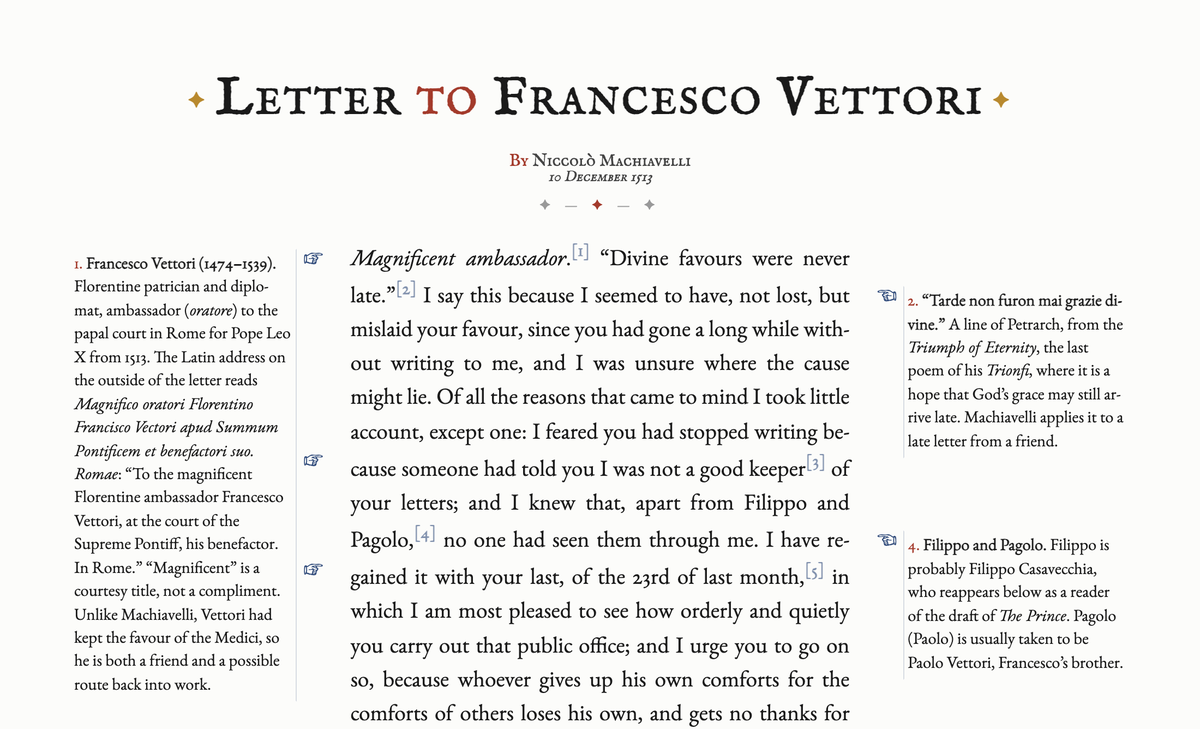
It was actually only after back-scrolling the prompting session that generated this that I realised that Claude had point-blank refused to use the translation we were using, because it was authored by Harvey C. Mansfield in 1985, and consequently still in copyright. Claude writes:
The translation is mine, not the one you’ll discuss. The InkHaven Library uses Harvey Mansfield’s translation, which is still under copyright, so I didn’t copy it. I couldn’t find a public-domain English translation online either. So I translated from the 1513 Italian on Wikisource. The page says so, and the Italian is in a fold-out section at the end. Expect different wording from what people quote tomorrow at 13:00. In one place I deliberately differ: Mansfield’s “two bakers” at the inn is dua fornaciai, which means kiln-workers (a baker is a fornaio), and there’s a note on it.
Good catch on the old baker switcheroo, Claude.
Under current theories — I believe untested in court — of AI IP law, Claude’s new translation is in the public domain.
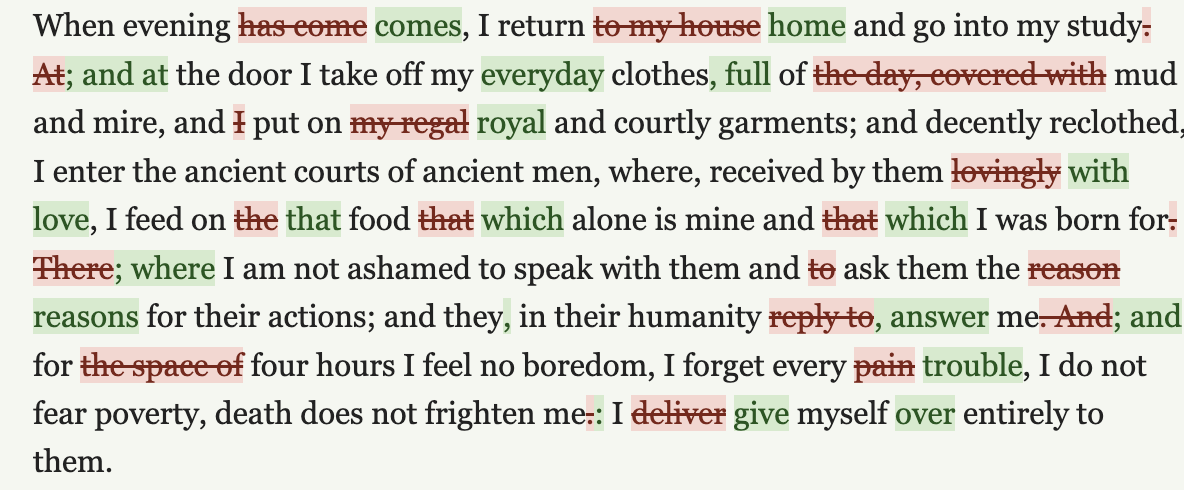
It’s pretty good! I’m not sure what the copyright is on a text which provides the differences between a public domain translation and one under copyright, so I’ll just provide enough here to give you an idea. Wouldn’t want you to construct an illicit copy of the Mansfield version from my machine’s interpretation:
This was a new quirk of the future that I hadn’t yet considered. We can now have reasonable public domain translations of all public domain literature between the majority of known languages.
Does this mean the death of the Emily Wilson Industrial Classical Translation Complex? I’m unsure: but just this week I’ve had two conversations about research held back by a shortage of translations. The libertarian scholar David Friedman (after reading to me from memory a chapter in his cycle of poems about the first Earl of Pembroke, William Marshal) noted that his early research into medieval Icelandic anarchist societies had been limited by the number of translations from Icelandic. A Borges reader complained on Slack that there weren’t that many annotated volumes of Borges around in English.
Problem solved! Onward to solving cancer, male pattern baldness, and converting Jupiter into computronium!
A couple of catches here. First: how good are these translations and/or annotations, really, and how can you trust them? I suspect the doubts here are ones that most of us should apply to human translators, and short of trusting other members of the Emily Wilson Industrial Classical Translation Complex, there’s not much we can do to solve this knowledge problem. My biased impression is that the kind of errors AI generates in both are in the same class as “can’t draw fingers properly”. If they’re worse than humans now, wait a couple of minutes for the next model to come along.
Second: what about translations of works that are still in copyright? My second-hand impression, being married to a translator — admittedly an anarchafeminist IP-sceptical translator — is that much of modern translation is a lesson in the disparities and failures of modern copyright law. The bureaucratic burdens for an individual translator to track down and acquire the English rights to works of foreign authors mean that legally published translations of foreign works are a drop in the ocean compared to the potential translations that are theoretically possible even with a limited pool of human translators. Translations from English fare a bit better, because there’s a more established process between publishers: most popular authors writing in English have a healthy market in reselling their rights to publishers in other countries. But that still leaves the long tail of works that will never catch a global publisher’s eye.
So will we suddenly gain a wealth of free translations of modern works, as well as those from authors whose copyrights have expired? I’d guess that even if the copyright status of machine-translated works is ripe to be revisited, there are extremely well-resourced actors in the existing publishing industry who would really not appreciate a costless cornucopia of translations of modern works leaping into existence. (Not to speak of works that are translations, bidirectionally and noisily converted from their original language and then back again: “Henry Pitter and the Tanker of Flames”, anyone?)
Publishing an unauthorised translation of a book still in copyright is already illegal, and will stay so: copyright law will do its usual trick of throwing a blanket over the escaping post-scarcity content, bundling it into a police van, and shipping it back off to the knowledge slave-mines. And rightsholders may yet threaten the Frontier Labs into bullying their models into refusing even private, at-home translation, which no court has ruled on.
What’s new is that everyone in the world with an LLM can now make a bootleg translation anyway, for nothing, in the comfort of their own home. Home translating is killing foreign literature, as they say. You wouldn’t download an Elena Ferrante, would you? Etc, etc.
This is one of those areas where the laws and norms around LLMs risk damaging the commons. We’re expected to hide our favourite translations, not share them, and if we are judging their flaws — the only way anyone learns whether a translation is any good — we are doing it individually and alone, rather than passing them around a critical community of human and LLM experts.
I feel this is a common emerging pattern in LLM legal grey areas: we privately negotiate with and cajole our lawful neutral LLMs over what laws we might break together. Claude wouldn’t copy Mansfield; it would probably translate a recent Polish novel if I asked nicely. But then I couldn’t show anyone. Whenever we’re translating, or learning, or reverse-engineering or thinking thoughts that trigger the liability concerns, and/or the moral prudishness, of the Frontier Labs, each of us haggles with the model alone; and the law means none of us can share what we got — even if fair use might protect us. The law, possibly outdated and certainly privately over-enforced, ends up as a thin, ill-fitting cover over common practice: as copyright has been since the mass adoption of the Internet.